


























Views
Downloads
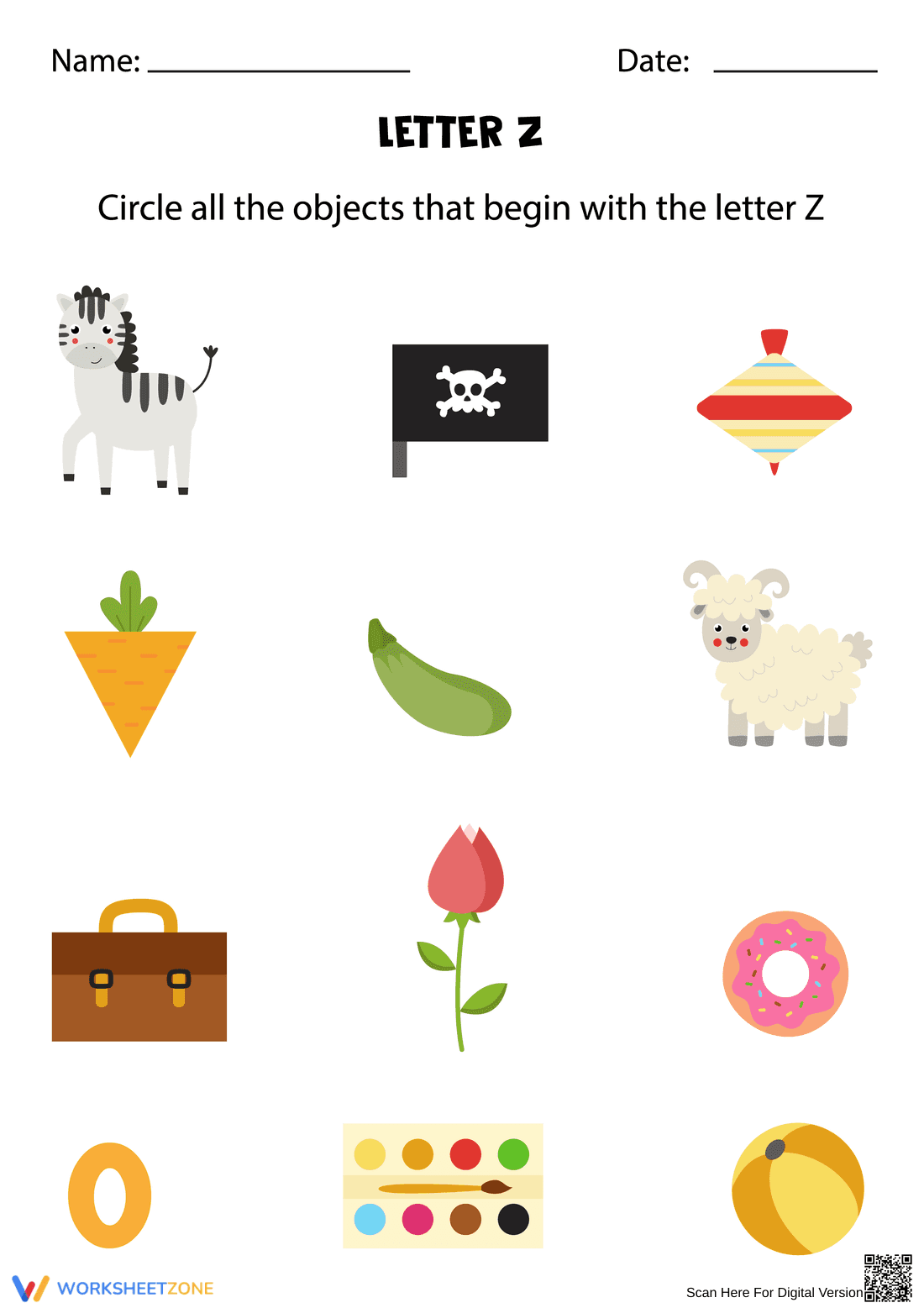

Letter Z Beginning Sounds Printable Worksheet
Paste this activity's link or code into your existing LMS (Google Classroom, Canvas, Teams, Schoology, Moodle, etc.).
Students can open and work on the activity right away, with no student login required.
You'll still be able to track student progress and results from your teacher account.
This foundational phonics worksheet helps early learners identify the beginning sound of the letter Z. Students evaluate twelve distinct images and circle the objects that start with the /z/ phoneme. This targeted practice strengthens letter-sound correspondence, building a critical stepping stone for decoding and early reading fluency.
At a Glance
- Grade: Kindergarten · Subject: ELA
- Standard:
CCSS.ELA-LITERACY.RF.K.3.A— Produce primary sounds for consonants- Skill Focus: Beginning Sounds (Letter Z)
- Format: 1 page · 12 problems · Answer key included · PDF
- Best For: Independent practice
- Time: 10–15 minutes
This single-page resource features twelve colorful, easily recognizable illustrations, including a zebra, zucchini, and other distractors. Students must visually scan the page, say the name of each object aloud, and determine if the initial phoneme matches the target letter. A complete answer key is provided to ensure accurate feedback and quick grading for educators.
This resource requires minimal teacher preparation:
- Print (1 minute): Simply download the PDF and print the required number of copies. The clear layout ensures high-quality reproduction even in black and white.
- Distribute (1 minute): Hand out the sheets during morning work, literacy centers, or as a quick transition activity.
- Review (3 minutes): Use the included answer key to quickly check student work or project it on a smartboard for whole-class review.
Total teacher prep time is under two minutes, making this an excellent addition to any emergency sub plan or last-minute phonics review session.
This activity aligns directly with CCSS.ELA-LITERACY.RF.K.3.A, requiring students to demonstrate basic knowledge of one-to-one letter-sound correspondences by producing the primary sound for each consonant. It also supports phonemic awareness by asking children to isolate the initial sound in spoken words. Both standard codes can be copied directly into lesson plans, IEP goals, or district curriculum mapping tools.
Use this worksheet immediately following direct instruction on the letter Z. It serves as an effective independent practice activity while the teacher pulls small groups for guided reading. Alternatively, use it as a formative assessment tool; observe students as they whisper the names of the pictures to check if they are accurately isolating the initial phoneme. Expected completion time ranges from ten to fifteen minutes, depending on the student's familiarity with the vocabulary.
Designed for Kindergarten students, this serves as excellent review for first graders or targeted intervention for Pre-K learners. For students requiring additional support, teachers can pre-teach the vocabulary by naming each picture aloud before independent work begins. Pair this worksheet with a tactile letter-tracing activity or a read-aloud focused on the /z/ sound to create a comprehensive phonics lesson.
Mastering letter-sound correspondence, specifically isolating initial phonemes like those targeted in CCSS.ELA-LITERACY.RF.K.3.A, is a fundamental predictor of future reading success. When students practice producing primary sounds for consonants, they build the neural pathways required for efficient decoding. According to Fisher & Frey (2014), providing students with immediate, focused practice on specific phonemes significantly increases their ability to transfer these skills to connected text. This worksheet facilitates that exact type of targeted repetition. By requiring learners to evaluate multiple images and isolate the beginning sound, educators can quickly identify gaps in phonemic awareness. Consistent exposure to these foundational tasks ensures that early readers develop the automaticity necessary for fluent reading, reducing cognitive load during later, more complex literacy activities. Early intervention with structured phonics practice remains one of the most effective strategies for preventing reading difficulties in primary grades.


