


























Views
Downloads
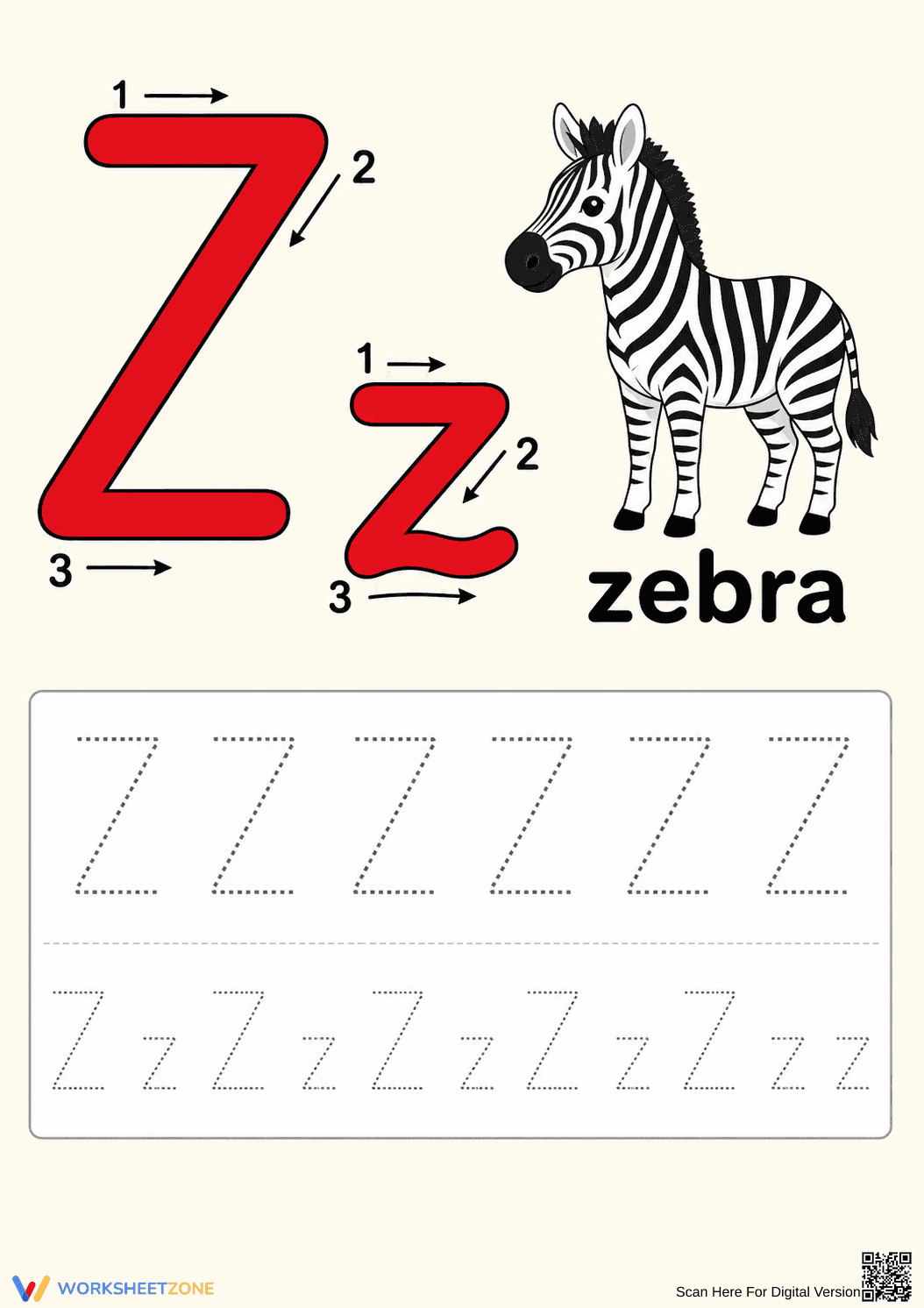

Letter Z Tracing & Beginning Sound | Essential Grade K-1
Paste this activity's link or code into your existing LMS (Google Classroom, Canvas, Teams, Schoology, Moodle, etc.).
Students can open and work on the activity right away, with no student login required.
You'll still be able to track student progress and results from your teacher account.
This essential Grade K-1 phonics worksheet helps young learners master the letter Z through guided tracing and visual association. By connecting the letter form to the zebra image, students solidify beginning sound recognition while developing the fine motor control necessary for legible handwriting. It provides a clear, distraction-free path to alphabet mastery.
At a Glance
- Grade: K-1 · Subject: ELA Phonics
- Standard:
CCSS.ELA-LITERACY.L.K.1.A— Print many upper- and lowercase letters of the alphabet- Skill Focus: Letter Z formation and beginning sounds
- Format: 1 page · 13 tracing tasks · Answer key included · PDF
- Best For: Morning work or independent literacy centers
- Time: 10–15 minutes
Inside this single-page PDF, students find a large visual anchor featuring a zebra and numbered directional arrows for both uppercase Z and lowercase z. The worksheet includes 6 uppercase tracing opportunities and 7 lowercase pairs, totaling 13 specific practice points. The clean layout ensures that early writers can focus entirely on stroke order and letter consistency.
The zero-prep workflow is designed for maximum efficiency. First, print the single-page PDF (30 seconds). Second, distribute the sheets to students during your phonics block or as a transition activity (1 minute). Third, review the completed tracing for proper stroke direction and provide immediate verbal feedback on letter formation (under 1 minute per student). This makes it an ideal sub-plan resource.
This resource aligns with `CCSS.ELA-LITERACY.L.K.1.A`, which requires students to print many upper- and lowercase letters. It also supports `CCSS.ELA-LITERACY.RF.K.1.D` by reinforcing the recognition of specific alphabet characters. Both standard codes can be copied directly into lesson plans, IEP goals, or district curriculum mapping tools to ensure compliance with state frameworks.
Use this worksheet as a formative assessment after introducing the letter Z sound. Observe students to ensure they follow the numbered arrows for correct top-to-bottom, left-to-right formation. Alternatively, place it in a dry-erase sleeve for a reusable literacy center activity. Expected completion time is 10 to 15 minutes depending on the fine motor proficiency of the individual student.
This resource is ideal for Kindergarten students beginning their handwriting journey and Grade 1 students requiring remedial support. It pairs naturally with a Letter of the Week curriculum or a specific phonics lesson on the /z/ sound. The visual zebra cue provides an excellent scaffold for English Language Learners (ELLs) building basic vocabulary while practicing letter shapes.
According to the RAND AIRS 2024 report on early literacy, consistent handwriting practice is a critical predictor of later reading fluency and written expression. This worksheet addresses the foundational need for orthographic mapping by linking the visual letter shape with its corresponding phoneme through the zebra anchor. Research from Fisher & Frey (2014) emphasizes that guided practice with immediate visual cues, such as the numbered stroke arrows provided here, reduces cognitive load for novice writers. By focusing on a single letter in a high-contrast format, the worksheet allows students to achieve mastery without the distraction of complex page layouts. This targeted approach ensures that the motor memory for the letter Z is established correctly from the first attempt. Educators can utilize this data-backed resource to bridge the gap between letter recognition and production, fulfilling core requirements for early childhood literacy development.


