


























Views
Downloads

Letter X Beginning Sound Printable Worksheet | Grade K
Paste this activity's link or code into your existing LMS (Google Classroom, Canvas, Teams, Schoology, Moodle, etc.).
Students can open and work on the activity right away, with no student login required.
You'll still be able to track student progress and results from your teacher account.
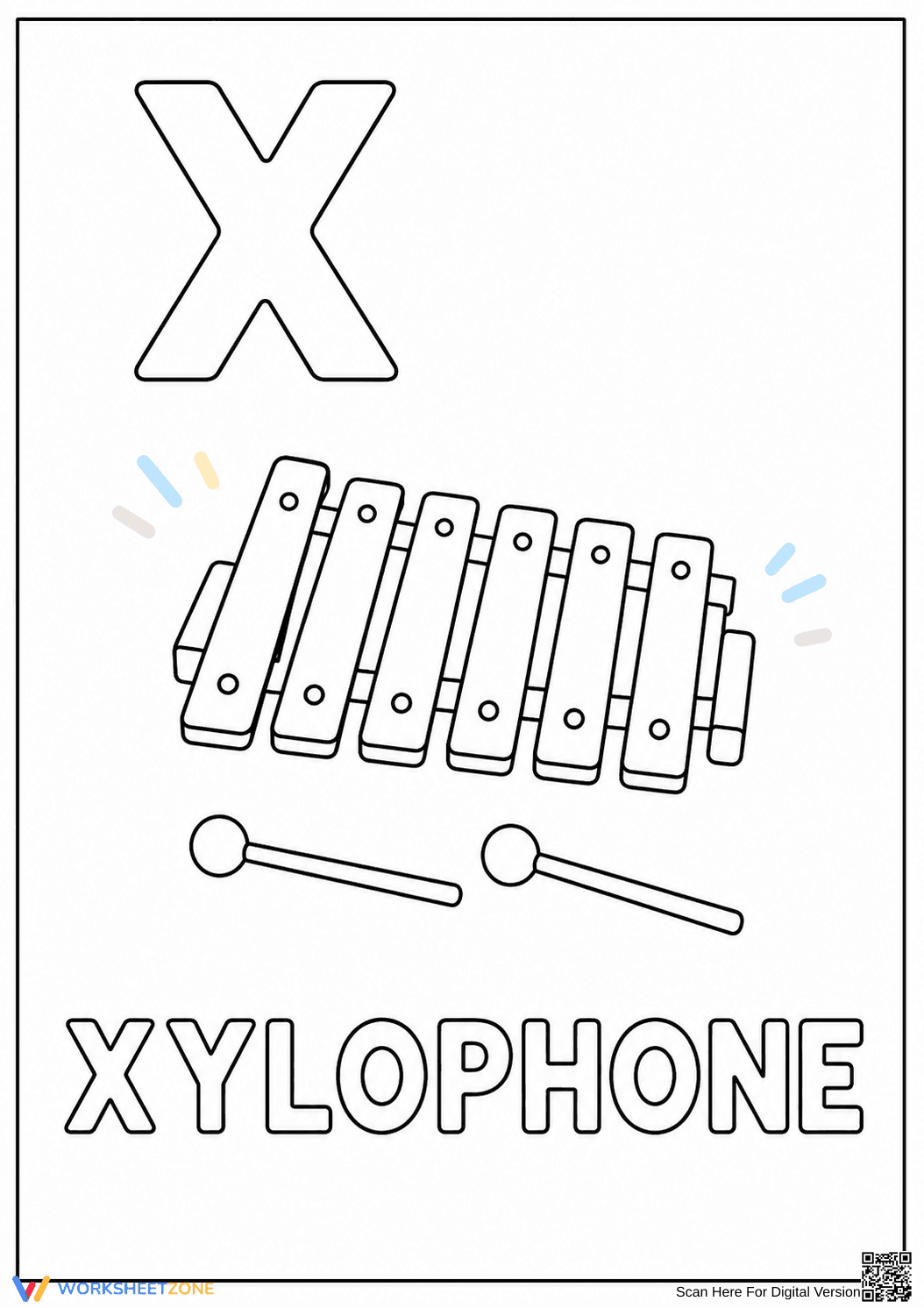
This foundational phonics worksheet helps early learners master the beginning sound of the letter X through an engaging coloring activity. By interacting with the visual representation of a xylophone and its corresponding text, students reinforce their letter-sound recognition skills while developing fine motor control.
At a Glance
- Grade: K · Subject: ELA
- Standard:
CCSS.ELA-LITERACY.RF.K.3.A— Produce primary sounds for consonants- Skill Focus: Letter X Beginning Sound
- Format: 1 page · 1 task · No answer key · PDF
- Best For: Independent practice centers
- Time: 10–15 minutes
Inside this single-page resource, educators will find a clear, bold outline of the uppercase letter X, accompanied by a large illustration of a xylophone. Below the image, the word "XYLOPHONE" is presented in hollow block lettering, providing an additional coloring opportunity. The minimalist design ensures young students remain focused on the target phonics skill without visual distractions, making it an ideal tool for early literacy development.
This resource is designed for a smooth, zero-prep classroom experience. The workflow is simple:
- Print: Generate copies for the entire class in under 1 minute.
- Distribute: Hand out the single-page activity during morning work or literacy centers (1 minute).
- Review: Circulate the room to check for understanding and correct letter-sound association (3 minutes).
With a total teacher preparation time of under two minutes, this worksheet is highly suitable for emergency sub plans, quick morning routines, or spontaneous phonics reinforcement sessions.
This activity is directly aligned with CCSS.ELA-LITERACY.RF.K.3.A: Demonstrate basic knowledge of one-to-one letter-sound correspondences by producing the primary sound or many of the most frequent sounds for each consonant. It also supports early print awareness and fine motor skill development. Both standard codes can be copied directly into lesson plans, IEP goals, or district curriculum mapping tools.
Teachers can utilize this worksheet during the independent practice phase of a direct instruction lesson on the letter X. It serves perfectly as a literacy center activity where students color the xylophone while verbally practicing the target sound. Alternatively, it can be sent home as a brief homework assignment. As a formative assessment observation tip, teachers should listen to students as they color, prompting them to say the word "xylophone" and isolate the initial phoneme. The expected completion time ranges from 10 to 15 minutes.
This resource is primarily designed for Kindergarten students, though it is also appropriate for Pre-K learners showing early phonemic awareness or first-grade students requiring targeted intervention. For differentiation, teachers can challenge advanced students to draw another object starting with the letter X on the back of the page. This worksheet pairs naturally with a whole-group anchor chart activity focusing on the alphabet and consonant sounds.
Developing strong phonemic awareness and letter-sound correspondence is a critical milestone in early childhood literacy. This resource targets CCSS.ELA-LITERACY.RF.K.3.A, requiring students to produce primary sounds for consonants. According to a comprehensive review by Fisher & Frey (2014), integrating multimodal activities—such as combining visual arts with phonics instruction—significantly enhances memory retention and student engagement in foundational reading skills. By coloring the xylophone and the corresponding text, learners create a cognitive link between the visual symbol of the letter X and its auditory beginning sound. This dual-coding approach ensures that early learners build a robust phonetic foundation, which is absolutely essential for future decoding and reading fluency. Providing targeted, single-skill practice opportunities like this worksheet allows educators to isolate specific learning objectives and monitor student progress effectively.


