


























Views
Downloads
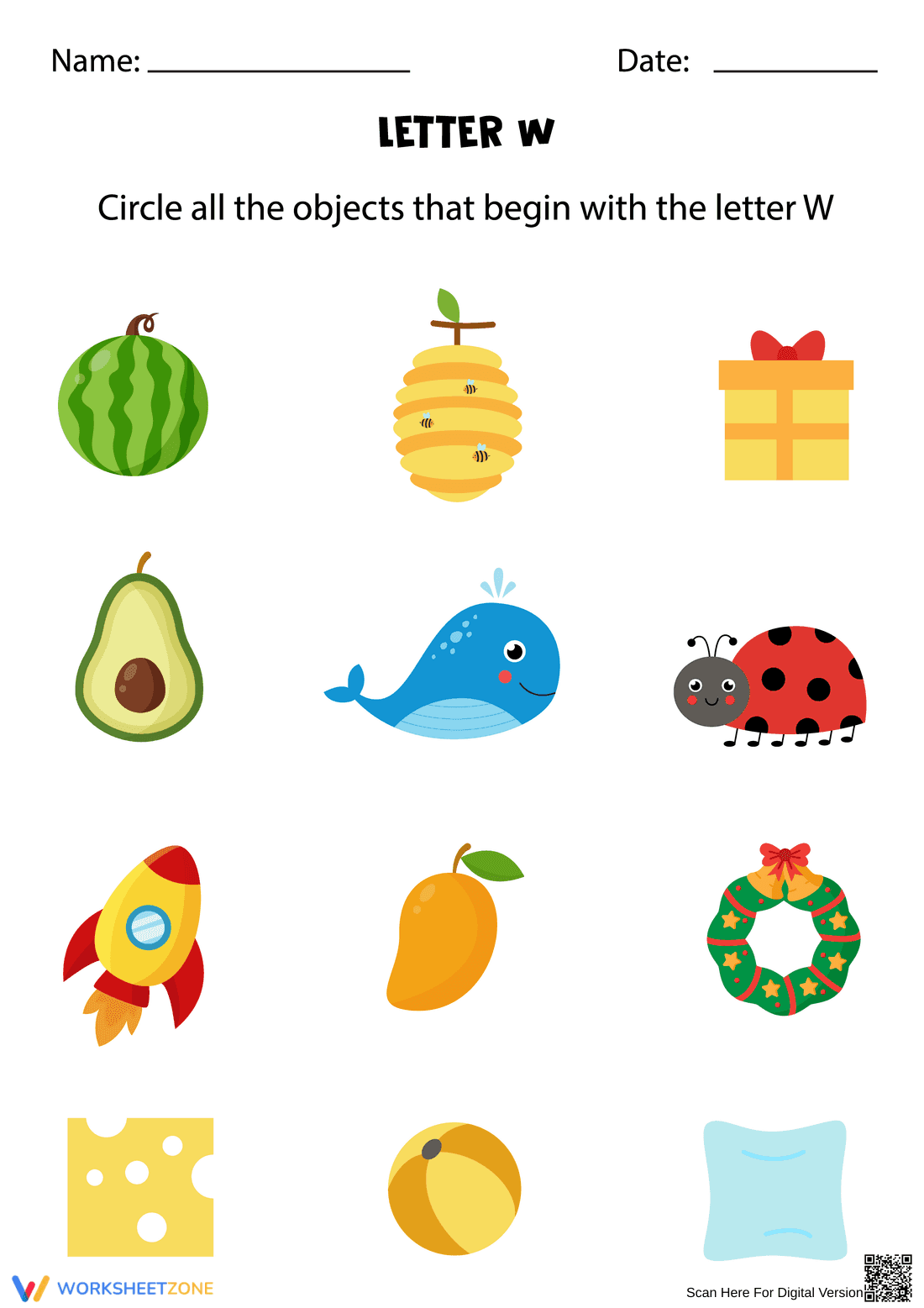

Letter W Beginning Sounds Worksheet | Essential Grade K
Paste this activity's link or code into your existing LMS (Google Classroom, Canvas, Teams, Schoology, Moodle, etc.).
Students can open and work on the activity right away, with no student login required.
You'll still be able to track student progress and results from your teacher account.
This essential Grade K phonics worksheet helps early learners master the initial /w/ sound through visual identification. Students examine 12 distinct illustrations to determine which objects begin with the letter W, reinforcing phonemic awareness and letter-sound correspondence. It provides a clear, focused path for students to practice isolating the beginning sounds of common words.
At a Glance
- Grade: Kindergarten · Subject: ELA
- Standard:
CCSS.ELA-LITERACY.RF.K.3.A— Demonstrate basic knowledge of one-to-one letter-sound correspondences by producing the primary sound- Skill Focus: Beginning sounds (Letter W)
- Format: 1 page · 12 problems · Answer key included · PDF
- Best For: Morning work or phonics center activity
- Time: 10–15 minutes
Inside this single-page PDF, you will find a clean, distraction-free layout featuring 12 high-quality illustrations. The task requires students to circle specific items like the watermelon, whale, and wreath while ignoring distractors like the avocado or rocket. The worksheet includes a dedicated space for the student's name and date, along with a clear instructional header that makes the objective immediately obvious to young learners.
This resource follows a zero-prep workflow designed for busy educators. First, print the single-page PDF (30 seconds). Second, distribute the sheets to your small group or whole class (1 minute). Third, review the answers together using the included key to provide immediate feedback (2 minutes). This streamlined process makes it an ideal choice for emergency sub plans, transition periods, or as a quick supplemental activity during your phonics block.
This worksheet aligns with `CCSS.ELA-LITERACY.RF.K.3.A`, which requires students to demonstrate basic knowledge of one-to-one letter-sound correspondences by producing the primary sound or many of the most frequent sounds for each consonant. It also supports RF.K.1.D by reinforcing letter recognition. Both standard codes can be copied directly into lesson plans, IEP goals, or district curriculum mapping tools to ensure instructional compliance.
Use this worksheet during the "You Do" phase of a gradual release model after introducing the letter W. It serves as an excellent formative assessment tool; observe if students can differentiate between the /w/ sound and similar phonemes like /m/ or /v/. Expected completion time is 10 to 15 minutes, making it perfect for independent desk work, a literacy station rotation, or even a quick homework assignment to reinforce the day's lesson.
This resource is designed for Preschool, Kindergarten, and Grade 1 students who are developing foundational literacy skills. It is particularly effective for English Language Learners (ELLs) who benefit from visual cues to build vocabulary while practicing pronunciation. Pair this worksheet with a letter W anchor chart or a short reading passage featuring "W" words to reinforce the concept across different modalities.
Phonemic awareness is a critical predictor of later reading success, as highlighted in the RAND AIRS 2024 report on early literacy interventions. This worksheet targets the specific skill of initial phoneme isolation, which is the ability to identify the first sound in a spoken word. By focusing on the letter W, students practice the one-to-one correspondence required by CCSS.ELA-LITERACY.RF.K.3.A. Research from Fisher & Frey (2014) emphasizes that visual supports and clear task structures, like the 12-item layout provided here, reduce cognitive load for novice readers. This allows students to focus entirely on the auditory-visual connection between the letter shape and its corresponding sound. Consistent practice with these foundational phonics elements ensures that students build the automaticity needed for decoding more complex texts. This printable resource provides a reliable, evidence-based method for reinforcing these essential early reading skills in any classroom setting.


