


























Views
Downloads

Printable Beginning Sounds Worksheet | Pre-K ELA
Paste this activity's link or code into your existing LMS (Google Classroom, Canvas, Teams, Schoology, Moodle, etc.).
Students can open and work on the activity right away, with no student login required.
You'll still be able to track student progress and results from your teacher account.
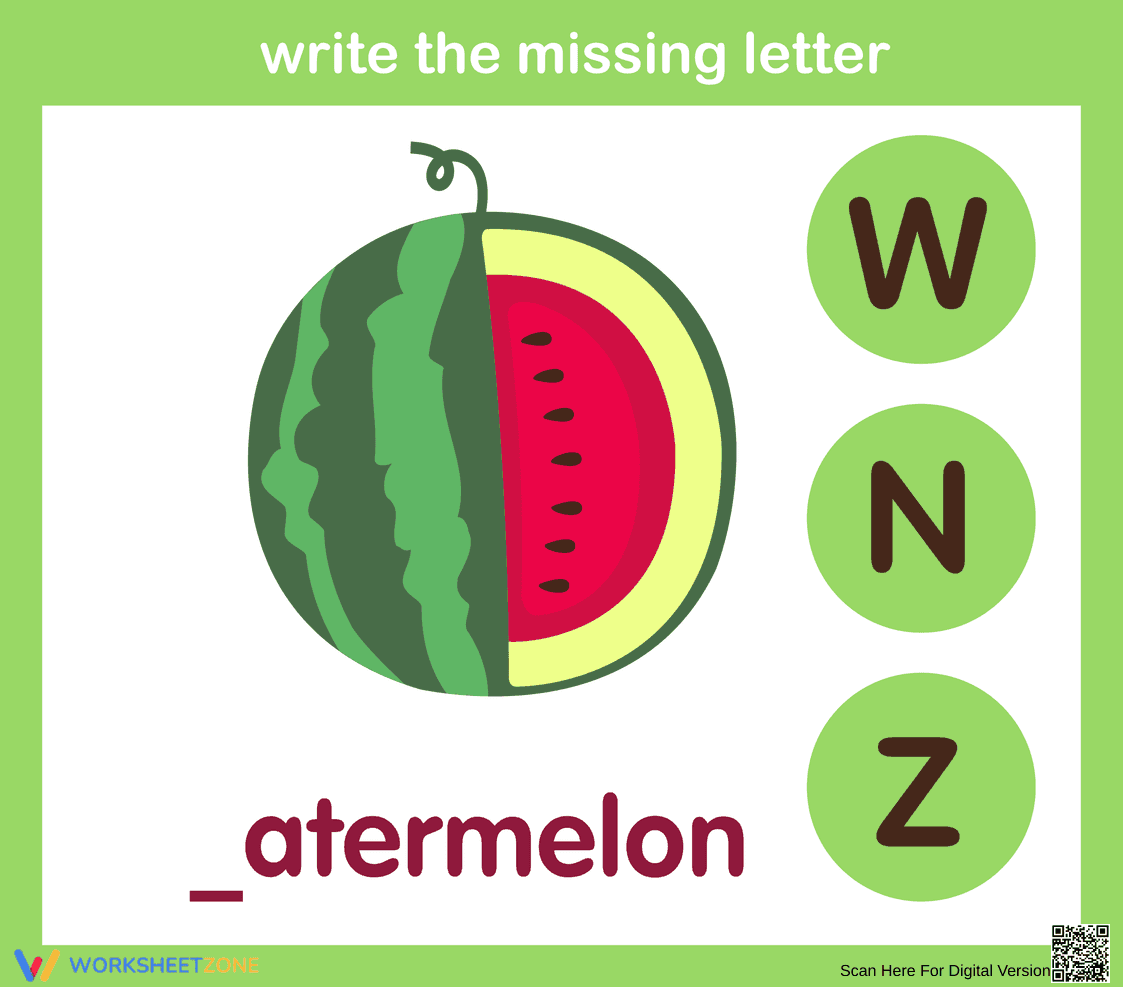
This Pre-K phonics worksheet helps early learners identify beginning sounds and connect them to familiar vocabulary. By selecting the correct initial letter for a pictured object, students build foundational phonemic awareness and letter-sound correspondence skills essential for future reading success.
At a Glance
- Grade: Pre-K · Subject: ELA
- Standard:
CCSS.ELA-LITERACY.RF.K.3.A— Identify primary sounds for consonants- Skill Focus: Beginning sounds
- Format: 1 page · 1 problem · No answer key · PDF
- Best For: Morning work or centers
- Time: 5–10 minutes
Inside this single-page resource, educators will find a focused phonics task featuring a vibrant illustration of a watermelon. Students are prompted to look at the picture, say the word aloud, and choose the correct missing initial letter from three distinct options provided in clear, readable bubbles. The layout is highly visual and uncluttered, ensuring that young learners remain focused on the specific letter-sound correspondence task without unnecessary distractions.
Zero-Prep Workflow
- Print (1 minute): Simply download the PDF and print the required number of copies. The bold graphics print clearly in both color and grayscale.
- Distribute (1 minute): Hand out the sheets during morning arrival, transition times, or at a dedicated literacy center.
- Review (3 minutes): Quickly check student selections as they work or review the correct answer together as a whole group.
Total teacher preparation requires under two minutes, making this an ideal, self-explanatory activity for emergency sub plans or quick skill reinforcement.
Standards Alignment
This activity aligns with CCSS.ELA-LITERACY.RF.K.3.A: Demonstrate basic knowledge of one-to-one letter-sound correspondences by producing the primary sound or many of the most frequent sounds for each consonant. It also supports early vocabulary development by pairing visual cues with text. Both standard codes can be copied directly into lesson plans, IEP goals, or district curriculum mapping tools.
How to Use It
Deploy this worksheet during independent literacy centers to reinforce direct instruction on the letter W. Alternatively, use it as a quick formative assessment tool during small group guided reading sessions. Teachers can observe whether a student correctly identifies the initial sound and matches it to the corresponding grapheme. Expected completion time ranges from five to ten minutes, depending on the child's familiarity with the alphabet.
Who It's For
This resource is designed primarily for preschool and early kindergarten students developing basic phonemic awareness. It serves as an excellent differentiation tool for students needing targeted intervention on specific consonant sounds. Pair this activity with a tactile alphabet chart or a read-aloud focused on the target letter to create a comprehensive, multi-sensory learning experience.
Developing strong phonemic awareness in early childhood is a critical predictor of later reading proficiency. This resource targets CCSS.ELA-LITERACY.RF.K.3.A, requiring students to identify primary sounds for consonants. According to Fisher & Frey (2014), providing young learners with explicit, focused practice on letter-sound correspondence significantly accelerates their decoding capabilities. By isolating the initial phoneme and matching it to a visual representation, students engage in the exact cognitive processes necessary for orthographic mapping. This targeted practice ensures that foundational literacy skills are solidified before students transition to more complex blending and segmenting tasks. Utilizing clear, single-focus activities like this one minimizes cognitive overload, allowing early learners to concentrate fully on mastering the specific phonetic relationship presented. Consistent exposure to these targeted exercises builds the automaticity required for fluent reading in subsequent grade levels.


