


























Views
Downloads
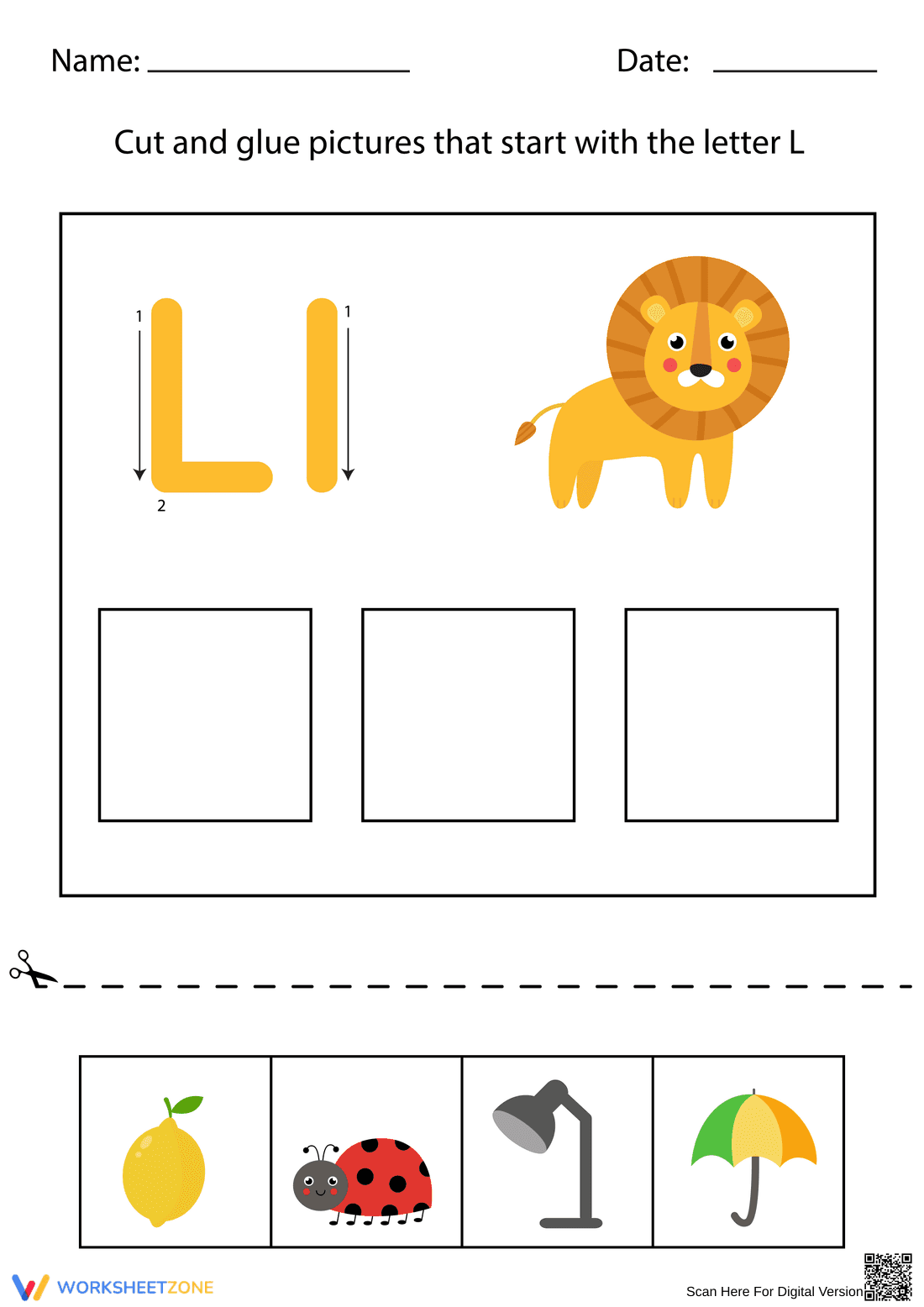

Kindergarten Letter L Beginning Sounds — Printable Worksheet
Paste this activity's link or code into your existing LMS (Google Classroom, Canvas, Teams, Schoology, Moodle, etc.).
Students can open and work on the activity right away, with no student login required.
You'll still be able to track student progress and results from your teacher account.
This phonics worksheet helps early learners master the beginning sound of the letter L through an engaging cut-and-paste activity. Students practice phonemic awareness and fine motor skills simultaneously by identifying images that start with the target sound and gluing them into the designated boxes.
At a Glance
- Grade: Kindergarten · Subject: ELA
- Standard:
CCSS.ELA-LITERACY.RF.K.3.A— Produce primary sounds for consonants- Skill Focus: Beginning sounds (Letter L)
- Format: 1 page · 3 problems · No answer key · PDF
- Best For: Independent practice
- Time: 10–15 minutes
This single-page resource features a child-friendly layout centered around the letter L. It includes uppercase and lowercase letters with tracing arrows, a lion image, and three empty squares. A dashed line separates four images: a lemon, a ladybug, a lamp, and an umbrella. Students evaluate these options and select the three starting with the /l/ sound.
This activity is designed for immediate classroom implementation.
- Print (1 minute): Generate the required number of copies directly from the PDF file. No special paper or color ink is necessary.
- Distribute (1 minute): Hand out the pages along with scissors and glue sticks. The visual instructions make the task immediately clear to young learners.
- Review (3 minutes): Quickly check student work by verifying the three pasted images (lemon, ladybug, lamp) and discussing why the umbrella was left out.
Total teacher prep time is under two minutes, making this an excellent option for morning work, literacy centers, or emergency substitute plans.
This activity aligns directly with CCSS.ELA-LITERACY.RF.K.3.A: Demonstrate basic knowledge of one-to-one letter-sound correspondences by producing the primary sound or many of the most frequent sounds for each consonant. By isolating the initial phoneme in familiar spoken words and matching it to the printed letter L, students build foundational decoding skills. Both standard codes can be copied directly into lesson plans, IEP goals, or district curriculum mapping tools.
Deploy this worksheet during literacy centers after introducing the letter L. It serves as an effective independent task while the teacher conducts guided reading groups. Alternatively, use it as morning work to reinforce phonics concepts. As a formative assessment observation tip, watch how students articulate the words before cutting; this self-talk indicates developing phonemic awareness. Expected completion time is ten to fifteen minutes.
This resource is primarily designed for Kindergarten students, though it also benefits Preschoolers ready for letter-sound correspondence and first graders needing targeted intervention. For differentiation, teachers can pre-cut the images for students struggling with fine motor skills, allowing them to focus solely on the phonics objective. Pair this worksheet with a tactile letter L anchor chart or a read-aloud book featuring heavy /l/ alliteration to reinforce the auditory pattern.
Mastering initial phonemes is a critical predictor of future reading success. This worksheet targets CCSS.ELA-LITERACY.RF.K.3.A, requiring students to produce primary sounds for consonants and match them to visual representations. According to Fisher & Frey (2014), integrating physical movement—such as cutting and pasting—with cognitive tasks significantly improves retention and engagement in early childhood literacy instruction. By combining fine motor practice with phonological awareness, this activity ensures multiple neural pathways are activated during the learning process. The tactile nature of sorting the lemon, ladybug, and lamp from the distractor image reinforces the specific /l/ sound in a concrete manner. Early intervention with targeted, multimodal phonics practice builds the automaticity necessary for fluent decoding in later grades, establishing a strong foundation for comprehensive literacy development.


