


























Views
Downloads

Printable Letter K Coloring Worksheet | Grade K ELA
Paste this activity's link or code into your existing LMS (Google Classroom, Canvas, Teams, Schoology, Moodle, etc.).
Students can open and work on the activity right away, with no student login required.
You'll still be able to track student progress and results from your teacher account.
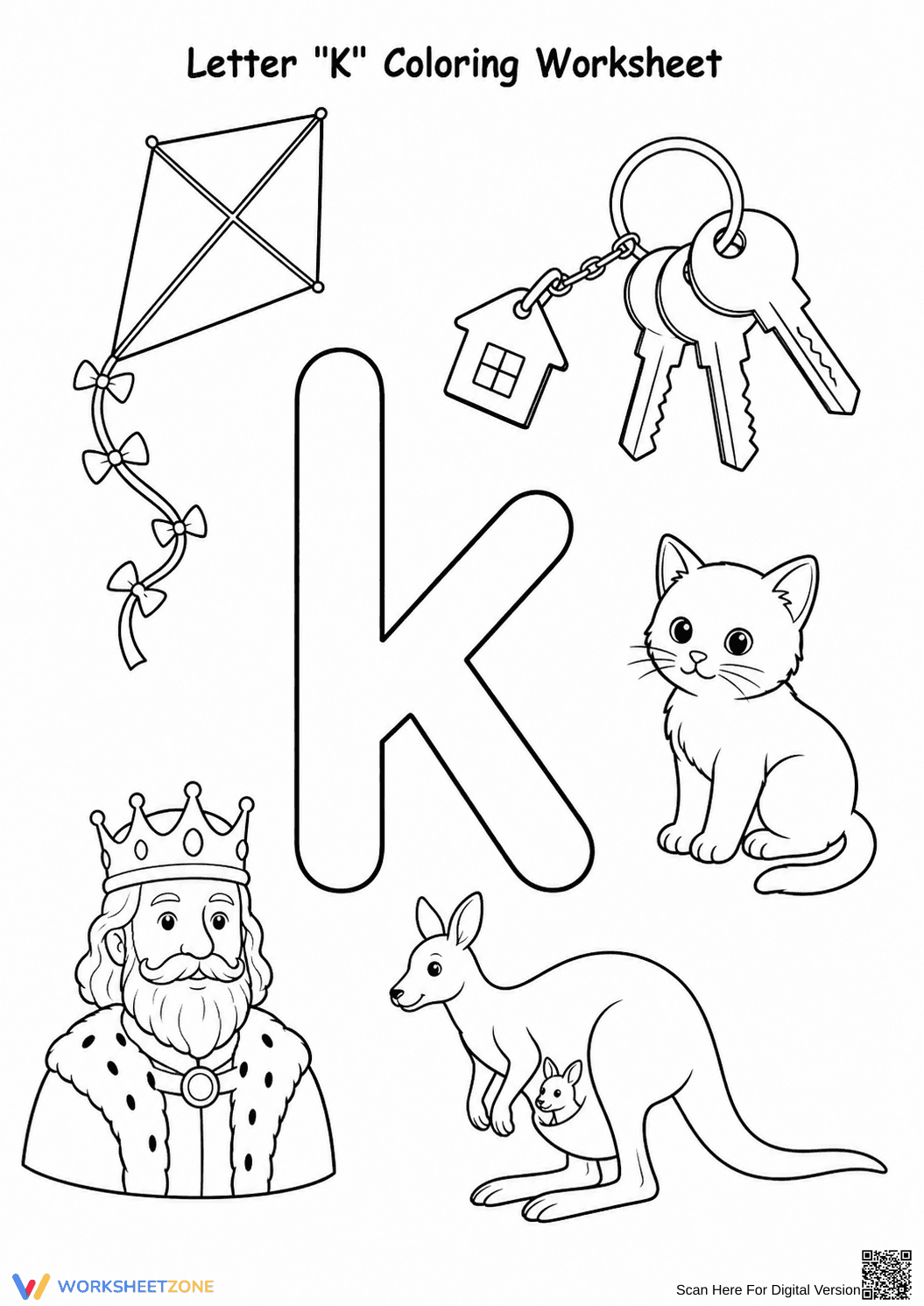
This printable Kindergarten phonics worksheet helps early learners master the letter K and its beginning sound. Students color a central lowercase letter surrounded by familiar vocabulary words like kite, king, and kangaroo, building essential letter-sound correspondence and fine motor skills in one engaging activity.
At a Glance
- Grade: K · Subject: ELA
- Standard:
CCSS.ELA-LITERACY.RF.K.3.A— Produce primary sounds for consonants- Skill Focus: Letter K Beginning Sound
- Format: 1 page · 6 coloring elements · No answer key needed · PDF
- Best For: Independent practice and centers
- Time: 10–15 minutes
Inside this single-page PDF, educators will find a clear coloring activity focused on the letter K. The page features a large lowercase 'k' surrounded by five recognizable objects starting with the /k/ sound: a kite, keys, a kitten, a king, and a kangaroo. Bold outlines support young children developing fine motor control, making it ideal for literacy stations.
Zero-Prep Workflow
This resource is designed for immediate classroom implementation.
- Print (1 minute): Download the PDF and print. The black-and-white design is highly ink-efficient.
- Distribute (1 minute): Hand out pages with crayons. The visual layout makes the task obvious to early learners.
- Review (0 minutes): As an exploratory coloring activity, no formal grading or answer key is necessary.
With total prep under two minutes, this is perfect for emergency sub plans or morning work folders.
Standards Alignment
This activity aligns directly with CCSS.ELA-LITERACY.RF.K.3.A: "Demonstrate basic knowledge of one-to-one letter-sound correspondences by producing the primary sound or many of the most frequent sounds for each consonant." By associating the visual representation of the letter K with familiar objects that share its initial phoneme, students reinforce their foundational decoding skills. Both standard codes can be copied directly into lesson plans, IEP goals, or district curriculum mapping tools.
How to Use It
This coloring page fits perfectly into a weekly letter-of-the-week curriculum. Use it during independent center time after a whole-group direct instruction lesson on the /k/ sound. Alternatively, assign it as a quiet morning work activity as students arrive. While students color, teachers can conduct quick formative assessments by walking around and asking individual children to name the objects and produce the initial sound. Expect students to complete this activity in 10 to 15 minutes.
Who It's For
This worksheet is primarily designed for Kindergarten and Preschool students who are building their initial alphabet knowledge. It serves as an excellent differentiation tool for visual and tactile learners who benefit from combining fine motor practice with phonics instruction. Pair this resource with a read-aloud book featuring heavy 'K' alliteration or a classroom anchor chart displaying the target letter to maximize student retention.
Early phonics instruction relies heavily on connecting visual symbols to auditory sounds. According to Fisher & Frey (2014), providing students with multiple modalities to interact with new concepts significantly increases retention and engagement. This worksheet targets CCSS.ELA-LITERACY.RF.K.3.A by requiring students to produce primary sounds for consonants while engaging in a tactile coloring task. By linking the abstract letter K to concrete, recognizable vocabulary words like kangaroo and kite, early learners can better anchor the phoneme in their working memory. Research consistently shows that integrating fine motor activities, such as coloring within boundaries, alongside foundational literacy tasks helps solidify neural pathways in young children. This dual-purpose approach ensures that students are not only practicing their letter-sound correspondence but also developing the physical dexterity required for future handwriting success.


