


























Views
Downloads

Letter K Beginning Sound Worksheet | Essential Grade K-2
Paste this activity's link or code into your existing LMS (Google Classroom, Canvas, Teams, Schoology, Moodle, etc.).
Students can open and work on the activity right away, with no student login required.
You'll still be able to track student progress and results from your teacher account.
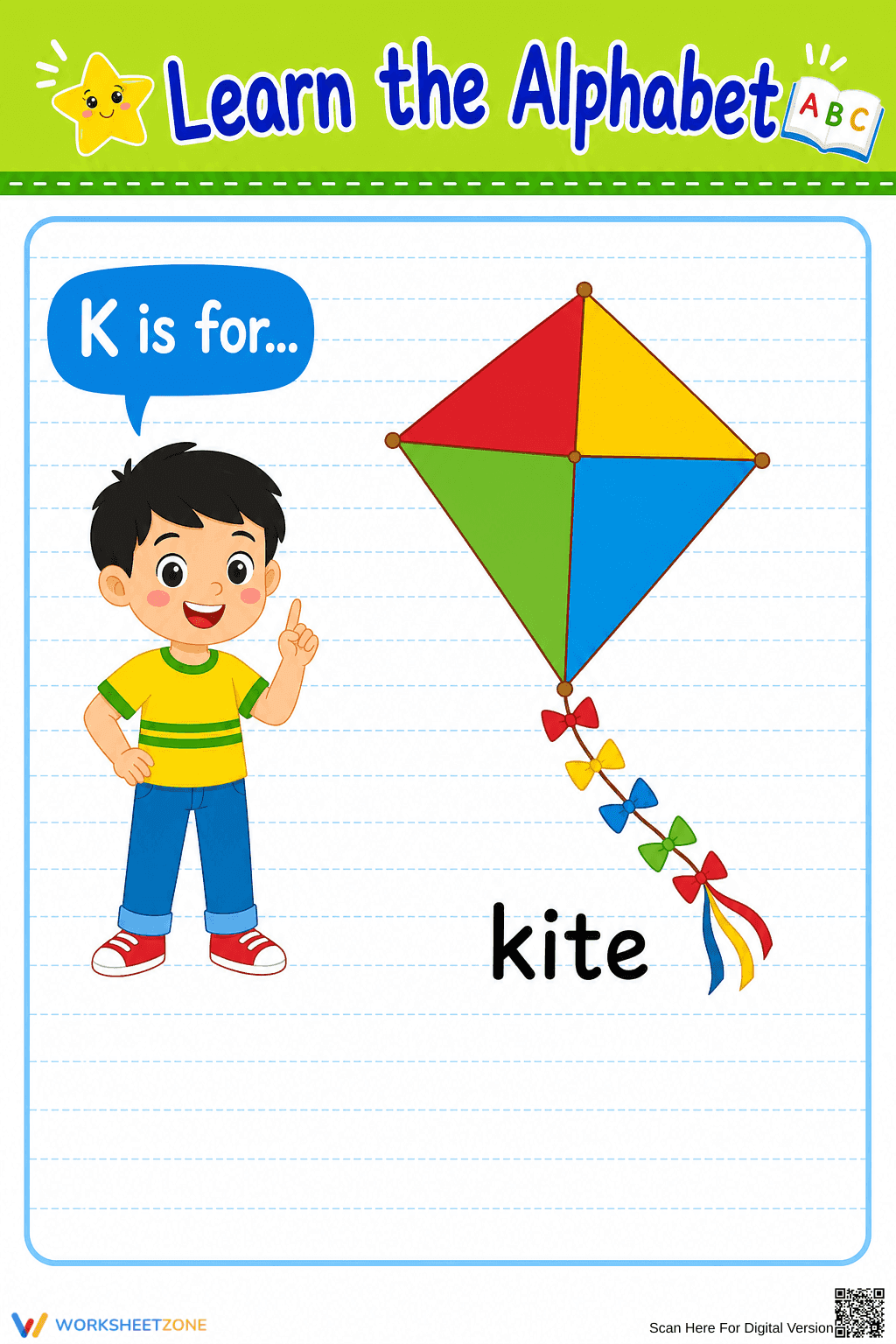
This Letter K beginning sound worksheet helps early learners connect the letter K with its corresponding phoneme through visual association. By focusing on the word "kite," students build foundational phonemic awareness necessary for decoding. This resource provides a clear, high-contrast visual aid to reinforce letter-sound correspondence in a classroom or home setting.
At a Glance
- Grade: Kindergarten · Subject: ELA Phonics
- Standard:
CCSS.ELA-LITERACY.RF.K.3.A— Demonstrate basic knowledge of one-to-one letter-sound correspondences by producing the primary sound- Skill Focus: Letter K Beginning Sound
- Format: 1 page · 1 primary task · Visual Anchor · PDF
- Best For: Initial phonics introduction and letter recognition
- Time: 5–10 minutes
This single-page PDF features a vibrant illustration of a kite paired with the lowercase word and the sentence starter "K is for...". The layout uses wide-ruled lines to simulate a primary writing environment, making it an ideal visual reference or introductory tracing page. It includes a clear character guide to engage young students during direct instruction.
Skill Progression
- Guided practice: Students engage in identifying the letter K and the kite image with a teacher to establish the initial sound connection.
- Supported practice: Learners move to repeating the /k/ sound and pointing to the word "kite" while observing the letter structure.
- Independent practice: Students demonstrate mastery by recognizing the letter K in other contexts or attempting to trace the word on the provided lines.
This structure supports the gradual-release model, often referred to as the "I Do, We Do, You Do" instructional framework.
Standards Alignment
This resource is aligned with `CCSS.ELA-LITERACY.RF.K.3.A`, which requires students to demonstrate basic knowledge of one-to-one letter-sound correspondences. It also supports `CCSS.ELA-LITERACY.RF.K.1.D` by helping students recognize and name lowercase letters of the alphabet. Both standard codes can be copied directly into lesson plans, IEP goals, or district curriculum mapping tools.
How to Use It
Use this worksheet during the "Letter of the Week" introduction as a primary anchor chart. It works well after direct instruction when students are first meeting the letter K. For a formative assessment, observe if students can independently produce the /k/ sound when pointing to the kite. Expected completion time is 5 to 10 minutes depending on the accompanying discussion.
Who It's For
This resource is designed for Kindergarten students, English Language Learners (ELLs), and Grade 1 students requiring phonics intervention. It pairs naturally with a "Letter K" alphabet book or a physical kite-building activity to provide a multi-sensory learning experience for diverse student populations.
According to the RAND AIRS 2024 report on early literacy, explicit instruction in phonemic awareness and letter-sound correspondence is a critical predictor of later reading success. This worksheet targets the CCSS.ELA-LITERACY.RF.K.3.A standard by providing a concrete visual anchor for the /k/ sound. Research indicates that pairing high-frequency vocabulary like "kite" with visual representations helps students internalize the relationship between graphemes and phonemes more effectively than rote memorization alone. By isolating the beginning sound, educators can help students build the phonological bridge required for blending and segmenting words. This resource serves as a foundational tool in a comprehensive literacy program, ensuring that students meet early benchmarks for alphabet recognition and phonetic decoding. The clear design minimizes cognitive load, allowing learners to focus entirely on the target sound-symbol relationship during the critical early stages of reading development.


