Why Letter H Worksheets Belong in Early Literacy Instruction
The letter H is one of the trickier uppercase forms for young writers because it asks for two parallel vertical strokes joined by a horizontal bar, a sequence that draws on control most preschoolers and kindergartners are still building. Good letter H worksheets give teachers a repeatable way to practice that stroke order while also anchoring the /h/ sound. When you plan alphabet instruction for a US early childhood classroom, a single letter page is rarely just handwriting practice. It is a chance to connect formation, letter name, and sound in one short task that students can complete in a center, during small-group time, or as a take-home review.
The value shows up in the research on how children learn letters. School-based, explicit alphabet instruction produces reliable gains, and a well-designed letter H page is a small, concrete piece of that larger routine rather than busywork.
A Trace, Say, Write, Apply Routine for the Letter H
Worksheets work best inside a predictable sequence. A multisensory routine keeps students moving from supported practice to independent recall in four steps:
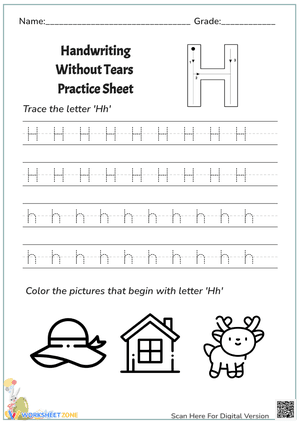
- Trace the dashed uppercase and lowercase H, watching for correct stroke order: top-to-bottom on each vertical line, then the crossbar.
- Say the letter name and the /h/ sound aloud while tracing, so the motor movement and the sound are linked.
- Write the letter independently in the practice boxes without the dashed guide.
- Apply by circling or coloring a picture that starts with H, such as a hat, horse, or house.
This trace, say, write, apply pattern turns a static page into an active task. It also mirrors how effective worksheet formats pair a phonics cue with dashed-line tracing and independent writing, which helps the letter transfer into real reading and spelling rather than staying stuck on the worksheet.
Building Fine-Motor and Stroke-Order Readiness
Before a child can write H cleanly, several readiness skills need to be in place: small-muscle development in the hands, eye-hand coordination, and the ability to produce basic strokes on demand. Uppercase and lowercase H tracing practice targets exactly these prerequisites. The straight verticals of H are an accessible starting point because they require fewer curves than letters like S or G, which makes H a confidence builder early in a handwriting scope and sequence.
Watch for grip, pencil pressure, and whether students start each line at the top. A worksheet that leaves room for four to six repetitions gives you enough of a sample to spot a student who reverses the stroke direction or drifts off the baseline, both common early patterns worth a quick reteach.
Pairing Recognition With Beginning-Sound Phonics
Letter H worksheets pull double duty when recognition and sound work sit side by side. Asking students to color only the pictures that begin with /h/ forces them to isolate the beginning sound, and combining that with tracing strengthens the link between the printed symbol and the phoneme.
Here is a detail many teachers miss: the format of your grouping matters as much as the worksheet itself. Studies on alphabet instruction show that small-group work can yield notably larger effects on letter-name knowledge than one-on-one tutoring, likely because peers model and reinforce the letter name and sound during the task. That means a letter H page used at a four-student table often outperforms the same page delivered in isolated tutoring, so the routine around the worksheet is a real instructional lever, not an afterthought.
Classroom Implementation
Fit letter H practice into a station rotation rather than a single long block. Five to eight focused minutes at a handwriting center, repeated across the week, tends to build formation more durably than one long sitting. Rotate the letter through your literacy centers so students see it in tracing, sound-sorting, and reading-of-the-room activities on different days.
According to Developing Early Literacy Skills, a meta-analysis of 63 studies with 8,468 participants, alphabet instruction produced an effect size of 0.59 for letter writing and 0.43 for letter-name knowledge, and school-based instruction outperformed home-based practice. That is a strong reminder that structured classroom routines built around individual letters like H carry measurable, research-backed weight.
Use completed pages as a fast formative check. A finished letter H worksheet tells you at a glance whether a student forms both cases correctly, starts strokes at the top, and connects the letter to its sound. Send a second copy home for take-home reinforcement, but treat the in-class version as your assessment of record since school-based practice shows the larger effect.
Frequently Asked Questions
1. What grade level or age is a letter H worksheet appropriate for?
Letter H worksheets fit preschool and kindergarten most naturally, roughly ages four to six, when students are building letter recognition and early handwriting. They also serve first-grade review and small-group intervention for students who need more formation practice.
2. How can teachers use letter H worksheets to support both handwriting and phonics goals?
Pair tracing with a beginning-sound task on the same page. Students trace and write the letter, say the /h/ sound aloud, then color pictures that start with H so the motor practice and the sound reinforce each other.
3. How much practice time should a single letter like H get in a literacy center?
Short, frequent sessions of about five to eight minutes across several days generally beat one long block. Distributed practice gives you repeated formation samples and keeps young writers engaged without fatigue.
4. What should teachers look for when checking a student's letter H formation?
Check that both vertical lines start at the top, the crossbar sits in the middle, and the letter rests on the baseline. Watch grip and pencil pressure, and note any reversed stroke direction for a quick reteach.
5. How can letter H worksheets be adapted for students who need extra fine-motor support?
Add starting dots, use highlighted guide strokes, and offer larger tracing lines. Verbal stroke cues and hand-over-hand modeling during small-group time help students who are still developing eye-hand coordination and small-muscle control.