


























Views
Downloads

Printable Letter H Tracing Worksheet | Kindergarten ELA
Paste this activity's link or code into your existing LMS (Google Classroom, Canvas, Teams, Schoology, Moodle, etc.).
Students can open and work on the activity right away, with no student login required.
You'll still be able to track student progress and results from your teacher account.
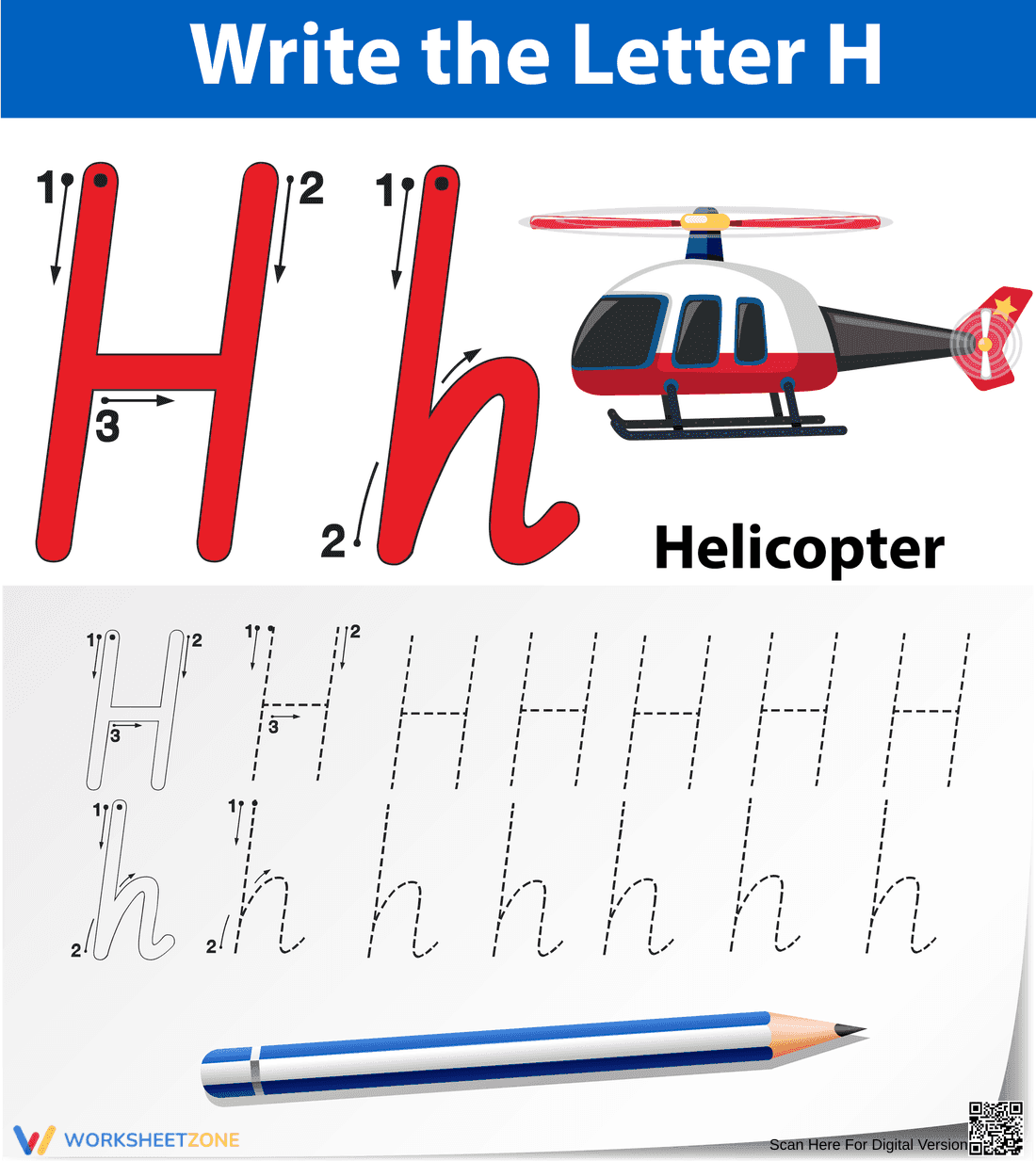
This foundational handwriting worksheet helps early learners master the letter H through guided, repetitive tracing. By practicing both uppercase and lowercase forms with directional arrows, students develop fine motor control and muscle memory essential for fluent writing. The engaging helicopter illustration provides a helpful phonetic connection.
At a Glance
- Grade: Kindergarten · Subject: English Language Arts
- Standard:
CCSS.ELA-LITERACY.L.K.1.A— Print many upper- and lowercase letters- Skill Focus: Letter H formation and tracing
- Format: 1 page · 14 problems · No answer key needed · PDF
- Best For: Independent morning work
- Time: 10–15 minutes
This single-page resource features a large, numbered instructional model demonstrating correct stroke order for the uppercase and lowercase letter H. Below the model, students find two practice rows containing 14 dashed tracing tasks. The first row focuses on the uppercase H, while the second row provides practice for the lowercase h, set against standard primary writing lines.
Zero-Prep Workflow
This resource is designed for immediate classroom implementation with minimal teacher setup.
- Print (1 minute): Simply download the PDF and print the required number of copies.
- Distribute (1 minute): Hand out the sheets alongside standard pencils or primary grip markers. The visual stroke guides make verbal instructions nearly unnecessary.
- Review (1 minute): Quickly scan student work to ensure they are following the directional arrows rather than drawing the letters backward.
With a total prep time of under two minutes, this activity is an excellent addition to any emergency sub plan or morning routine.
Standards Alignment
This tracing activity is directly aligned with CCSS.ELA-LITERACY.L.K.1.A, which requires students to print many upper- and lowercase letters. By providing explicit, numbered stroke paths, the worksheet ensures students practice correct letter formation rather than simply copying shapes. Both standard codes can be copied directly into lesson plans, IEP goals, or district curriculum mapping tools.
How to Use It
Deploy this worksheet during morning work or literacy centers after a whole-group lesson on the letter H. As a formative assessment tip, observe students while they trace the first few letters to ensure they are starting at the top line and following the numbered arrows downward, correcting any bottom-up strokes immediately. Most early learners will complete this task within 10 to 15 minutes.
Who It's For
This resource is primarily designed for Kindergarten students, though it is equally effective for Pre-K learners developing fine motor skills or first graders needing handwriting remediation. For students requiring extra support, consider having them trace the large model at the top with their finger before using a pencil. Pair this worksheet with a phonics anchor chart featuring other "H" words to bridge handwriting and letter-sound recognition.
Effective handwriting instruction requires explicit modeling and guided repetition to build automaticity. This resource targets CCSS.ELA-LITERACY.L.K.1.A, helping students print many upper- and lowercase letters accurately. According to Fisher & Frey (2014), providing clear visual scaffolds—such as the numbered directional arrows featured in this activity—significantly reduces cognitive load for early writers, allowing them to focus on motor execution rather than shape recall. When students practice tracing with proper stroke order, they develop the muscle memory necessary for fluent, legible writing in later grades. Automatic letter formation frees up working memory for higher-order tasks like spelling and composition. By integrating phonetic cues like the helicopter illustration, the worksheet also reinforces the connection between physical letter formation and phonemic awareness.


