Where Letter J Fits in Your Alphabet Scope and Sequence
If you teach a letter of the week or run a systematic phonics block, letter J usually lands somewhere in the middle of the year. It isn't one of the earliest, highest-frequency letters kids meet in their own names, and it shows up less often in classroom print than letters like S, T, or M. That lower exposure is exactly why J deserves deliberate practice instead of a quick mention.
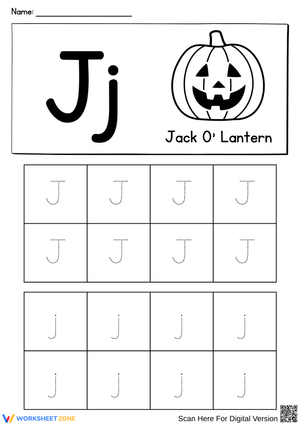
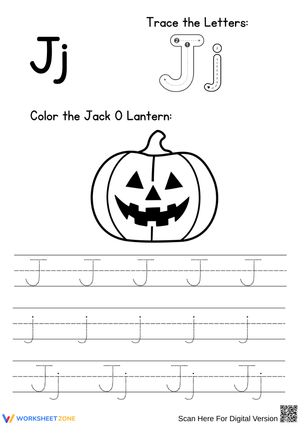
Slot your letter J worksheets into the same predictable routine you use for every other letter: introduce the name, model the sound, demonstrate formation, then move students into guided and independent tracing. Keeping the structure identical from letter to letter frees up working memory, so students spend their attention on the new symbol rather than on figuring out what to do next.
Correct Uppercase and Lowercase J Stroke Order
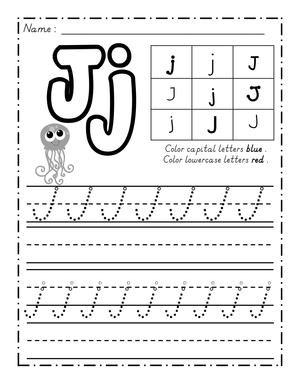
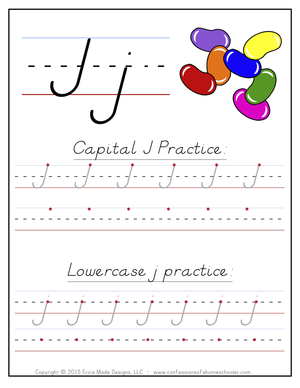
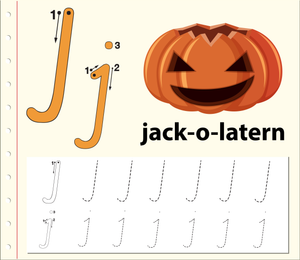
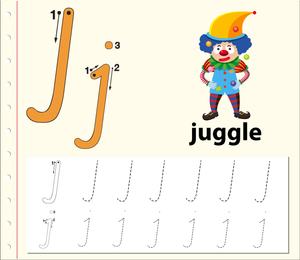
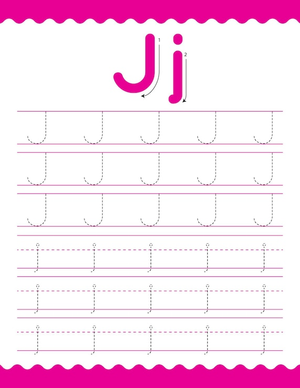
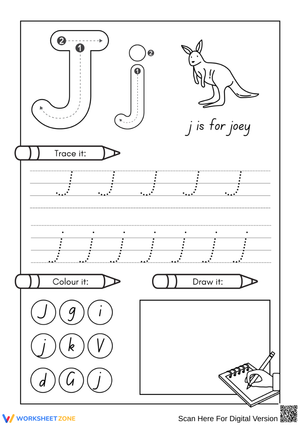
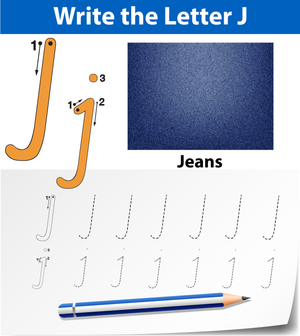
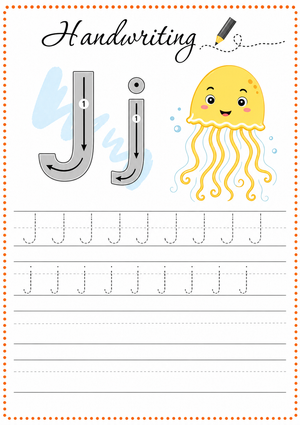
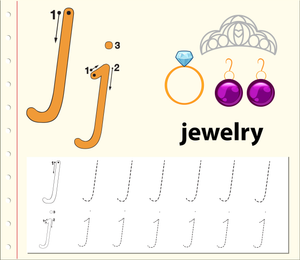
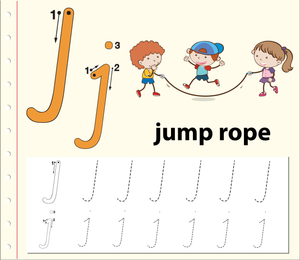
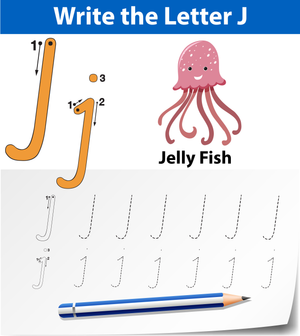
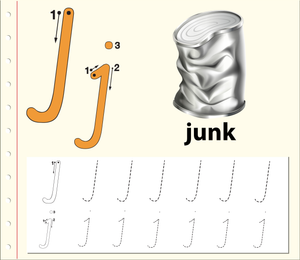
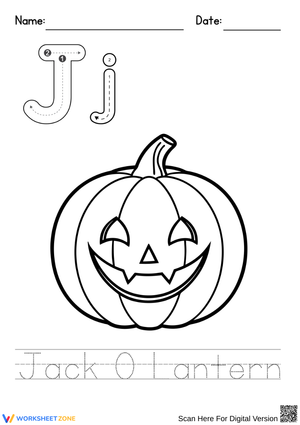
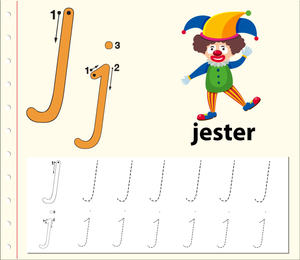
Uppercase J is a single continuous stroke. Students start at the top line, pull straight down, curve around to the left at the bottom, then lift the pencil and add a short cross at the top. Lowercase j follows a similar path—start below the midline, pull down through the baseline, curve left—then add the dot on top once the pencil lifts.
Watch for the two errors that show up most on J worksheets. The first is a backward curve, where students hook the bottom to the right instead of the left, which turns J into a shape closer to a U or a fishhook facing the wrong way. The second is forgetting the dot on lowercase j or the cross on uppercase J. Circle these on the first practice sheet and re-model before students repeat the row.
Here's the pattern worth watching: the bottom curve on J drops below the baseline, making it one of the few early letters with a descender-style motion. Students who reverse the J curl almost always reverse lowercase g and y the same week, because all three share that same down-and-curve-left path. Grouping J worksheets alongside g and y practice lets you correct one motor habit instead of chasing three separate ones.
Teaching the /j/ Sound Alongside Formation
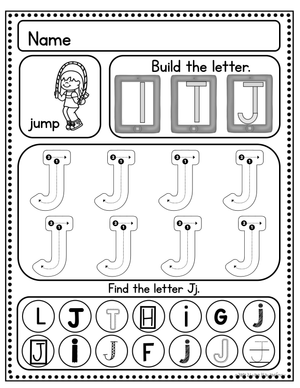
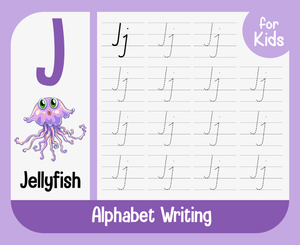
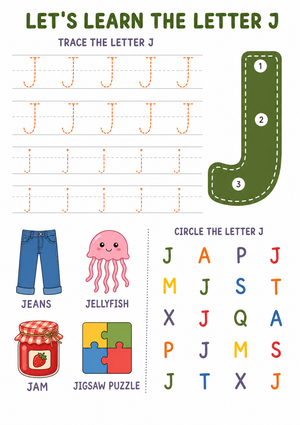
Formation and sound should travel together. As students trace, have them say the /j/ sound—the initial sound in jump, jam, and jet—so the motor pattern and the phoneme lock in at the same moment. Picture cues printed on the worksheet help, but the verbal repetition does the heavy lifting for letter-sound recall.
Research on early literacy is consistent: alphabet knowledge—naming letters and producing their sounds—ranks among the strongest predictors of later reading and spelling. A meta-analysis of alphabet learning reports that explicit, direct instruction outperforms incidental exposure, which is why a scripted J routine works better than hoping students simply absorb the letter on their own.
Classroom Implementation
A tight, repeatable sequence keeps a J lesson to about ten minutes and works for whole-class or small-group settings. Try this flow with your letter J worksheets:
- Model first: form uppercase and lowercase J on the board while narrating each stroke out loud.
- Sky-write: have students trace J in the air with a full arm before pencil hits paper.
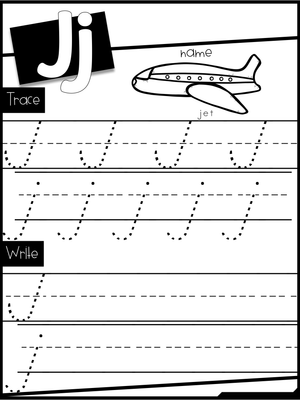
- Trace with voice: students trace the worksheet outlines while saying the /j/ sound on each rep.
- Independent row: students write J without guides, then circle their own best attempt.
- Quick check: scan for reversals and missing dots before moving on.
Multisensory steps matter more for J than for high-frequency letters. Because students see and write J less often, pairing tracing with sky-writing and a tactile tray—salt, sand, or a textured card—builds the motor memory that repetition alone can miss.
Using Letter J Worksheets for Small-Group Intervention
For students behind on alphabet benchmarks, J worksheets double as a focused intervention tool. Pull a small group, cut the practice to two or three letters at a time, and keep the same script every session so the routine itself becomes automatic.
By age four, roughly 60% of children already know more than half of their uppercase letters and a handful of lowercase letters, so a student who can't yet name or form J by late pre-K is worth a closer look. Short, daily J sessions—three to five minutes—usually move formation faster than one long weekly block, because motor learning responds to frequency.
Differentiating Letter J Practice Across Grade Levels
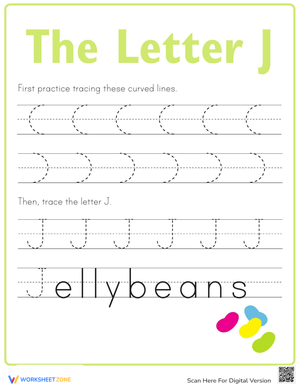
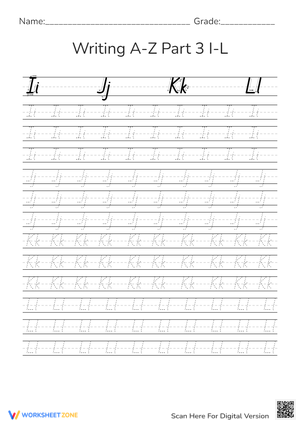
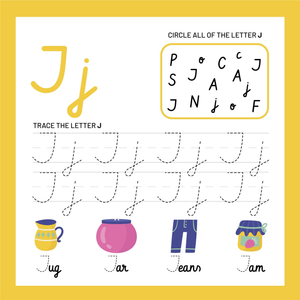
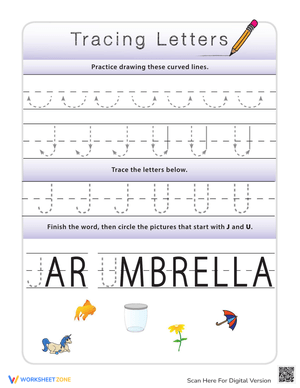
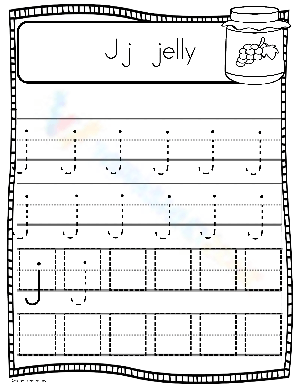
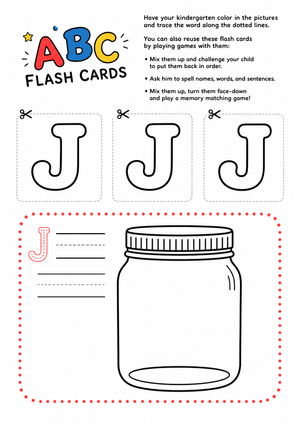
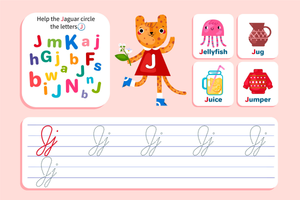
The same letter J worksheets flex across ages with small adjustments. Preschoolers do well with oversized tracing lines and dotted guides. Kindergartners can move to standard three-line handwriting paper and add simple J words like jet or jam. Older struggling writers benefit from the identical formation practice, framed with age-appropriate images so the sheet doesn't feel babyish.
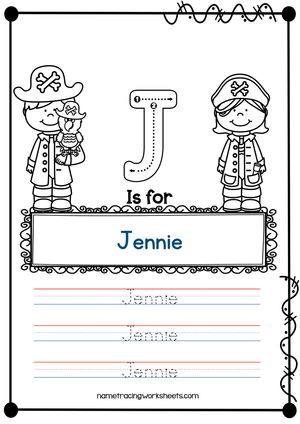
- Preschool: jumbo dotted J, directional arrows, and a picture cue.
- Kindergarten: midline paper, uppercase and lowercase pairs, and a short J word.
- Intervention: fewer reps, more teacher modeling, and a running record of reversals.
Used this way, a letter J worksheet also works as a fast formative check. One clean independent row tells you a student has both the fine motor control and the letter-sound recall to move on to the next letter in your sequence.
Frequently Asked Questions
1. What is the correct stroke order for uppercase and lowercase J?
For uppercase J, start at the top, pull straight down, curve left at the bottom, then add the top cross. For lowercase j, start below the midline, pull down past the baseline, curve left, then lift and add the dot. Teaching it as one continuous downward-and-curve motion prevents most reversals.
2. What age or grade should practice letter J formation?
Most children work on J formation in preschool and kindergarten, often mid-year once earlier, higher-frequency letters are established. By kindergarten entry, benchmarks generally expect recognition of at least 10 letters, with most letters and sounds mastered by the end of kindergarten.
3. How can letter J worksheets support struggling writers or fine motor delays?
Use larger tracing guides, add tactile practice like a salt tray, and shorten each session. Pairing sky-writing with tracing gives students a whole-arm motor pattern before they manage finer pencil control, which helps writers who tire quickly or reverse letters.
4. How many practice sessions does letter J mastery usually take?
It varies, but short, frequent sessions beat long ones. Three to five minutes of daily J practice across a week or two is a reasonable target for many learners, with struggling students needing more repetitions and closer teacher modeling.
5. How do letter J worksheets fit into a broader phonics curriculum?
Treat J as one stop in a systematic scope and sequence. Tie each worksheet to the /j/ sound, connect it to letters that share the same motion, and revisit J in review rotations so it doesn't fade the way less-frequent letters often do.