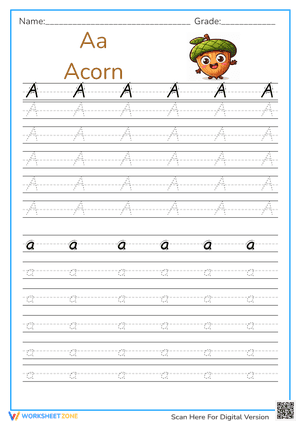
A is where most children begin, and it is a kind first letter to meet. Capital A is three straight lines with no curves to control, so a child who can draw a line can draw an A. These letter A worksheets take a preschooler from that first slanted stroke to writing the letter from memory, and every page prints free as a PDF.
Writing capital A and lowercase a
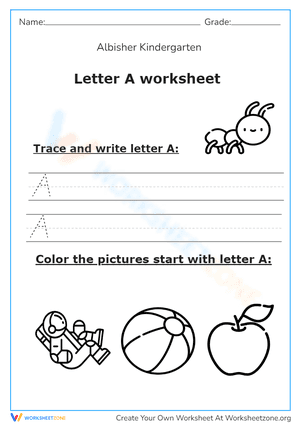
Capital A is built in three strokes: a slanted line down to the left, a second slanted line down to the right so the two meet in a point at the top, then a short bar across the middle. Young writers often make the bar too high, which turns the A into a thin triangle, so point to the middle of the two legs before they draw it.
Lowercase a is a different job. It starts as a small circle pulled around to the left, and finishes with a straight line down the right-hand side touching the circle. The circle has to close, or the letter reads as a u. If a child is not yet confident with circles, spend a few days on tracing the letter A first.
Why lowercase a has two shapes
Children notice quickly that the a in their reading book does not match the a they are taught to write. Printed books mostly use a two-storey a with a small hook over the top, while handwriting uses the simple round a. Both are correct, and nobody expects a child to write the book version. Say so out loud, because a child who thinks they are copying the letter wrongly may stop trying.
Letter A and letter B together
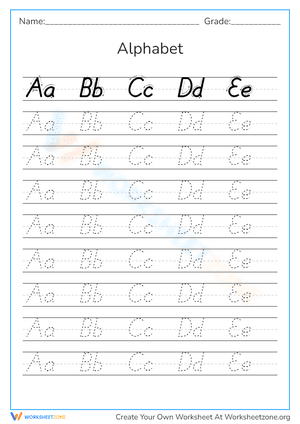
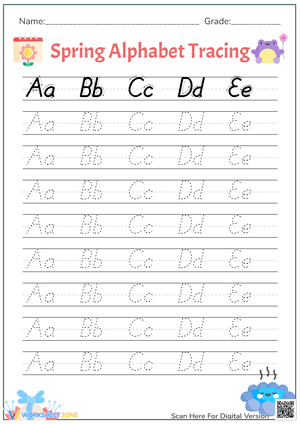
A and B are often taught as a pair in the first weeks of the alphabet, and worksheets covering letter A and B together let a child practise two shapes in one sitting. They contrast well: A is all straight lines, letter B is a straight line plus a curve. Print an A page and a B page and alternate the lines, so the child has to switch between a point and a bump.
The sounds the letter A makes
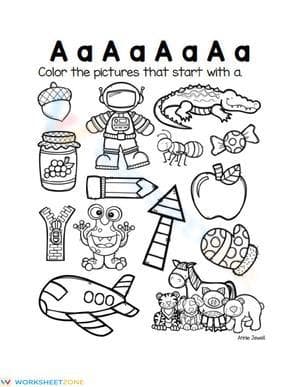
A is a vowel, so it carries more than one sound. The short a in apple, ant and cat is the one taught first, because most early reading words use it. The long a, which says its own name, turns up in acorn, apron and cake. Keep the two apart at the start: pick short a words for sound work, and come back to the long a once the short sound is secure. The beginning sounds worksheets give more practice listening for the a at the start of a word, and the vowel worksheets cover the short and long pairs properly.
Good short a words to say while writing: apple, ant, ax, and, at, cat, hat, bag. Children also like alligator and astronaut, which are long but memorable.
When writing is still too hard
Some three and four year olds can recognise an A long before their hands can draw one. Cut-and-paste and spot-the-letter activities do real work here: the child has to tell an A from a similar shape without needing pencil control. The find the letter worksheets ask a child to circle every A on the page, and the letter recognition worksheets mix capital and lowercase forms.
Frequently Asked Questions
1. What age can a child start letter A worksheets?
Most children are ready for tracing pages somewhere between three and four, and for writing A on their own in the pre-K or kindergarten year. Age matters less than grip and interest. If a child cannot yet hold a pencil steadily, work on big A shapes in sand, paint or chalk first, then come back to paper.
2. Should my child learn capital A or lowercase a first?
Capital A is usually easier, because three straight lines are simpler to control than a closed circle. Many preschool programmes teach capitals first for that reason. Do not leave lowercase a too long, though, since almost every a a child meets in a book is lowercase.
3. Why does my child write A backwards or upside down?
Capital A is symmetrical, so it is rarely reversed, but children do start the strokes in odd places, often drawing the crossbar first and hanging the legs off it. Watch the starting point rather than the finished letter. Ask the child to begin at the top point every time and the shape settles quickly.
4. Which words work best for letter A practice?
Start with short a words a child already says: cat, hat, bag, apple, ant. Their own name is better still if it contains an a. Name tracing sheets are a good next step once single letters feel easy.
















 Interactive Worksheet Maker
 Quiz Maker
 Word Search Maker
 Crossword Puzzle Maker
 Word Scramble Generator
 Sentence Scramble Generator
 Handwriting Worksheet Generator
 Name Tracing Generator
 Fill In The Blank Generator