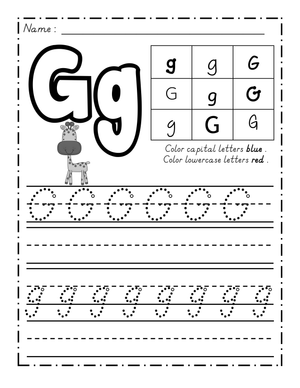
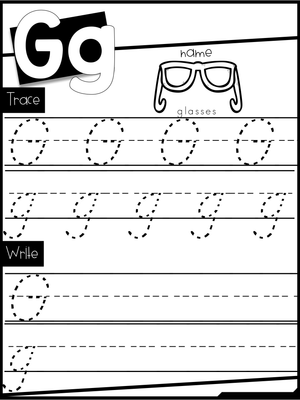
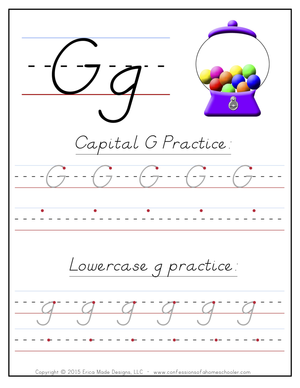
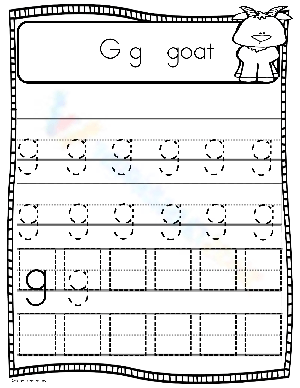
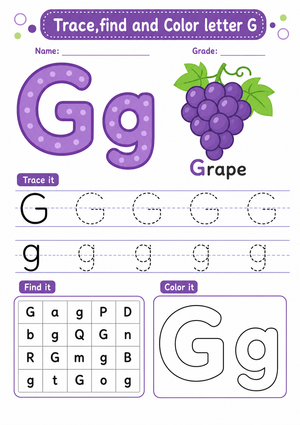
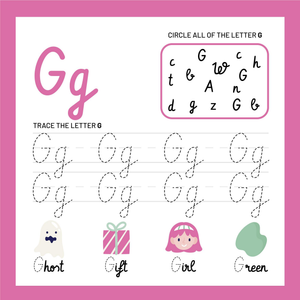
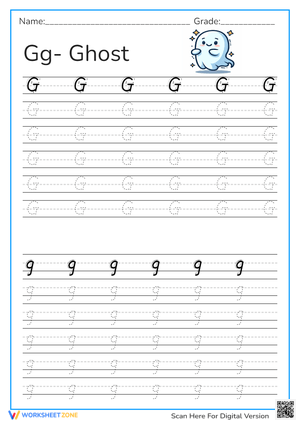
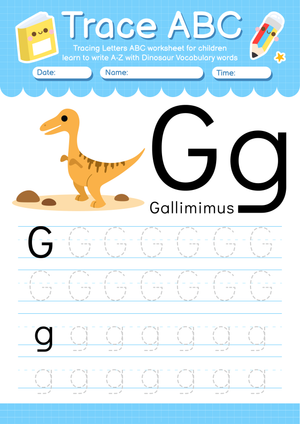
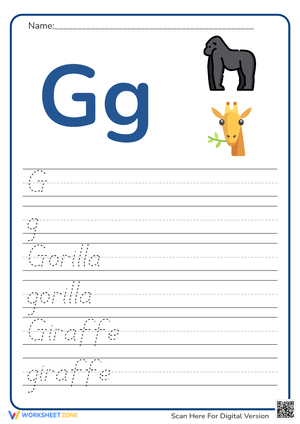
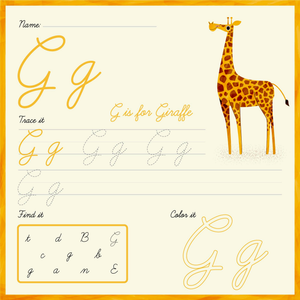
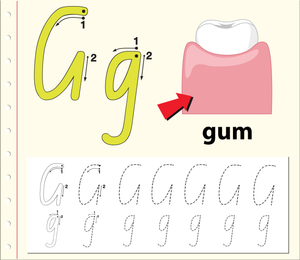
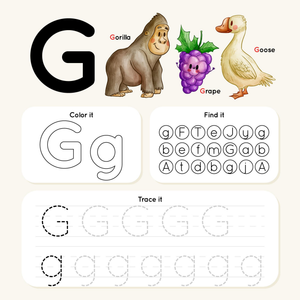
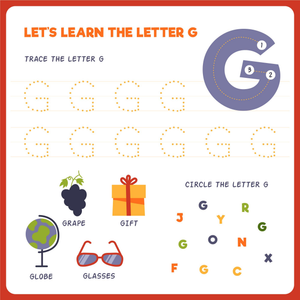
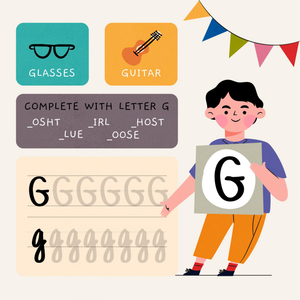
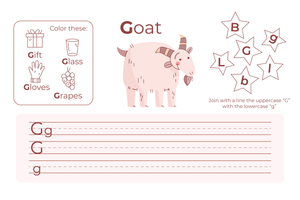
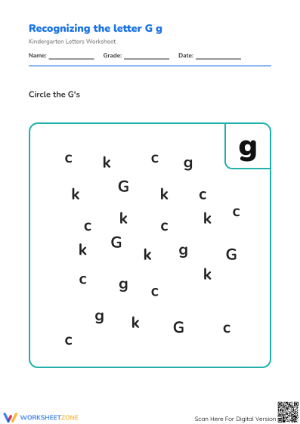
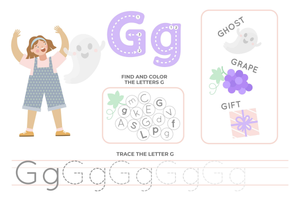
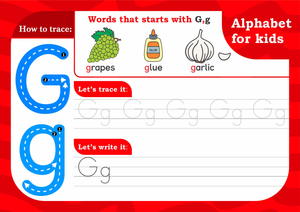
Letter G is one of the trickier letters for young writers to master. It pairs a curved opening stroke with either a closed bowl or a descender that dips below the baseline, so students often reverse it, leave the loop open, or float it above the line. Well-designed letter G worksheets give pre-K through first grade students the structured, repeatable practice they need to lock in correct formation before shaky habits set in.
Start With Uppercase G, Then Lowercase g
Developmentally, most preschoolers learn to write uppercase letters before lowercase ones. Uppercase letters are built mostly from big lines and simple curves that start at the top, which matches young children's motor control better than the small loops and precise placement lowercase letters demand.
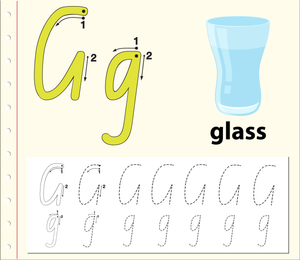
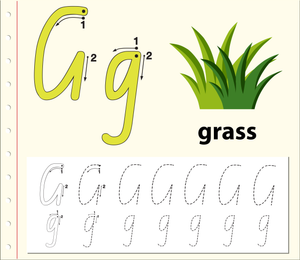
For letter G, that means introducing uppercase G first. Uppercase G starts like a C, curving from the top down and around, then adds a short horizontal shelf that turns back toward the center. Once students form uppercase G confidently, move to lowercase g. Sequencing this way prevents the frustration that comes from asking students to control a descender before they've mastered the basic curve.
The Magic C Method for a Consistent Lowercase g
Lowercase g is commonly taught with the "Magic C" formation method, the same starting move used for a and d. Students begin with a c-shaped curve, then complete the letter by adding the descending stroke and hook below the line. Teaching g alongside a and d helps students transfer one reliable starting habit across several letters instead of learning each shape from scratch.
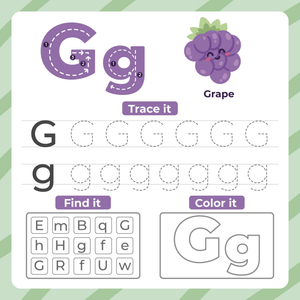
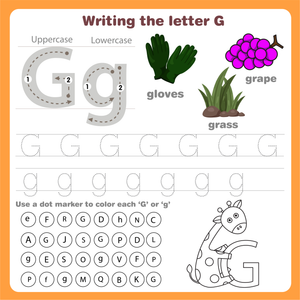
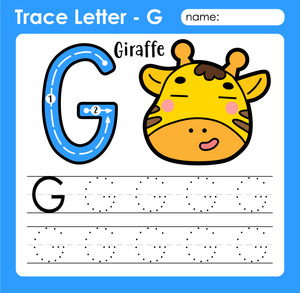
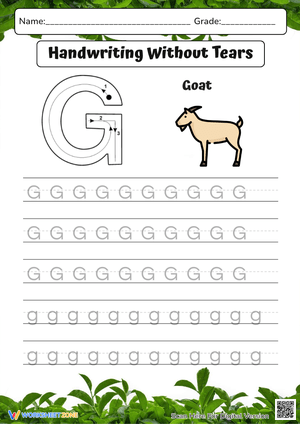
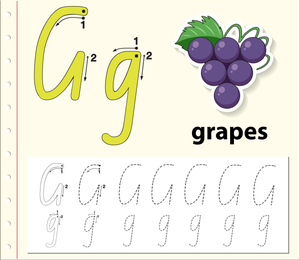
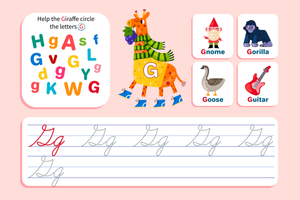
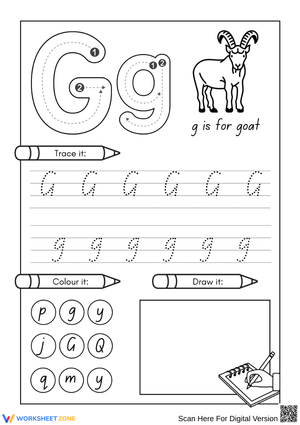
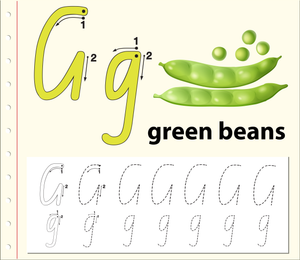
Resources like The OT Toolbox describe this shared "Magic C" family as a way to reduce the number of distinct motor patterns young writers have to remember. One efficient move is to teach a small batch, uppercase G, then lowercase a, d, and g in the same week, so the shared opening stroke gets reinforced from several angles and students begin to self-correct faster. On your letter G worksheets, look for a clear starting dot, directional arrows, and a few fully modeled letters before the tracing rows begin.
Handling the Descender in the Drop-Down Letter Group
Letters with descenders that fall below the baseline, including g, j, p, q, and y, are usually grouped and taught as their own "drop-down letter" set. These are harder for young writers to form consistently because they require crossing the baseline and controlling a stroke in the space below the line, where there's no printed guide in ordinary writing.
When you teach lowercase g as part of this drop-down group, use explicit cues: "start at the middle, curve back like a c, then drop down below the line and hook back." A common error is stopping the pencil at the baseline and adding a stub, which produces a g that reads like a q or an a. Naming the below-the-line hook explicitly, and pointing to the dashed descender zone on the page, heads that off.
Connecting Letter G to Its Sound
Here's what many alphabet packets miss: letter recognition, letter-name knowledge, letter-sound knowledge, and letter production are distinct but sequentially linked skills. Research summarized in the journal Reading and Writing shows that recognition tends to predict name knowledge, which in turn predicts sound knowledge. A student who traces G cleanly may still not connect it to /g/, so formation worksheets should never be your only measure of mastery.
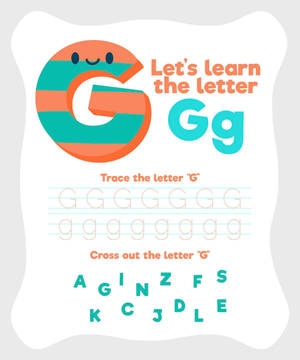
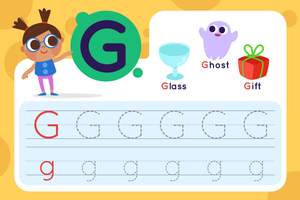
Pair every letter G worksheet with a quick sound routine. As students trace, have them say "G says /g/" and name a keyword like goat or gum. This links the motor pattern to the phoneme, so the worksheet builds alphabet knowledge and not just fine motor control. Watch for the soft g in words like giraffe, and keep early practice focused on the hard /g/ sound.
Classroom Implementation
Fit letter G worksheets into a predictable rotation rather than treating them as one-off pages. A workable small-group sequence looks like this:
- Model first. Form uppercase G and lowercase g on the board while narrating each stroke.
- Multi-sensory warm-up. Have students form g in sand trays, with play dough, or on a dry-erase board before touching the printed page.
- Guided tracing. Students trace the modeled letters, saying the sound on each rep.
- Independent rows. Move to unassisted formation only after tracing looks controlled.
- Quick check. Ask students to write one G from memory as an exit ticket.
For intervention and special education groups, slow this sequence down and add more multi-sensory reps. The wet-dry-try method, tracing a chalk letter with a wet sponge, then a dry one, then a pencil, gives students behind on fine motor milestones extra repetitions without turning practice into a stack of identical worksheets. Track formation, not just completion: a finished page full of reversed or open Gs isn't mastery. Spot-check a few letters from each student and reteach the specific stroke that's breaking down rather than assigning another full page.
Frequently Asked Questions
1. What is the correct stroke order for uppercase G and lowercase g?
Uppercase G starts at the top like a C, curves down and around, then adds a short horizontal shelf that turns back toward the center. Lowercase g uses the "Magic C" start: a c-shaped curve, then a stroke that drops below the baseline and hooks back to the left.
2. What grade level should master letter G formation?
Most students work on letter G formation in pre-K and kindergarten, with independent, consistent formation expected by the end of kindergarten or early first grade. Uppercase G typically comes first, and lowercase g follows once basic curves are secure.
3. How can I tell if a student struggles with G from fine motor delays versus lack of practice?
Watch across letters. A student who forms most letters cleanly but rushes G likely needs more targeted practice. A student who struggles with grip, spacing, and control on many letters may have a broader fine motor need worth flagging for occupational therapy screening.
4. How many practice sessions does a student need before writing G independently?
It varies, but short daily reps beat one long session. Many students need repeated multi-sensory and tracing practice across one to two weeks before forming G reliably from memory. Use an exit-ticket check rather than a fixed worksheet count to decide when to move on.
5. How should letter G worksheets be paired with phonics?
Attach the /g/ sound to every formation rep. Have students say "G says /g/" and name a keyword as they trace, and connect the letter to hard-g words like goat and gum before introducing the soft g. This keeps handwriting and phonics reinforcing each other.