What Letter Z Worksheets Cover in Pre-K and Kindergarten
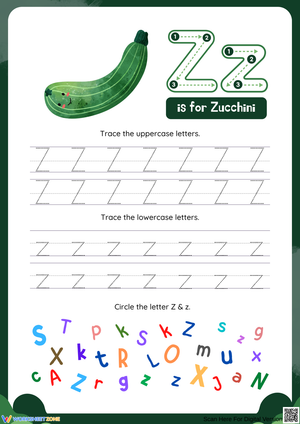
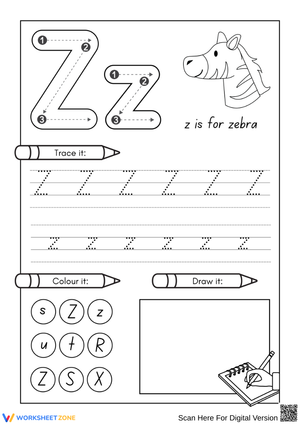
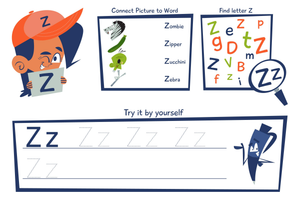
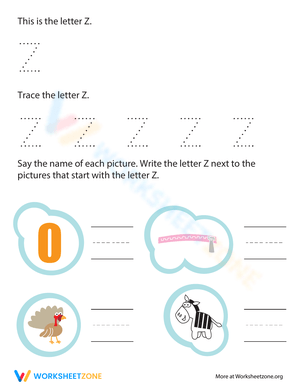
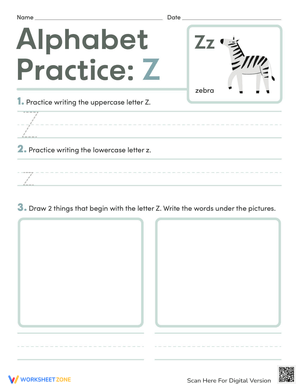
Letter Z worksheets give young learners focused practice with the final letter of the alphabet, usually across three connected skills: recognizing uppercase Z and lowercase z, forming each letter with correct strokes, and connecting the letter to its sound through Z-words. For pre-K and kindergarten teachers, these pages work best as short, targeted stations rather than long assignments. A typical set includes tracing rows, a recognition hunt where students circle every Z on a mixed grid, and a picture-matching task that pairs the letter with words like zebra or zipper.
Because Z shows up so rarely in everyday text, students often see it less than high-frequency letters like S or T. That makes dedicated Z practice worth the classroom time, especially when you want every child to finish the year able to name and write all 26 letters with confidence.
Where Letter Z Fits in End-of-Alphabet Review
In most letter-of-the-week sequences, Z lands last. That timing turns the letter into a natural capstone: by the time you reach it, students have already met the other 25 letters, so a Z lesson can double as a full-alphabet check. Many teachers pair the new letter with a quick review sweep of earlier letters, using the Z page as the anchor task while small groups rotate through recognition and writing.
This end-of-year position also shapes how you read the results. If a student struggles with Z formation but names every other letter cleanly, the fix is targeted handwriting practice. If gaps show up across several letters during the same week, the Z worksheet has surfaced a broader recognition need worth addressing before you move into blending and CVC words.
Reading Rockets highlights alphabet knowledge as one of the strongest early predictors of later reading achievement. In longitudinal studies, letter-name knowledge at kindergarten entry correlates near .50 with later reading scores and explains roughly 25% of the variance—evidence that letter-focused practice like Z worksheets carries measurable weight in early instruction.
Tracing and Correct Z Formation
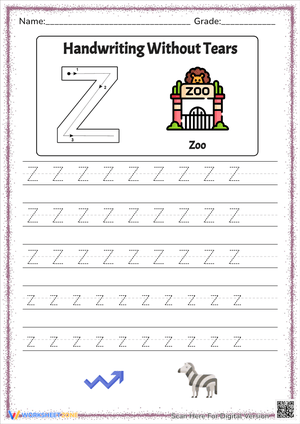
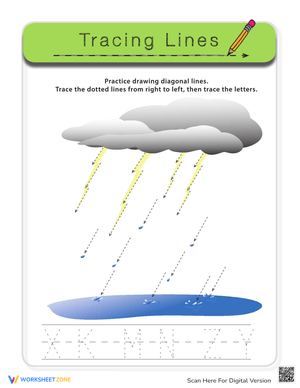
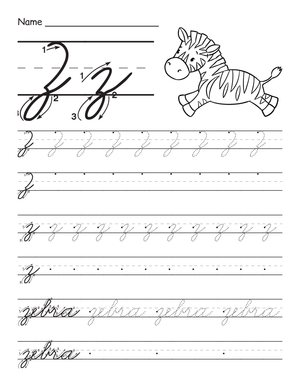
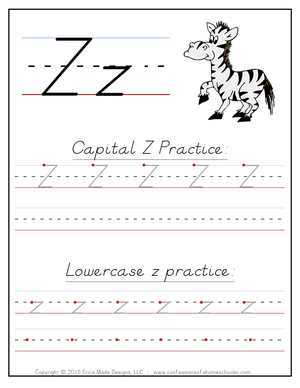
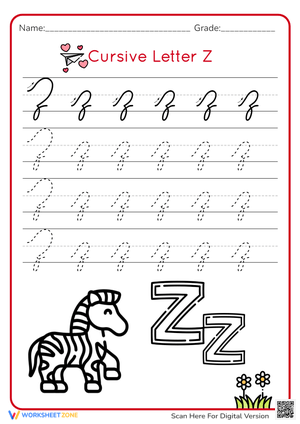
Uppercase Z is one of the friendlier letters to write: a straight line across the top, a diagonal down to the left, and a straight line across the bottom. Lowercase z follows the same shape at a smaller size. Tracing worksheets reinforce that stroke order so students build a consistent motor pattern instead of drawing the letter differently each time. Start with large guided rows, then move to smaller independent boxes as control improves.
Watch for the two most common Z errors: reversing the diagonal so it slants the wrong way, and rounding the corners into a loose S shape. Directional arrows and a numbered start dot on the worksheet help, and saying the strokes aloud—across, down, across—gives kinesthetic and auditory learners an extra hook. Fine motor tracing like this supports handwriting readiness right alongside letter recognition.
Classroom Implementation
Set up Z practice as a rotation rather than a whole-class worksheet. One station handles tracing, a second runs picture-to-letter matching, and a third uses a multisensory tray—sand, salt, or a whiteboard—where students form Z with a finger before committing it to paper. Ten to twelve minutes per rotation keeps young attention spans engaged and lets you pull a small group for closer coaching.
Here is a pattern worth watching: because Z is taught last and appears so seldom in decodable text, it is often the letter students recognize slowest months later, even when their overall alphabet knowledge looks strong. Building a brief Z touchpoint into your spring review—rather than treating the letter-of-the-week lesson as the final exposure—closes that retention gap. A single reappearance a few weeks after the unit tends to lock in recognition far better than one concentrated week ever does.
Keep the paper task short and the talk generous. The worksheet anchors the skill, but the conversation around it—naming the letter, sounding the words, describing the strokes—is where most of the learning happens for this age group.
Frequently Asked Questions
1. What age or grade level are letter Z worksheets appropriate for?
They fit best in preschool, pre-K, and kindergarten, roughly ages 3 to 6, when children are learning letter names, sounds, and formation. Older students who need extra alphabet support can use them for targeted review during small-group intervention.
2. How can teachers use letter Z worksheets to check alphabet mastery?
Because Z is usually taught last, a Z page paired with a quick sweep of earlier letters works as an end-of-unit check. Have students name, write, and match the letter, then log the results before moving on to blending.
3. What are effective Z words to pair with these worksheets?
Stick to a small, familiar bank: zebra, zipper, zoo, zucchini, zigzag, and zero. The limited set is helpful—students see the same images repeatedly and build fast, reliable sound-letter links rather than juggling unfamiliar vocabulary.
4. How do letter Z worksheets support handwriting and fine motor skills?
Tracing rows guide correct stroke order—across, down, across—while building the hand control young writers need. Directional arrows and a start dot reduce reversals, and the practice strengthens handwriting readiness alongside letter recognition.
5. How can teachers differentiate Z instruction for students who need extra support?
Reduce the visual load with larger print and fewer letters per row, highlight the target Z in color, and add a multisensory tray for finger-formation. For students who are ready, layer in writing a Z-word beneath each traced letter.