




























Views
Downloads

Letter H Tracing Worksheet | Essential Grade K-1 Ready

Paste this activity's link or code into your existing LMS (Google Classroom, Canvas, Teams, Schoology, Moodle, etc.).
Students can open and work on the activity right away, with no student login required.
You'll still be able to track student progress and results from your teacher account.
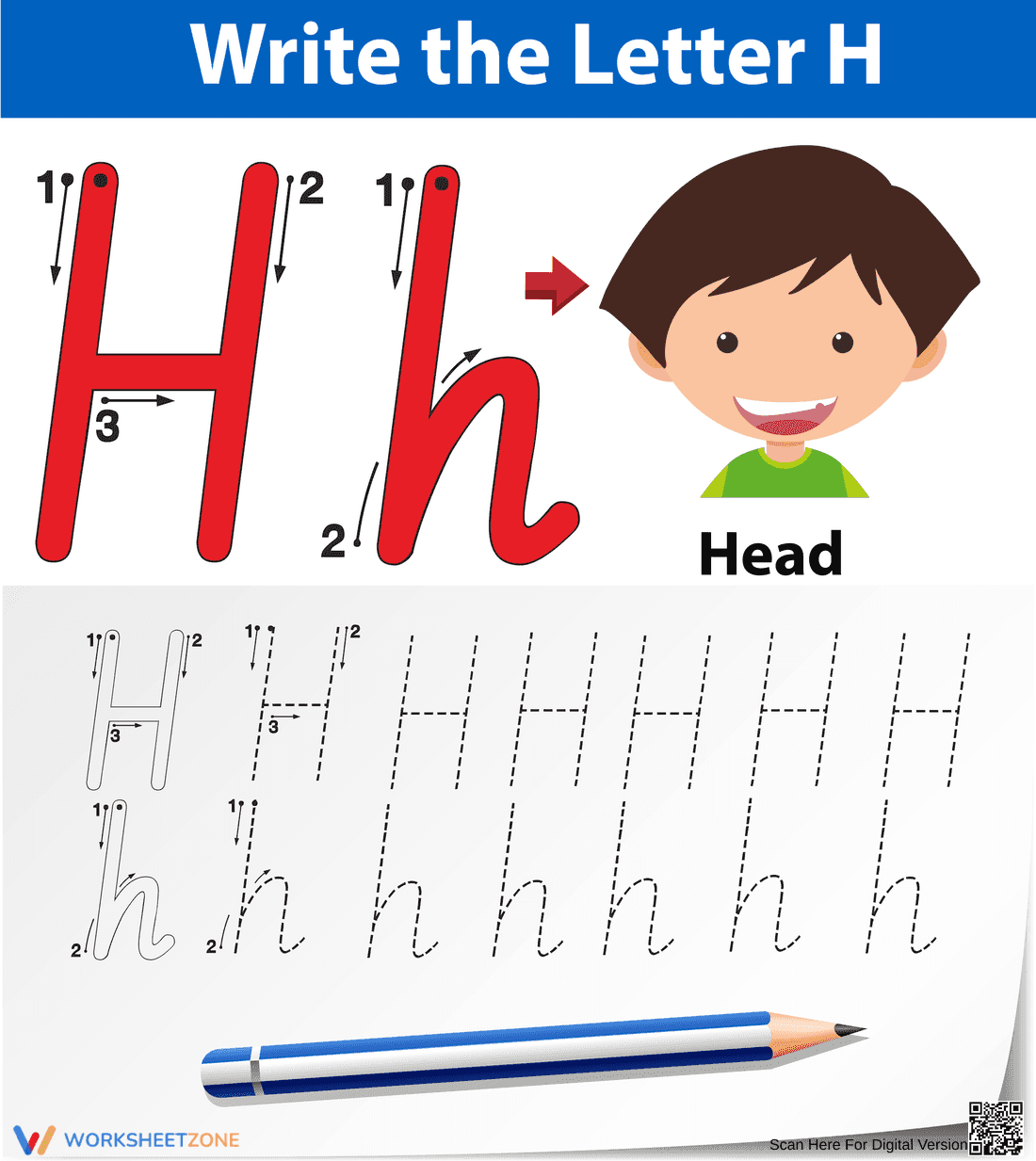
This Letter H tracing worksheet helps early learners master the formation of both uppercase and lowercase letters through guided repetition. Students develop fine motor control and letter recognition by following numbered stroke sequences. This resource ensures young writers build the muscle memory needed for legible handwriting and confident literacy development in early childhood settings.
At a Glance
- Grade: Kindergarten · Subject: Handwriting
- Standard:
CCSS.ELA-LITERACY.L.K.1.A— Print many upper- and lowercase letters with correct stroke order- Skill Focus: Letter H formation
- Format: 1 page · 14 problems · Answer key included · PDF
- Best For: Morning work or literacy centers
- Time: 10–15 minutes
The worksheet features two large, color-coded models of the letter H with numbered arrows to demonstrate proper stroke direction. Below the models, students find two rows of dashed-line letters for tracing: seven uppercase and seven lowercase examples. A visual anchor—a boy pointing to his head—reinforces the phonetic connection between the letter and the "h" sound.
This resource is designed for a three-step classroom workflow. First, print the single-page PDF in under 30 seconds. Second, distribute the sheets to students for immediate use during independent practice or as a quick sub-plan filler. Finally, review student work in less than a minute by checking for proper stroke adherence. Total teacher preparation time is less than 2 minutes.
This activity aligns with CCSS.ELA-LITERACY.L.K.1.A, which requires students to print many upper- and lowercase letters. It specifically targets the mechanical aspect of writing by providing clear visual scaffolds for letter height and width. Both standard codes can be copied directly into lesson plans, IEP goals, or district curriculum mapping tools.
Use this worksheet during the instructional phase of a handwriting lesson after demonstrating the letter on a whiteboard. It serves as an excellent formative assessment tool; observe students as they trace to ensure they are following the numbered arrows rather than drawing the letters from the bottom up. Completion typically takes 10 to 15 minutes.
This practice sheet is ideal for preschool, kindergarten, and first-grade students who are developing foundational graphomotor skills. It is particularly helpful for English Language Learners (ELLs) who benefit from the visual "Head" anchor. Pair this with a letter-sound anchor chart or a tactile sand-tracing activity for a multi-sensory learning experience.
Effective handwriting instruction in early childhood is a critical predictor of later writing success, as noted in the RAND AIRS 2024 report on foundational literacy. This worksheet addresses the CCSS.ELA-LITERACY.L.K.1.A standard by providing structured tracing opportunities that transition students from guided to independent letter formation. By focusing on the specific mechanics of the Letter H, the resource helps students internalize stroke patterns, reducing the cognitive load required for letter production. Research from Fisher & Frey (2014) emphasizes that such scaffolded practice is essential for moving students toward automaticity. This 14-task exercise provides the necessary repetition to build muscle memory without overwhelming young learners. Educators can use this tool to bridge the gap between letter recognition and production, ensuring that students meet developmental milestones for legibility and speed in their early primary years.


