




























Views
Downloads

Letter H Tracing Worksheet | Kindergarten Printable

Paste this activity's link or code into your existing LMS (Google Classroom, Canvas, Teams, Schoology, Moodle, etc.).
Students can open and work on the activity right away, with no student login required.
You'll still be able to track student progress and results from your teacher account.
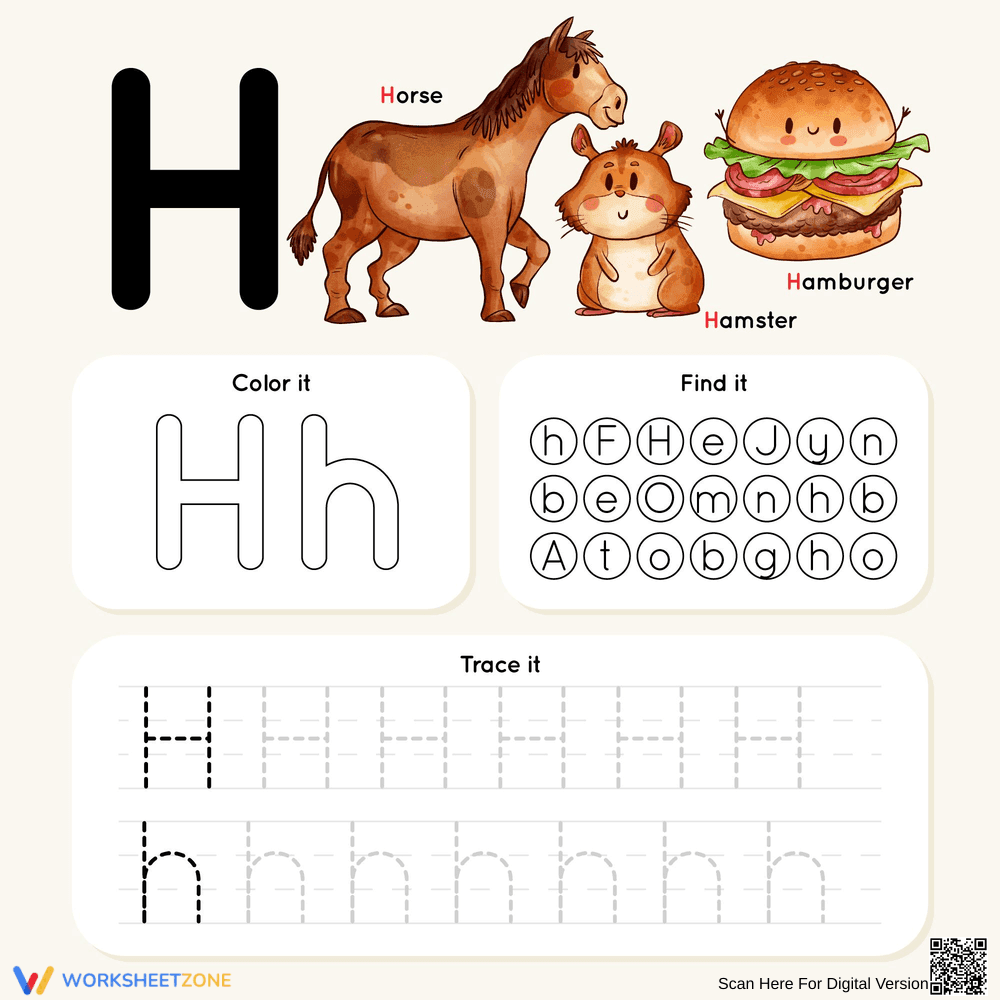
This foundational handwriting worksheet helps early learners master the letter H through targeted, multi-sensory practice. By combining visual identification with fine motor tracing, students build essential alphabet recognition and letter formation skills required for early reading and writing success.
At a Glance
- Grade: Kindergarten · Subject: ELA
- Standard:
CCSS.ELA-LITERACY.L.K.1.A— Print upper- and lowercase letters- Skill Focus: Letter H recognition and tracing
- Format: 1 page · 3 tasks · No answer key · PDF
- Best For: Independent morning work
- Time: 10–15 minutes
This single-page resource features three activity zones. Students begin with a "Color it" section featuring bubble letters. Next, a "Find it" letter hunt challenges children to visually discriminate the target letter among 21 mixed alphabet circles. Finally, the "Trace it" section provides 14 dashed-line opportunities to practice proper stroke order for capital and lowercase forms, accompanied by illustrations of a horse, hamster, and hamburger.
This resource features a streamlined zero-prep workflow:
- Print (1 minute): Simply download the PDF and print the single-page layout. No special cutting, laminating, or assembly is required.
- Distribute (1 minute): Hand out the worksheets along with basic supplies like crayons and pencils. The intuitive layout means students can begin immediately.
- Review (1 minute): The visual nature of the tasks allows teachers to assess completion and accuracy at a quick glance during independent work time.
With prep time under two minutes, this activity is ideal for substitute plans or literacy centers.
This activity is directly aligned to CCSS.ELA-LITERACY.L.K.1.A, requiring students to print many upper- and lowercase letters. It also supports foundational reading skills by helping students recognize and name all upper- and lowercase letters of the alphabet. Both standard codes can be copied directly into lesson plans, IEP goals, or district curriculum mapping tools.
This versatile printable fits perfectly into morning work routines, allowing students to practice independently while the teacher takes attendance. It also serves as an effective transition activity after a whole-group phonics lesson on the /h/ sound. As a formative assessment tip, observe students during the tracing portion to ensure they are starting their pencil strokes from the top down, correcting any bottom-up habits early. Most early learners will complete this worksheet in 10 to 15 minutes.
This worksheet is primarily designed for preschool and kindergarten students who are developing their fine motor control and alphabet knowledge. It provides excellent scaffolding for students who need extra repetition with letter discrimination. For a complete literacy block, pair this printable with an interactive read-aloud focusing on words starting with the letter H or a classroom anchor chart displaying H-words.
Mastering letter formation and recognition through targeted practice is a critical stepping stone in early childhood literacy. According to a comprehensive EdReports 2024 analysis of foundational reading programs, explicit instruction in printing upper- and lowercase letters, as outlined in CCSS.ELA-LITERACY.L.K.1.A, significantly correlates with later reading fluency and spelling accuracy. When students engage in multi-modal tasks—such as coloring, visually discriminating, and physically tracing the letter H—they build stronger neural pathways for orthographic mapping. This specific combination of visual identification and fine motor execution ensures that early learners do not just memorize shapes, but internalize the structural components of the alphabet. Providing consistent, structured opportunities to print upper- and lowercase letters reduces cognitive load during subsequent writing tasks, allowing young writers to focus on expressing their ideas rather than struggling with basic letter formation.


