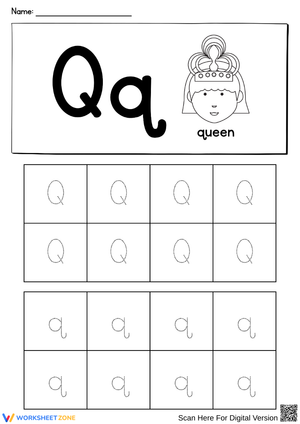
Why Letter Q Deserves Extra Practice Time
Q is one of the lowest-frequency letters in English print, which means your students simply see it far less often than letters like s, t, or a. Fewer natural exposures in books, labels, and classroom print translate to fewer chances to build recognition on their own. That gap is exactly why targeted letter Q worksheets earn their place in a PreK or kindergarten literacy block: they concentrate practice on a letter that everyday reading rarely reinforces.
Alphabet knowledge is not one skill but four: letter recognition, letter-name knowledge, letter-sound knowledge, and letter production through handwriting. A strong letter Q sequence touches all four. When you plan practice around this letter, you are not just filling a worksheet slot. You are closing a predictable weak spot before it slows early decoding.
Teach the /kw/ Sound Before the Written Form
Here is where Q breaks the pattern most young learners expect. Almost every other consonant maps to a single sound, but Q rarely acts alone. It travels with U, and together qu produces the /kw/ sound heard in queen, quick, and quilt. If you introduce Q as a solo letter with its own sound, students end up confused when it never behaves that way in real words.
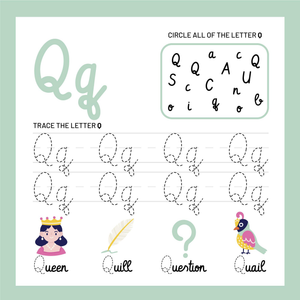
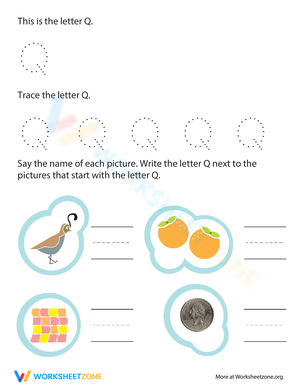
A sound-first routine works better. Say the /kw/ blend aloud, stretch it, and have students echo it while you show picture cards for queen, quilt, and question. Only after the ear is trained do you connect that sound to the printed qu pair. Reading Universe recommends this explicit, direct approach to teaching qu, and it lines up with research showing that scripted, direct instruction outperforms incidental exposure for letters and sounds.
Handwriting Formation: Lowercase q vs. Uppercase Q
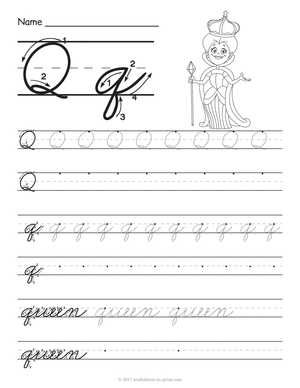
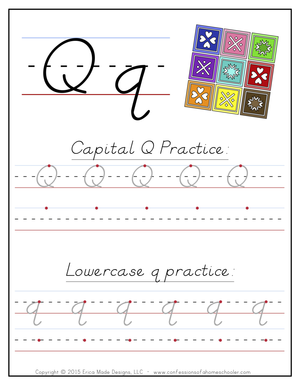
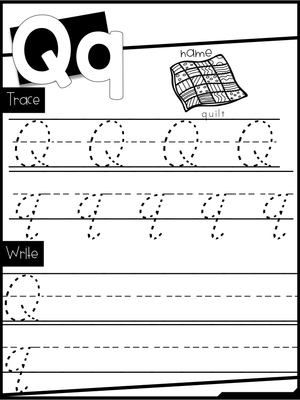
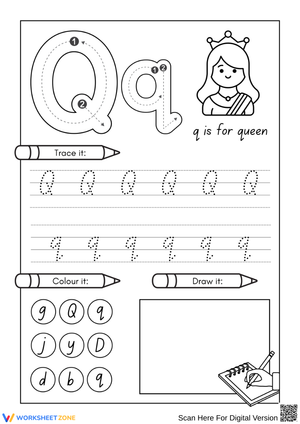
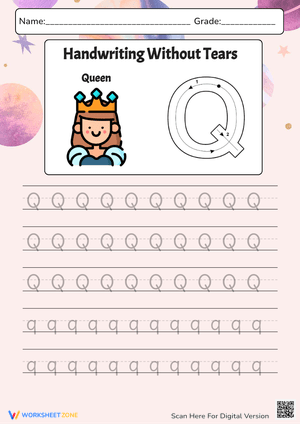
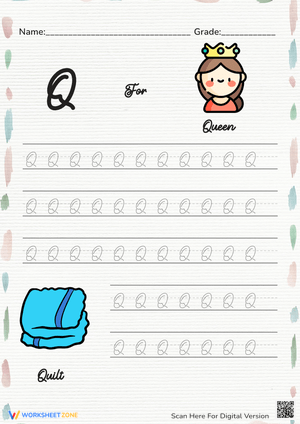
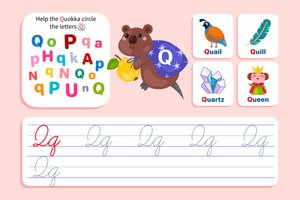
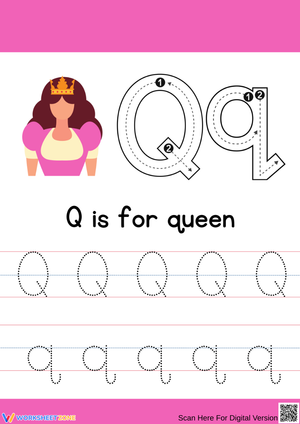
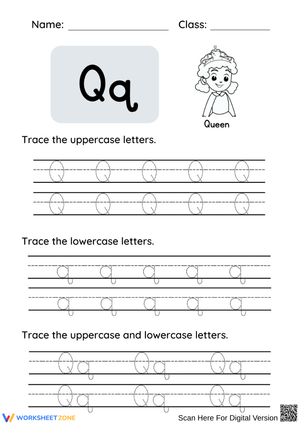
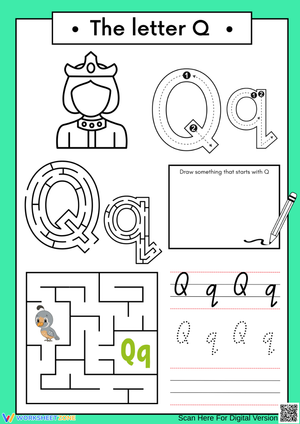
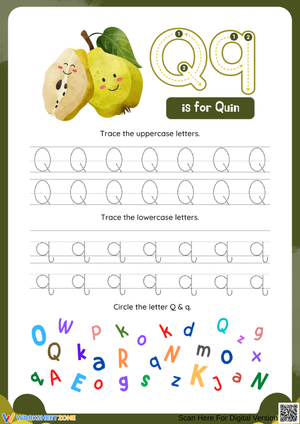
Formation is the second place Q trips students up. Lowercase q has a descender that drops below the baseline, and young writers often confuse it with g and p, or flip it toward b and d. A clear verbal cue helps: start like a c, close the circle, then pull a straight line straight down below the baseline. Naming the stroke out loud while students trace builds the motor memory that silent copying misses.
The most common error I see on letter Q worksheets is not a malformed circle but a missing or curled descender. Students draw the round part cleanly, then add a tail that hooks like a g or stops at the baseline like an a. Build one worksheet column that isolates just the descender stroke, repeated five or six times, before students ever attempt the full letter. Separating the hard motor component from the familiar circle cuts reversal errors far faster than practicing the whole letter over and over.
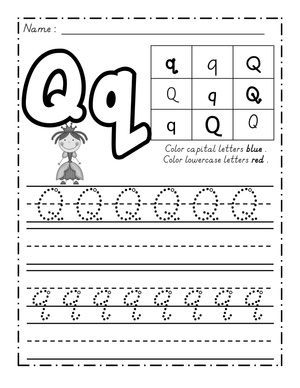
Uppercase Q is lower stakes but worth a quick model. Write a full O, then add the short diagonal tail crossing the lower right of the circle. Pairing the two forms on the same page lets students see how the capital and lowercase relate without blending their strokes together.
Classroom Implementation
Letter Q worksheets slot naturally into a predictable weekly routine. A simple sequence keeps the load low for you and the practice consistent for students:
- Day 1: Introduce the /kw/ sound with picture cards and a whole-group tracing page.
- Day 2: Focus on lowercase q formation, isolating the descender stroke first.
- Day 3: Practice uppercase Q and match capital to lowercase pairs.
- Day 4: Blend qu into simple words like quit and quiz with a sound-boxes page.
- Day 5: Review and assess with a mixed recognition-and-writing worksheet.
Keep each session short. Five to ten focused minutes with a single worksheet beats a long, unfocused packet, especially for the attention spans in a PreK or kindergarten room. Print a small stack ahead of time so the materials are ready for centers, morning work, or a fast small-group pull.
Multisensory Extensions That Reinforce Worksheet Practice
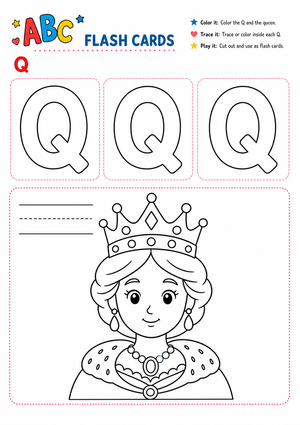
Worksheets anchor the practice, but pairing them with hands-on activities makes the letter stick. Finger-trace a large Q in a tray of sand or salt, then move to the printed page while the motion is fresh. Run a quick classroom scavenger hunt for the /kw/ sound, listening for queen, question, and quiet. Themed crafts around a queen or a quilt give students a reason to say and see qu-words repeatedly.
The Measured Mom offers a full Qq teaching sequence that blends these activities with print practice. The point is not to replace the worksheet but to surround it, so students meet the letter through their ears, hands, and eyes on the same day. That repeated, varied exposure is what a rare letter needs most.
Frequently Asked Questions
1. What sound does the letter Q make and why is it always paired with U?
Q almost never works alone in English. It pairs with U to form the /kw/ blend heard in queen, quick, and quilt. Teach it as qu from the start so students are not surprised when Q never makes a standalone sound in real words.
2. How should teachers introduce the qu sound before handwriting practice?
Start with the ear. Say and stretch the /kw/ sound, have students echo it, and show picture cards for queen, quilt, and question. Once they can hear and produce the blend, connect it to the printed qu pair and then to worksheet tracing.
3. What is the correct stroke order for writing lowercase q versus uppercase Q?
For lowercase q, start like a c, close the circle, then pull a straight line down below the baseline for the descender. For uppercase Q, write a full O, then add a short diagonal tail crossing the lower right of the circle.
4. How many worksheets does a student need to master a low-frequency letter like Q?
There is no fixed number, but plan for more repetition than higher-frequency letters need, since students get far fewer natural exposures to Q in everyday print. Short daily sessions across a full week, then periodic review, usually work better than one long packet.
5. How can letter Q worksheets be used in small-group or intervention settings?
Pull a small group, model the /kw/ sound and the descender stroke, then use one focused page while you watch stroke order and grip. Sort worksheets by the specific component a student is missing, whether that is recognition, sound, or handwriting.