




























Views
Downloads

Letter H Handwriting Worksheet | Grade K-1 Printable

Paste this activity's link or code into your existing LMS (Google Classroom, Canvas, Teams, Schoology, Moodle, etc.).
Students can open and work on the activity right away, with no student login required.
You'll still be able to track student progress and results from your teacher account.
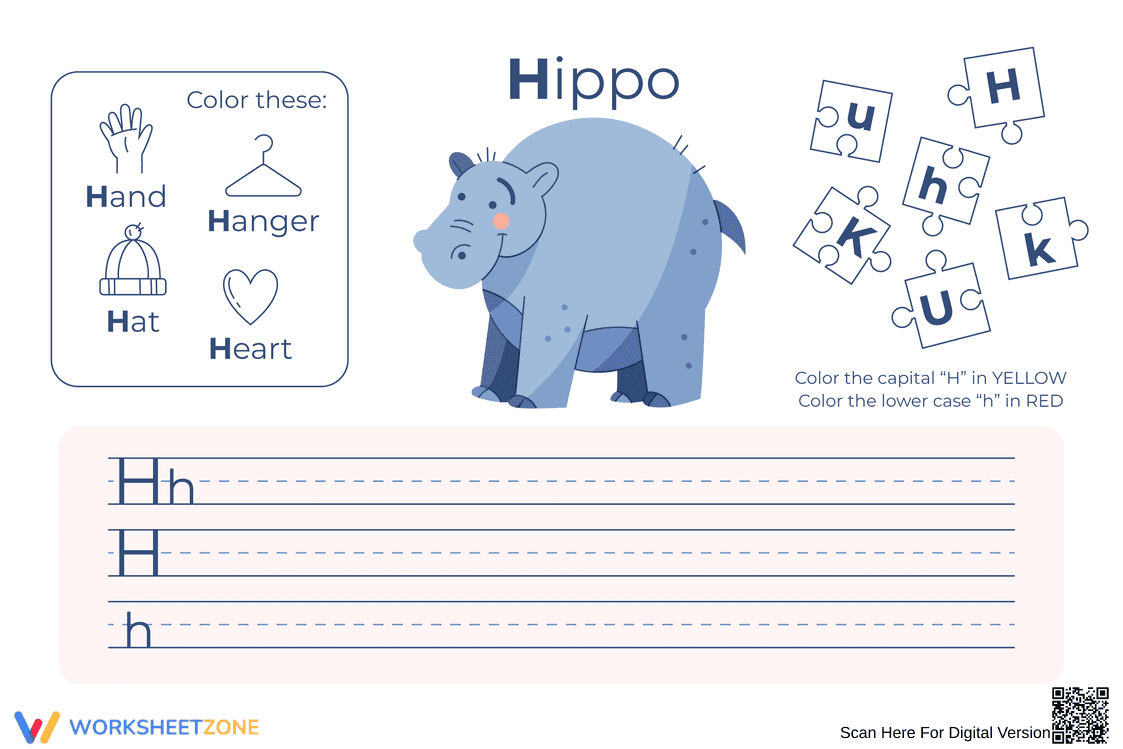
This Kindergarten letter H worksheet provides a comprehensive approach to early literacy by combining fine motor development with alphabet recognition. Students engage in multi-sensory learning as they trace, color, and identify both uppercase and lowercase forms. By connecting the letter H to familiar objects like a hippo and a hat, learners build strong phonemic associations and improve their handwriting neatness.
At a Glance
- Grade: Kindergarten · Subject: Handwriting
- Standard:
CCSS.ELA-LITERACY.L.K.1.A— Print many upper- and lowercase letters with proper form and orientation- Skill Focus: Letter H formation and identification
- Format: 1 page · 14 tasks · No-prep · PDF
- Best For: Independent literacy centers and morning work
- Time: 15–20 minutes
The worksheet features a structured layout designed for young learners. It includes a dedicated tracing section with three primary-ruled lines for practicing uppercase H and lowercase h. Above the writing area, students find a Color these box featuring four H-initial objects: a hand, hanger, hat, and heart. A central hippo illustration serves as a focal point for coloring, while a letter-sorting puzzle on the right challenges students to distinguish H and h from other distractors like u and k.
This resource is designed for a zero-prep classroom environment. Teachers can print the single-page PDF in less than 30 seconds. Distribution takes approximately 1 minute during transition periods. Reviewing student work is efficient; teachers can quickly scan the coloring puzzle to ensure correct letter identification and check the tracing lines for proper stroke order. Total teacher preparation time is under 2 minutes, making it an ideal choice for emergency sub plans or unexpected schedule gaps.
This resource aligns with CCSS.ELA-LITERACY.L.K.1.A, which requires students to print many upper- and lowercase letters. It also supports phonological awareness by linking the letter shape to its corresponding sound through visual cues. This standard code can be copied directly into lesson plans, IEP goals, or district curriculum mapping tools to ensure instructional compliance and track student progress toward mastery.
Use this worksheet during the independent practice phase of a lesson after demonstrating the vertical and horizontal strokes of the letter H. It works exceptionally well as a formative assessment tool; observe students as they color the puzzle pieces to identify those who may need additional support with letter discrimination. Completion typically takes 15 to 20 minutes depending on the student's fine motor speed and coloring detail.
This activity is tailored for Kindergarten and Grade 1 students who are developing pencil control and letter-sound correspondence. It provides necessary scaffolding for students with fine motor delays through the use of large tracing paths and clear visual boundaries. Pair this worksheet with a letter H anchor chart or a read-aloud featuring a hippo character to reinforce the learning objectives across different instructional modes.
According to the RAND AIRS 2024 report on early childhood literacy, integrated handwriting and phonics instruction significantly improves letter recognition speed in emergent readers. This worksheet applies these findings by requiring students to perform the physical act of printing CCSS.ELA-LITERACY.L.K.1.A while simultaneously engaging in visual discrimination tasks. Research indicates that multi-sensory activities—such as coloring and tracing—help solidify the neural pathways responsible for orthographic mapping. By providing a clear path from guided tracing to independent identification, this resource ensures that students move beyond rote memorization toward functional literacy. The inclusion of high-frequency vocabulary words like hand and heart further supports vocabulary acquisition alongside handwriting goals. Educators can rely on this structured approach to meet foundational standards while maintaining high student engagement through varied task types.


