


























Views
Downloads
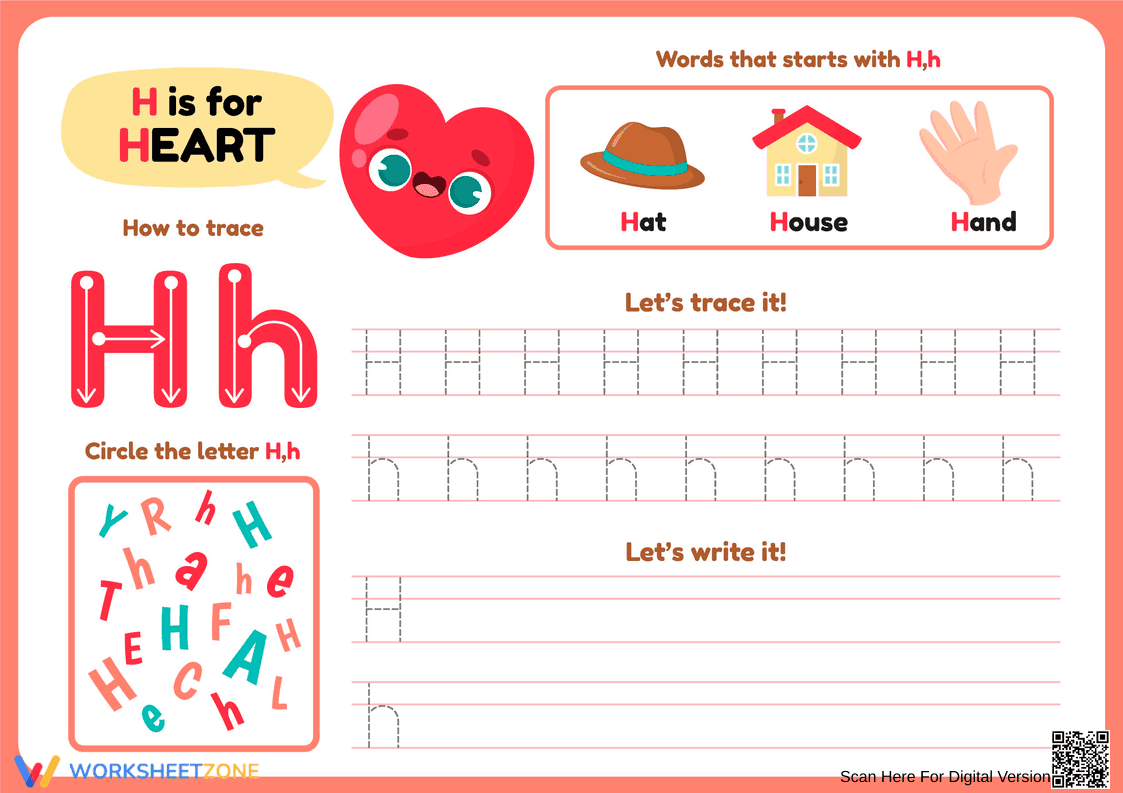

Letter H Handwriting Guide | Grade 1 Essential Worksheet
Paste this activity's link or code into your existing LMS (Google Classroom, Canvas, Teams, Schoology, Moodle, etc.).
Students can open and work on the activity right away, with no student login required.
You'll still be able to track student progress and results from your teacher account.
This Grade 1 handwriting worksheet provides a comprehensive approach to mastering the letter H. Students engage in letter formation through guided tracing and independent writing while building phonemic awareness with visual cues. By combining motor skill development with letter recognition, this resource ensures students build a solid foundation for early literacy and neat penmanship.
At a Glance
- Grade: 1 · Subject: Handwriting
- Standard:
CCSS.ELA-LITERACY.L.1.1.A— Print all upper- and lowercase letters correctly and legibly- Skill Focus: Letter H formation and identification
- Format: 1 page · 4 tasks · Answer key included · PDF
- Best For: Morning work or literacy centers
- Time: 10–15 minutes
Inside this single-page PDF, you will find a structured layout designed for young learners. It includes a large directional tracing guide for both uppercase and lowercase letters, two dedicated rows for tracing practice, and two rows for independent writing. Additionally, a letter-hunt box challenges students to identify the letter among distractors, while illustrated vocabulary words like Hat and House reinforce initial sounds.
This resource is designed for a zero-prep workflow. First, print the single-page PDF in under 30 seconds. Next, distribute the sheets to your students during your literacy block or as a transition activity. Finally, review the letter identification box and handwriting lines for immediate formative feedback. Total teacher preparation time is under two minutes, making it an ideal sub plan.
This worksheet aligns with `CCSS.ELA-LITERACY.L.1.1.A`, which requires students to print all upper- and lowercase letters. It also supports phonological awareness by connecting the letter shape to its corresponding sound in common words. Both standard codes can be copied directly into lesson plans, IEP goals, or district curriculum mapping tools.
Use this worksheet during the independent practice phase of a gradual release lesson on the alphabet. It works exceptionally well as a quiet morning activity or a focused station in a literacy center. Teachers should observe student grip and stroke direction during the tracing phase to provide real-time corrections. Expect completion within 10 to 15 minutes.
This resource is perfect for first-grade students or kindergarteners ready for advanced letter practice. It provides necessary scaffolding for students struggling with fine motor control through the use of dashed lines. Pair this worksheet with a letter H anchor chart or a phonics passage to create a cohesive learning experience.
Research from Fisher & Frey (2014) emphasizes the importance of the gradual release of responsibility, moving from guided tracing to independent production. This worksheet facilitates that transition by providing 20 tracing opportunities before requiring independent writing. According to the RAND AIRS 2024 report, consistent handwriting practice in early grades is directly correlated with improved word recognition and reading fluency. By integrating visual identification tasks with motor practice, this resource addresses multiple cognitive pathways. The inclusion of the CCSS.ELA-LITERACY.L.1.1.A standard ensures that the practice is not just busy work but a targeted step toward meeting national literacy benchmarks. Educators can use the 4 distinct tasks to gauge student readiness for more complex writing assignments. This evidence-based design supports the development of automaticity in letter formation, which is a critical precursor to expressive writing and overall academic success in the primary classroom.


