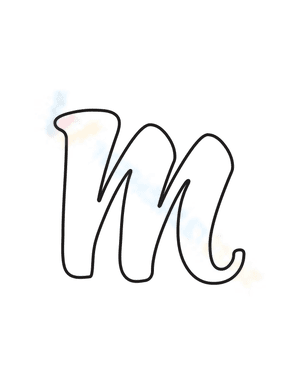
M is a letter of repetition: two humps in lowercase, two diagonals in the capital, and the main skill is making the halves match. These free printable letter M worksheets cover both forms for preschool and kindergarten.
Writing capital M and lowercase m
Capital M is four strokes. A tall line down the left. Back to the top, then a diagonal down to the middle of the writing space. A second diagonal back up to the top right. Then a line straight down to the baseline. The point in the middle is the tricky part: many children stop the valley halfway down, which flattens the letter, or run it below the line.
Lowercase m is a line with two humps. Draw the short vertical line, retrace up it, push out into a first hump that lands on the baseline, retrace up the second leg, and make a matching hump. Both humps should be the same width and the same height, and all three legs should land on the line.
M, n and u in one family
Lowercase m, n and u are close relatives, and teaching them as a group is more efficient than teaching them separately. N is one hump, m is two. U is the same hump turned upside down, which is why children sometimes write u where an n belongs. Counting the humps aloud while writing gives the hand a simple rule to follow.
If humps come out uneven, slow the retrace down. The second leg of an m is drawn over the first hump, and children who rush it start the second hump from the wrong place. The letter M tracing worksheets keep the hump positions marked while the movement becomes automatic.
M sounds and words
M is one of the best sounds to teach early. The lips stay closed and the sound can be held for as long as you have breath, so a child can hum it and feel the vibration. That makes it ideal for stretching out the beginning of a word: mmmmoon.
Useful M words: moon, map, mouse, milk, man, mat, mop, mum, monkey. M is also common at the end of words, in ham, him and swim. Many children learn m very early because it begins a word they use constantly. The beginning sounds worksheets give more practice hearing it at the start of a word.
Using these letter M worksheets
Capital M suits a child who can already manage diagonals; if they cannot, teach lowercase m first, since humps are easier than slants. For either form, watch the width. An m squeezed too narrow becomes unreadable, and one drawn too wide runs into the next letter. The alphabet worksheets set has a page for every letter, and letter N is the natural page to visit next.
Frequently Asked Questions
1. How many strokes does capital M take?
Four in most handwriting styles: down, diagonal down, diagonal up, down. Some programmes teach it as a single continuous zigzag, which is faster but harder to keep even for a beginner.
2. Why are my child's two humps different sizes?
Usually because the second hump starts before the pencil has retraced fully up the first leg. Slow that retrace down, and count one, two aloud as each hump is formed.
3. Which M words are best for a preschooler?
Short words with the sound held at the front: moon, map, milk, mat, mop. Monkey and mouse are popular and easy to picture, which helps the letter stick.
4. Is capital M or lowercase m easier to write?
Lowercase m is usually easier, because humps are a gentler movement than the sharp diagonals of the capital. Children who are still working on slanted strokes often produce a neat lowercase m weeks before the capital looks tidy.
5. My child's m runs into the next letter. What helps?
Width is the issue rather than shape. An m takes up roughly twice the space of an n, and children who do not plan for that end up cramped at the edge of the line. Practising m inside a drawn box, or on paper with wider spacing, trains the hand to allow room for both humps.