


























Views
Downloads

Printable Letter H Tracing Worksheet | Kindergarten ELA
Paste this activity's link or code into your existing LMS (Google Classroom, Canvas, Teams, Schoology, Moodle, etc.).
Students can open and work on the activity right away, with no student login required.
You'll still be able to track student progress and results from your teacher account.
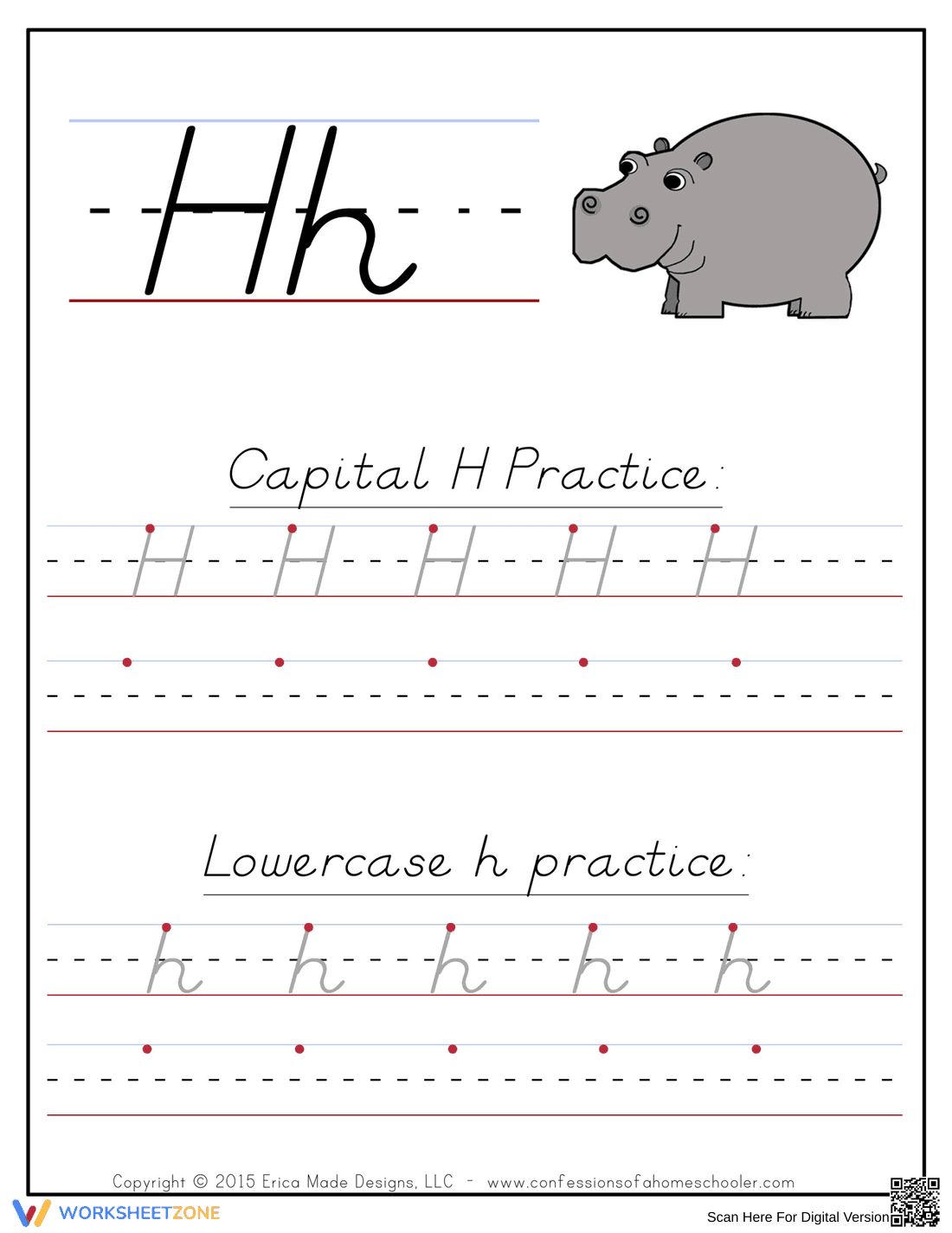
This single-page handwriting worksheet helps early learners master the formation of the letter H in the D'Nealian style. By practicing both uppercase and lowercase strokes, students develop fine motor control and letter recognition skills essential for fluent writing. The clear visual guides ensure proper starting points and stroke direction.
At a Glance
- Grade: Kindergarten · Subject: English Language Arts
- Standard:
CCSS.ELA-LITERACY.L.K.1.A— Print many upper- and lowercase letters independently.- Skill Focus: Letter H formation and tracing
- Format: 1 page · 20 problems · No answer key needed · PDF
- Best For: Morning work or literacy centers
- Time: 10–15 minutes
Inside this resource, educators will find a straightforward, single-page practice sheet featuring a friendly hippopotamus illustration to reinforce the /h/ sound. The page is divided into two main sections: Capital H Practice and Lowercase h practice. Each section provides dashed letters with directional starting dots for guided tracing, followed by a row of starting dots for independent letter formation. With 20 total letter formations, students get ample repetition without experiencing writing fatigue.
Zero-Prep Workflow
This resource is designed for immediate classroom implementation.
- Print (1 minute): Download the PDF and print copies. The design is ink-friendly.
- Distribute (1 minute): Hand out the worksheets. Visual cues make the task obvious.
- Review (1 minute): Scan student work to ensure correct stroke paths.
With total prep under two minutes, this is perfect for sub plans.
Standards Alignment
This handwriting practice aligns directly with CCSS.ELA-LITERACY.L.K.1.A, requiring students to print many upper- and lowercase letters. By providing both tracing models and independent starting points, the worksheet scaffolds the transition from guided to independent letter formation. Both standard codes can be copied directly into lesson plans, IEP goals, or district curriculum mapping tools.
How to Use It
This worksheet serves as an ideal morning work activity as students settle into the classroom. It can also be placed in a literacy center inside a dry-erase sleeve for repeated practice with whiteboard markers. While students are working, teachers should observe their pencil grip and ensure they are initiating strokes from the top down, rather than from the bottom up. Most kindergarteners will complete this task within a 10 to 15-minute timeframe.
Who It's For
This resource is primarily designed for kindergarten and preschool students who are developing their foundational handwriting skills. It is particularly beneficial for students who need explicit visual cues, such as the red starting dots, to guide their spatial awareness on the page. For a comprehensive phonics lesson, pair this tracing sheet with a read-aloud book that heavily features the letter H, or an anchor chart displaying H-words.
Developing automaticity in letter formation is a critical precursor to expressive writing and reading fluency in early education. According to Fisher & Frey (2014), explicit instruction in handwriting, combined with guided repetition, significantly reduces the cognitive load required for transcription, allowing young learners to focus on content generation later in their academic careers. This worksheet directly supports CCSS.ELA-LITERACY.L.K.1.A by helping students print many upper- and lowercase letters accurately and independently. The inclusion of starting dots and dashed lines provides the exact scaffolding necessary to build muscle memory for the D'Nealian letter H. By isolating this specific motor skill, educators can ensure that students build a strong foundation for future literacy success. Consistent, targeted practice with resources like this one is essential for moving students from conscious stroke formation to automatic letter production.


