




























Views
Downloads



Percent Composition Worksheet | Essential Chemistry Practice

Paste this activity's link or code into your existing LMS (Google Classroom, Canvas, Teams, Schoology, Moodle, etc.).
Students can open and work on the activity right away, with no student login required.
You'll still be able to track student progress and results from your teacher account.
This high school chemistry worksheet provides comprehensive practice for calculating percent composition by mass. Students will master the relationship between atomic mass and molecular composition through 22 rigorous problems. By determining the mass percentage of each element within various compounds, learners develop the quantitative skills necessary for stoichiometry and chemical analysis.
At a Glance
- Grade: 9–12 · Subject: Chemistry
- Standard:
HS-PS1-7— Use mathematical representations to support the claim that atoms and mass are conserved- Skill Focus: Percent Composition by Mass
- Format: 4 pages · 22 problems · Answer key included · PDF
- Best For: Independent practice and lab prep
- Time: 45–60 minutes
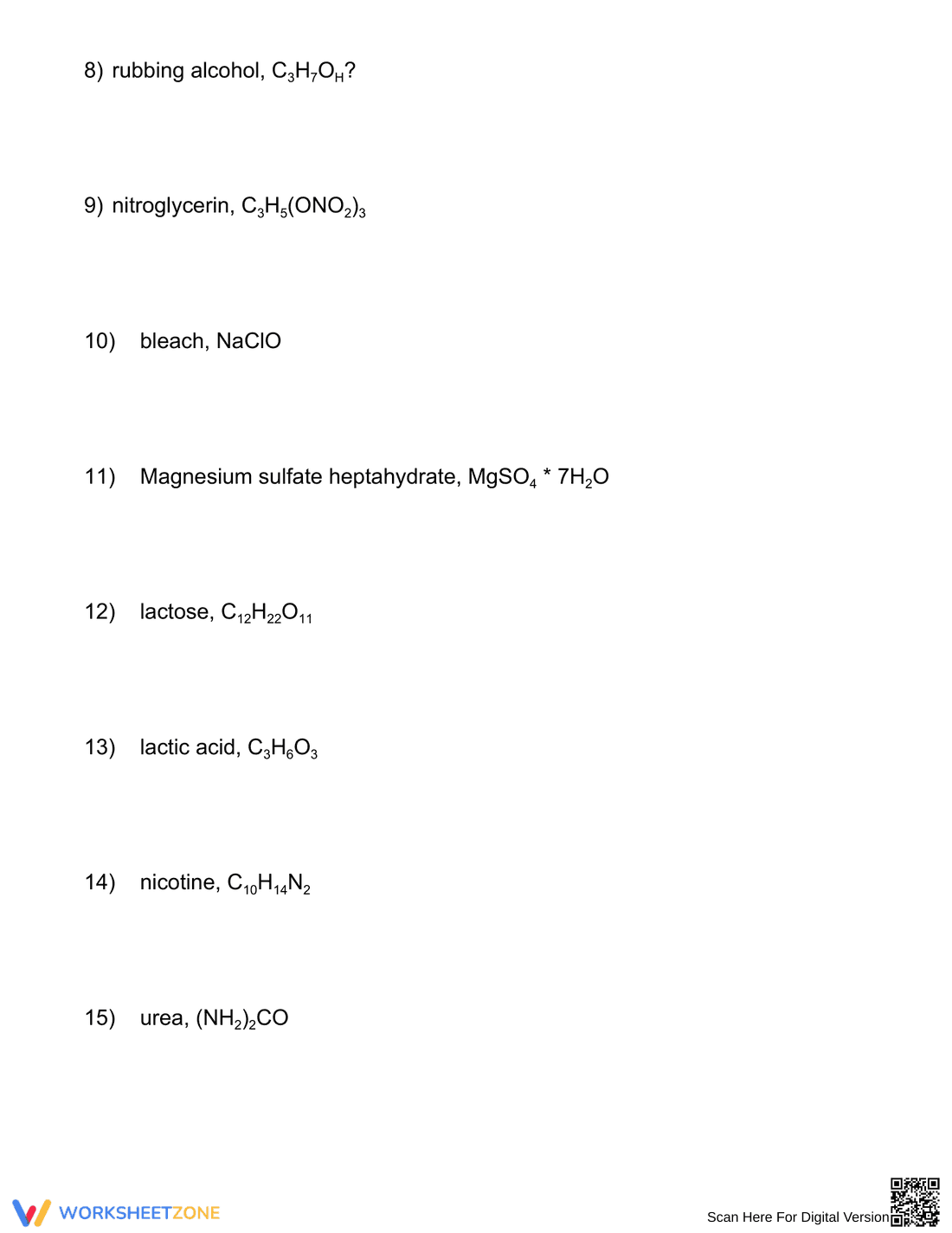
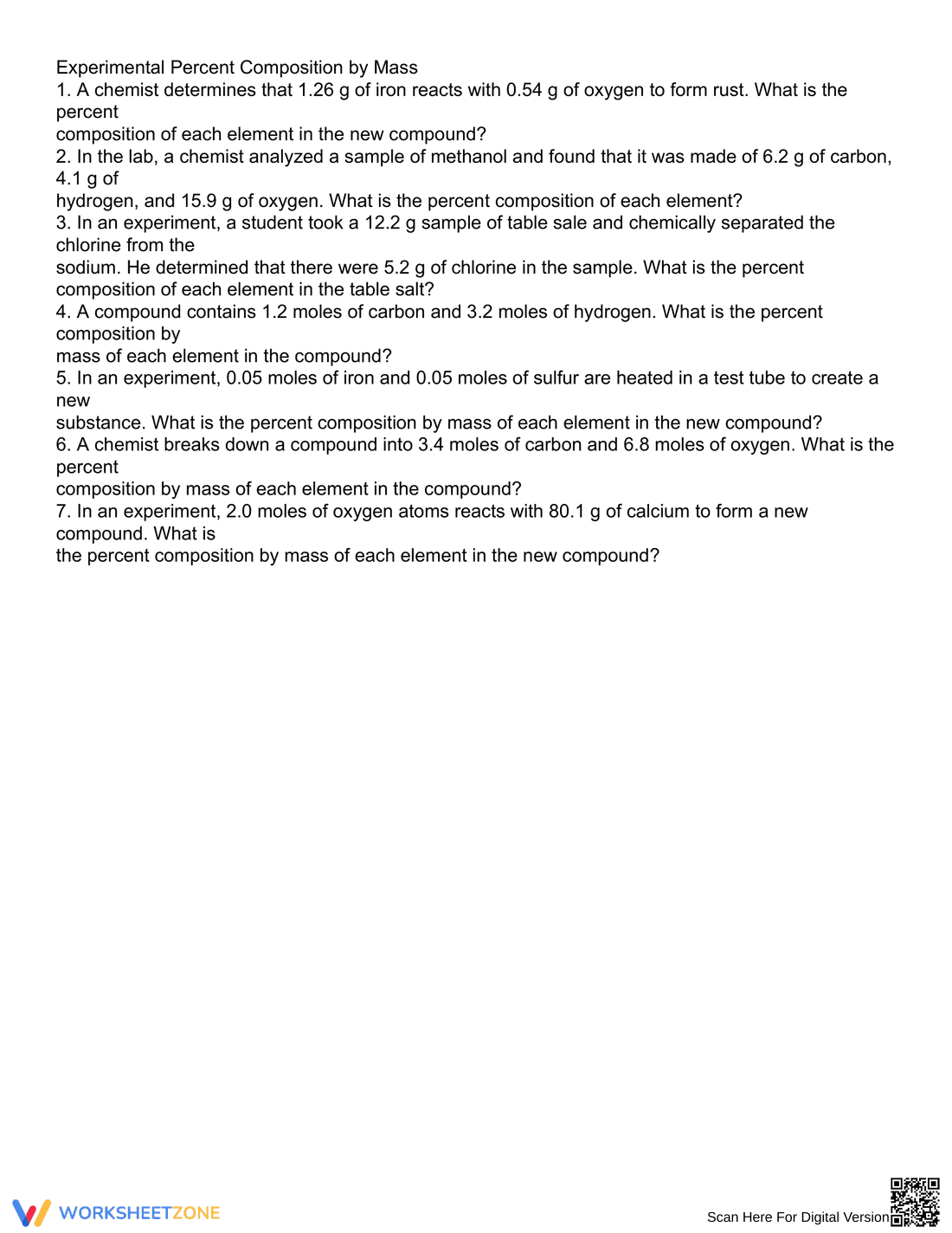
The resource contains four pages of structured chemistry tasks. The first two pages present 15 chemical formulas, ranging from simple oxides like carbon dioxide to complex hydrates and organic molecules like aspirin and nicotine. The final page introduces 7 experimental scenarios where students must calculate percent composition from raw laboratory data, including mass-to-mass and mole-to-mass conversions. A complete answer key is provided for rapid grading.
- Guided Practice: The first 5 problems use familiar compounds with clear formulas to establish the basic calculation routine and molar mass summation.
- Supported Practice: Problems 6 through 15 introduce polyatomic ions, hydrates, and larger organic molecules requiring more complex significant figure management.
- Independent Practice: The experimental section challenges students to apply their knowledge to word problems and laboratory data without pre-defined formulas.
This sequence follows a gradual-release model, moving from formula-based computation to real-world experimental analysis.
This worksheet is specifically designed to meet `HS-PS1-7`. This standard requires students to use mathematical representations to support the claim that atoms, and therefore mass, are conserved during a chemical reaction. By calculating the fixed ratios of elements within a compound, students demonstrate an understanding of the Law of Definite Proportions. Both standard codes can be copied directly into lesson plans, IEP goals, or district curriculum mapping tools.
Assign this worksheet during the stoichiometry unit after students have mastered molar mass calculations but before introducing empirical formulas. It serves as an excellent bridge between basic atomic theory and advanced chemical quantitative analysis. For formative assessment, observe students as they handle the hydrate problems to ensure they are correctly accounting for the mass of water molecules. Completion typically takes 45 to 60 minutes.
This resource is ideal for general chemistry students in grades 9 through 12, as well as Honors or AP Chemistry students needing a quick refresher. It provides necessary scaffolding for learners who struggle with multi-step math problems while offering enough complexity for advanced students. Pair this worksheet with a periodic table and a lesson on the Law of Conservation of Mass for a complete instructional block.
According to the Fisher & Frey (2014) framework for purposeful literacy in the sciences, quantitative literacy is a prerequisite for higher-order chemical reasoning. This worksheet addresses that need by providing 22 distinct opportunities for students to practice the mathematical representation of matter, directly aligning with the HS-PS1-7 standard. Research from EdReports (2024) emphasizes that high-quality science materials must integrate mathematical thinking with core disciplinary ideas. By requiring students to show all work and use correct significant figures, this resource reinforces the precision required in professional laboratory settings. The inclusion of experimental data problems ensures that students are not merely performing rote calculation but are instead interpreting data in a way that mirrors actual scientific inquiry. This dual approach—formulaic and experimental—supports a deeper mastery of percent composition and prepares students for more complex stoichiometric challenges in future chemistry coursework.


