


























0
Views
0
Downloads

0.0
0
Save
0 Likes
Share
Everyday Neutralization Worksheet
0 Views
0 Downloads
Paste this activity's link or code into your existing LMS (Google Classroom, Canvas, Teams, Schoology, Moodle, etc.).
Students can open and work on the activity right away, with no student login required.
You'll still be able to track student progress and results from your teacher account.
Information
Description
What It Is:
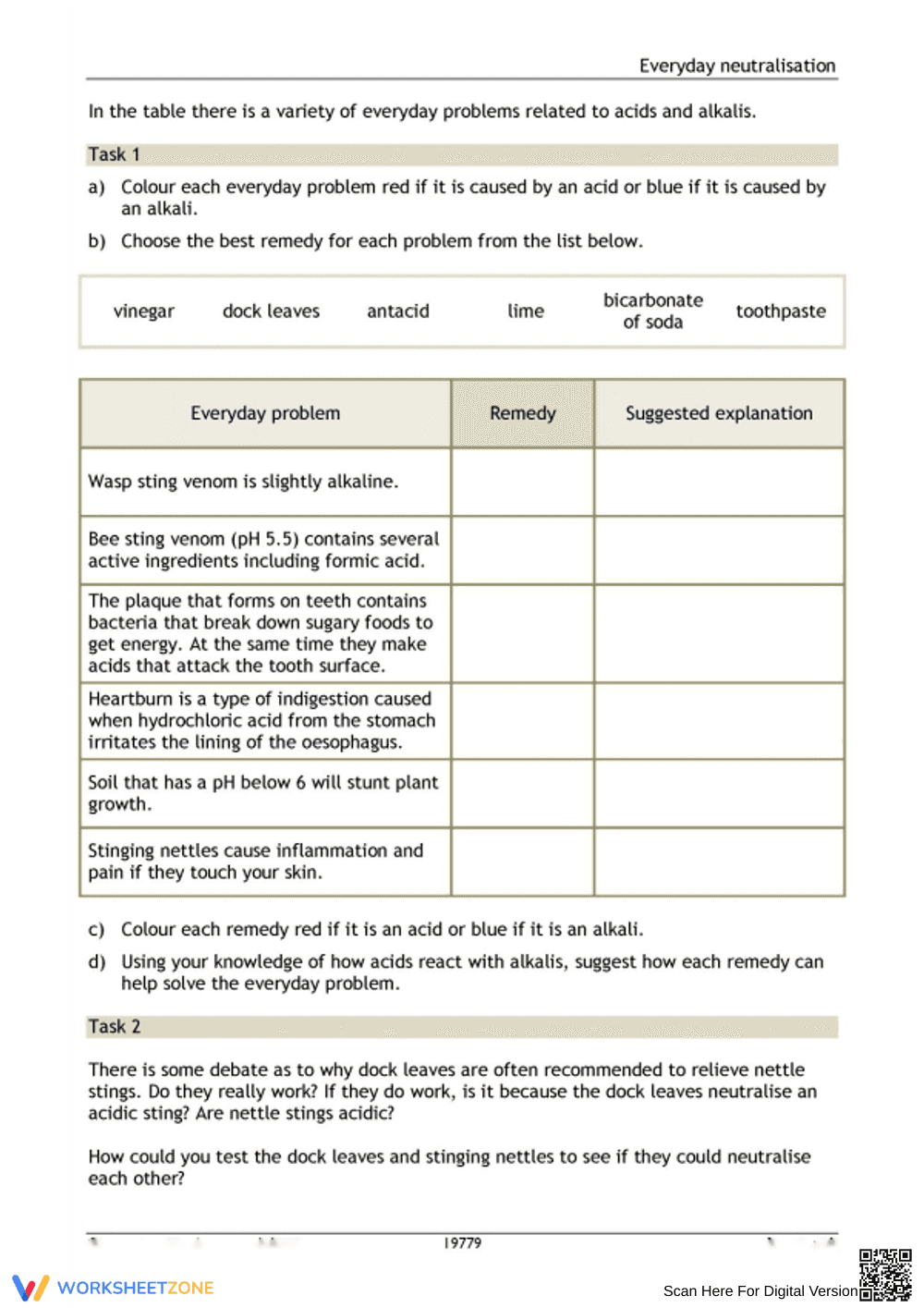
This is an educational worksheet focusing on everyday neutralization reactions, specifically related to acids and alkalis. Task 1 involves identifying whether everyday problems are caused by acids or alkalis, choosing appropriate remedies from a provided list (vinegar, dock leaves, antacid, lime, bicarbonate of soda, toothpaste), and explaining how the remedies work. Task 2 poses a question about the effectiveness of dock leaves for nettle stings and asks how to test if they neutralize each other. The worksheet contains a table to fill in, with columns for 'Everyday problem,' 'Remedy,' and 'Suggested explanation.'
Grade Level Suitability:
This worksheet is suitable for middle school (grades 6-8) and early high school (grade 9) students. It requires understanding of basic chemistry concepts like acids, alkalis, pH, and neutralization, as well as the ability to apply this knowledge to real-world situations.
Why Use It:
This worksheet reinforces the concepts of acids and alkalis by connecting them to everyday problems. It encourages critical thinking by requiring students to analyze the cause of each problem and select an appropriate remedy. It also promotes scientific reasoning by prompting students to explain the neutralization process.
How to Use It:
Students should first read the description of each 'Everyday problem' and determine if it is caused by an acid or an alkali, coloring it red or blue accordingly. Then, they should choose the best 'Remedy' from the provided list and write it in the table. Finally, they should use their knowledge of acids and alkalis to provide a 'Suggested explanation' of how the remedy works. For Task 2, students need to consider the information provided about dock leaves and nettle stings, and then formulate a test to see if dock leaves neutralize stinging nettles.
Target Users:
The target users are middle and high school students learning about acids, alkalis, and neutralization reactions in a science or chemistry class. It is also beneficial for students who want to understand the scientific principles behind common remedies for everyday problems.
This is an educational worksheet focusing on everyday neutralization reactions, specifically related to acids and alkalis. Task 1 involves identifying whether everyday problems are caused by acids or alkalis, choosing appropriate remedies from a provided list (vinegar, dock leaves, antacid, lime, bicarbonate of soda, toothpaste), and explaining how the remedies work. Task 2 poses a question about the effectiveness of dock leaves for nettle stings and asks how to test if they neutralize each other. The worksheet contains a table to fill in, with columns for 'Everyday problem,' 'Remedy,' and 'Suggested explanation.'
Grade Level Suitability:
This worksheet is suitable for middle school (grades 6-8) and early high school (grade 9) students. It requires understanding of basic chemistry concepts like acids, alkalis, pH, and neutralization, as well as the ability to apply this knowledge to real-world situations.
Why Use It:
This worksheet reinforces the concepts of acids and alkalis by connecting them to everyday problems. It encourages critical thinking by requiring students to analyze the cause of each problem and select an appropriate remedy. It also promotes scientific reasoning by prompting students to explain the neutralization process.
How to Use It:
Students should first read the description of each 'Everyday problem' and determine if it is caused by an acid or an alkali, coloring it red or blue accordingly. Then, they should choose the best 'Remedy' from the provided list and write it in the table. Finally, they should use their knowledge of acids and alkalis to provide a 'Suggested explanation' of how the remedy works. For Task 2, students need to consider the information provided about dock leaves and nettle stings, and then formulate a test to see if dock leaves neutralize stinging nettles.
Target Users:
The target users are middle and high school students learning about acids, alkalis, and neutralization reactions in a science or chemistry class. It is also beneficial for students who want to understand the scientific principles behind common remedies for everyday problems.


