


























1 / 4
0
Views
0
Downloads


Save
0 Likes
Share
Ionic & Covalent Compounds Worksheet
0 Views
0 Downloads
Paste this activity's link or code into your existing LMS (Google Classroom, Canvas, Teams, Schoology, Moodle, etc.).
Students can open and work on the activity right away, with no student login required.
You'll still be able to track student progress and results from your teacher account.
Information
Description
What It Is:
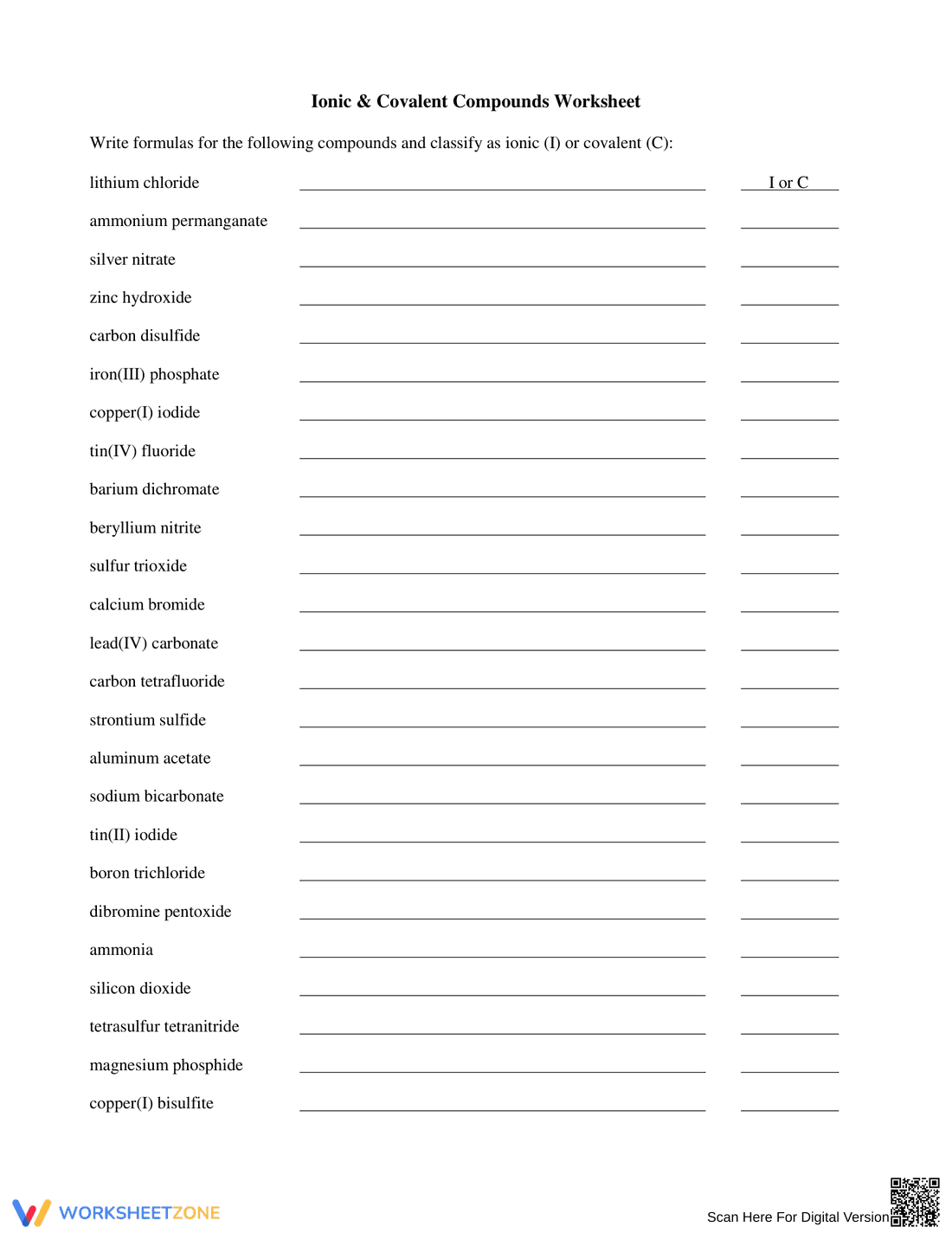
This is a chemistry worksheet focused on ionic and covalent compounds. Students are tasked with writing the chemical formulas for a list of compounds, such as lithium chloride, ammonium permanganate, zinc hydroxide, carbon disulfide, iron(III) phosphate, copper(II) iodide, tin(IV) fluoride, barium dichromate, beryllium nitride, sulfur trioxide, calcium bromide, lead(IV) carbonate, carbon tetrafluoride, strontium sulfide, aluminum acetate, sodium bicarbonate, tin(II) iodide, boron trichloride, dibromine pentoxide, ammonia, silicon dioxide, tetrasulfur tetranitride, magnesium phosphide, and copper(I) bisulfite. After writing the formulas, students must classify each compound as either ionic (I) or covalent (C).
Grade Level Suitability:
This worksheet is suitable for high school students, specifically grades 9-12, studying chemistry. It requires an understanding of chemical nomenclature, polyatomic ions, and the differences between ionic and covalent bonding.
Why Use It:
This worksheet reinforces the ability to translate chemical names into formulas and to distinguish between ionic and covalent compounds. It helps students practice applying rules for naming and writing formulas, solidifying their understanding of chemical bonding principles.
How to Use It:
Students should use their knowledge of chemical nomenclature and bonding to write the chemical formula for each compound listed. Then, based on the elements involved and the type of bonding, they should classify each compound as either ionic (I) or covalent (C) in the provided space.
Target Users:
The target users are high school chemistry students learning about chemical nomenclature, formula writing, and the differences between ionic and covalent compounds. It's also useful for teachers looking for practice worksheets to reinforce these concepts.
This is a chemistry worksheet focused on ionic and covalent compounds. Students are tasked with writing the chemical formulas for a list of compounds, such as lithium chloride, ammonium permanganate, zinc hydroxide, carbon disulfide, iron(III) phosphate, copper(II) iodide, tin(IV) fluoride, barium dichromate, beryllium nitride, sulfur trioxide, calcium bromide, lead(IV) carbonate, carbon tetrafluoride, strontium sulfide, aluminum acetate, sodium bicarbonate, tin(II) iodide, boron trichloride, dibromine pentoxide, ammonia, silicon dioxide, tetrasulfur tetranitride, magnesium phosphide, and copper(I) bisulfite. After writing the formulas, students must classify each compound as either ionic (I) or covalent (C).
Grade Level Suitability:
This worksheet is suitable for high school students, specifically grades 9-12, studying chemistry. It requires an understanding of chemical nomenclature, polyatomic ions, and the differences between ionic and covalent bonding.
Why Use It:
This worksheet reinforces the ability to translate chemical names into formulas and to distinguish between ionic and covalent compounds. It helps students practice applying rules for naming and writing formulas, solidifying their understanding of chemical bonding principles.
How to Use It:
Students should use their knowledge of chemical nomenclature and bonding to write the chemical formula for each compound listed. Then, based on the elements involved and the type of bonding, they should classify each compound as either ionic (I) or covalent (C) in the provided space.
Target Users:
The target users are high school chemistry students learning about chemical nomenclature, formula writing, and the differences between ionic and covalent compounds. It's also useful for teachers looking for practice worksheets to reinforce these concepts.


