


























Views
Downloads

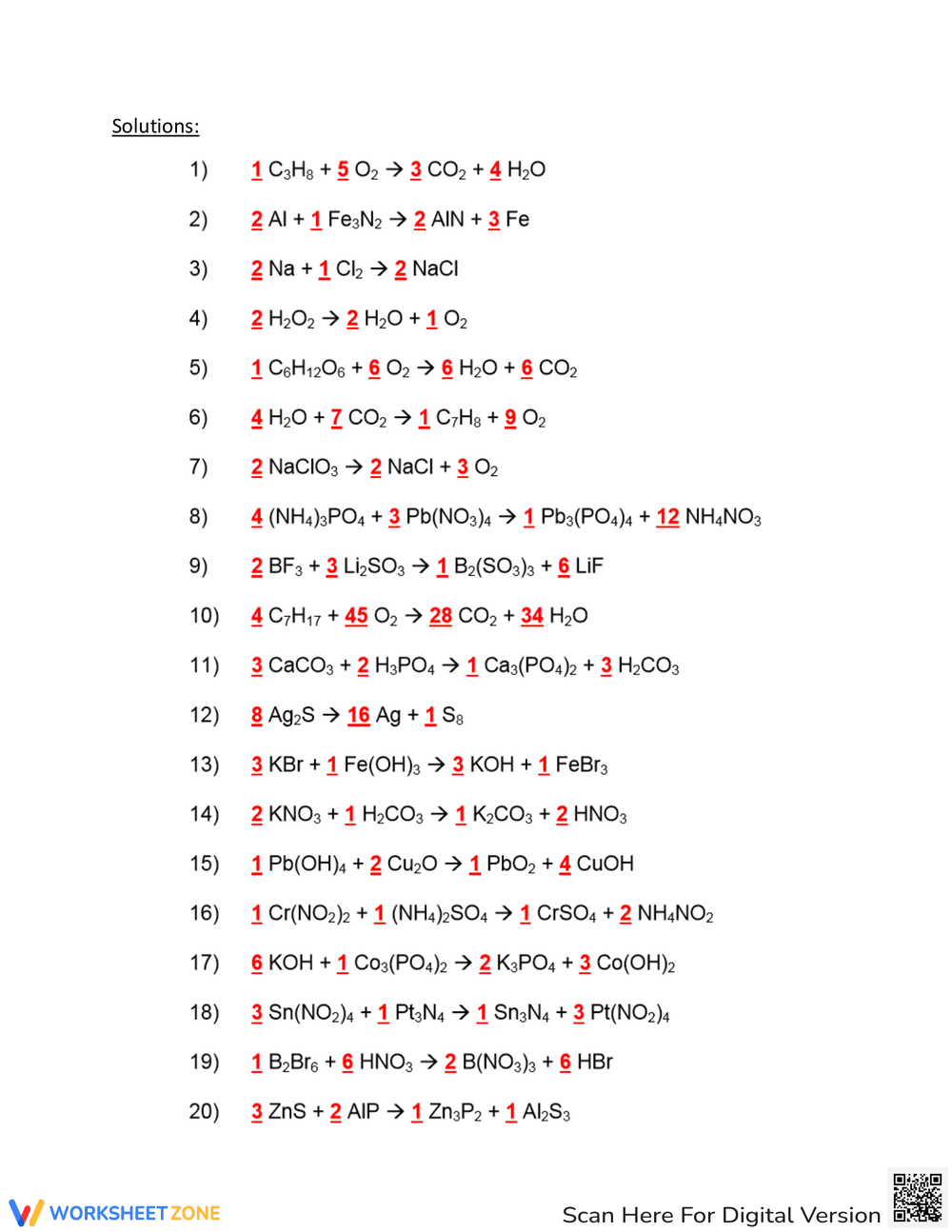

Printable Balancing Chemical Equations Worksheet | Grade 9
Paste this activity's link or code into your existing LMS (Google Classroom, Canvas, Teams, Schoology, Moodle, etc.).
Students can open and work on the activity right away, with no student login required.
You'll still be able to track student progress and results from your teacher account.
This Grade 9 and 10 chemistry worksheet gives students focused practice to master balancing chemical equations. By determining the correct coefficients for 20 distinct reactions, learners will solidify their understanding of the law of conservation of mass and ensure that the number of atoms remains equal on both sides.
At a Glance
- Grade: 9-10 · Subject: Chemistry
- Standard:
HS-PS1-7— Use mathematical representations to show mass conservation in reactions- Skill Focus: Balancing chemical equations
- Format: 2 pages · 20 problems · Answer key included · PDF
- Best For: Independent practice or homework
- Time: 20–30 minutes
This resource features a single-page student worksheet containing 20 fill-in-the-blank chemical equations of varying complexity. Students will calculate and write the missing stoichiometric coefficients to balance each reaction. A complete, color-coded answer key is provided on the second page, allowing for quick grading or self-assessment by the students.
Zero-Prep Workflow
This resource is designed for immediate classroom implementation with minimal teacher setup:
- Print (1 minute): Simply print the single-page student worksheet. The PDF format ensures formatting remains perfectly intact.
- Distribute (1 minute): Hand out the assignment as a warm-up, in-class activity, or homework task. The instructions are self-explanatory.
- Review (3 minutes): Use the provided color-coded answer key to quickly check student work or project it on the board for whole-class review.
Total teacher prep time is under two minutes, making this an excellent, reliable option for emergency sub plans.
Standards Alignment
This practice aligns with HS-PS1-7: Use mathematical representations to support the claim that atoms, and therefore mass, are conserved during a chemical reaction. By calculating the exact coefficients needed for each molecule, students mathematically demonstrate that matter is neither created nor destroyed. Both standard codes can be copied directly into lesson plans, IEP goals, or district curriculum mapping tools.
How to Use It
This worksheet is highly versatile. Assign it immediately after direct instruction on the law of conservation of mass to reinforce the mechanical steps of balancing equations. Alternatively, use it as a formative assessment tool before a unit test. While students work, observe their process: if a student struggles with equations containing polyatomic ions (like problem 8 or 16), they may need a quick review on treating those ions as single units. Expected completion time is 20 to 30 minutes.
Who It's For
This practice is ideal for high school chemistry or physical science students in grades 9 and 10. For students who need extra scaffolding, teachers can allow the use of a whiteboard and physical manipulatives to model the atoms before writing the coefficients. It pairs perfectly with an introductory direct instruction lesson on stoichiometry or a visual anchor chart detailing the steps to balance complex reactions.
Mastering the skill to use mathematical representations to show mass conservation in reactions is a critical threshold concept in high school chemistry. According to a ScienceDirect TpT Analysis, repeated, focused practice on foundational skills like balancing chemical equations significantly reduces cognitive load during more advanced stoichiometric calculations later in the curriculum. When students internalize the mechanics of HS-PS1-7, they free up working memory to tackle complex word problems and laboratory analyses. Providing a structured set of 20 problems allows learners to recognize patterns across different types of chemical reactions, from simple synthesis to more complex double replacement scenarios. This targeted repetition builds the automaticity required for success in advanced science coursework and standardized assessments, ensuring students confidently grasp the fundamental principle that matter is conserved.


