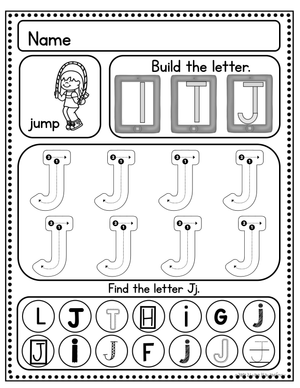
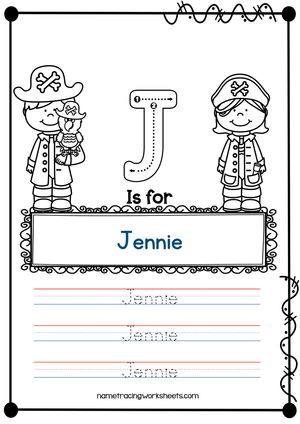
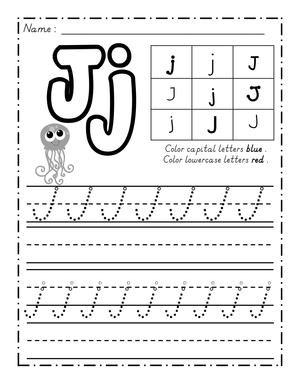
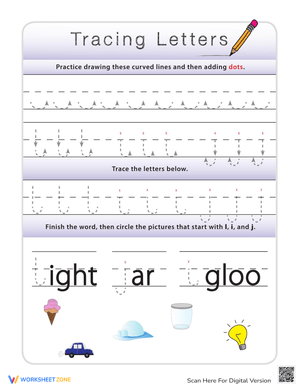
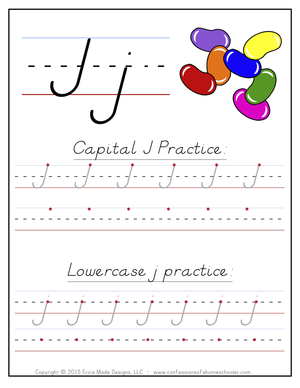
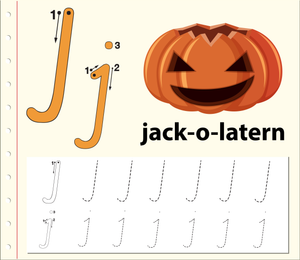
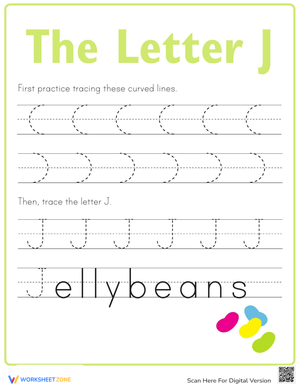
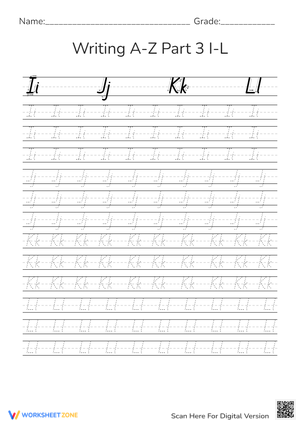
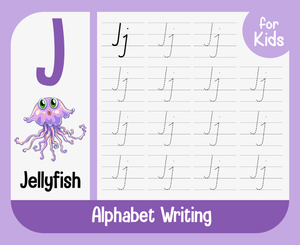
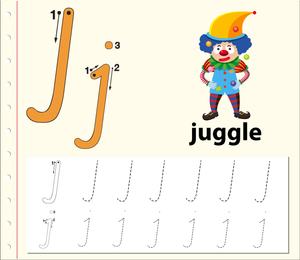
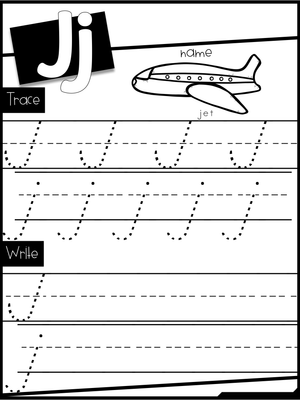
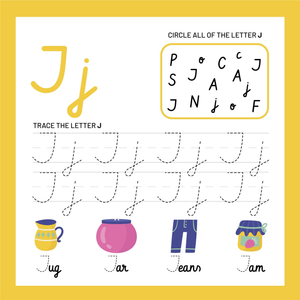
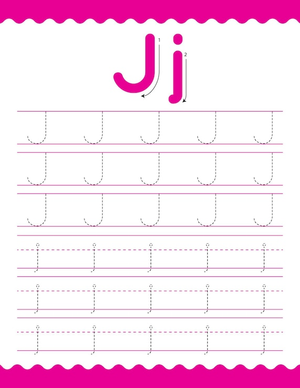
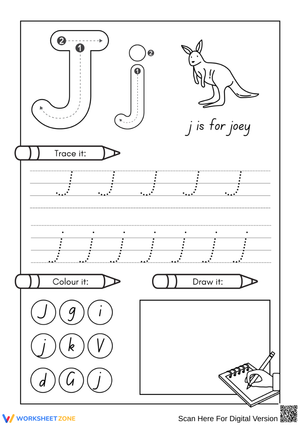
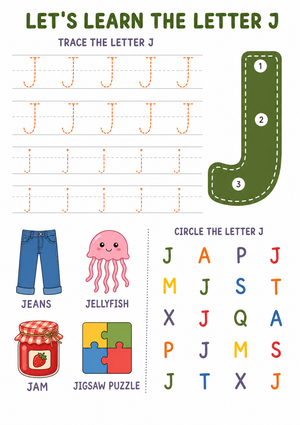
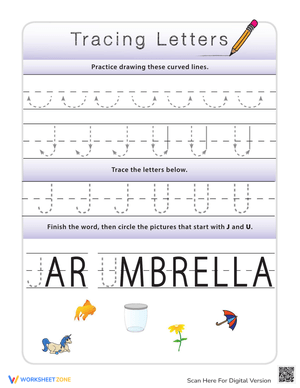
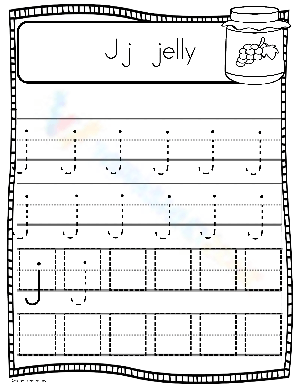
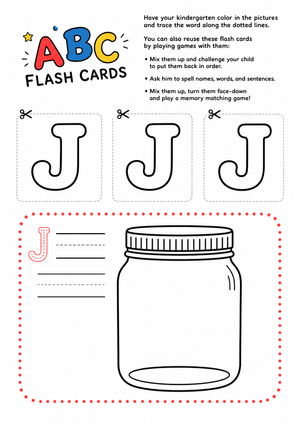
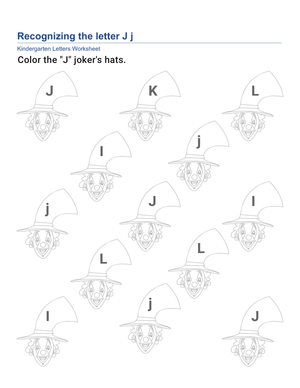
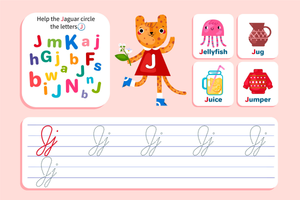
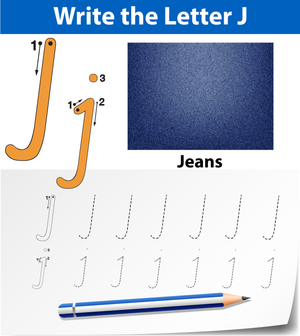
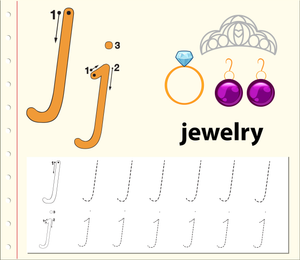
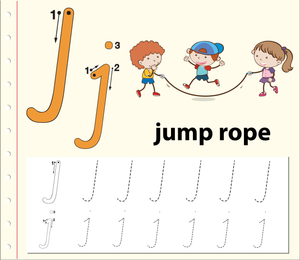
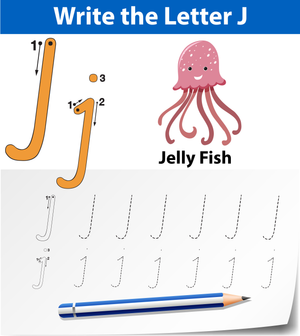
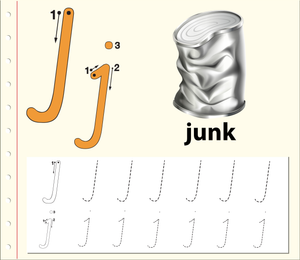
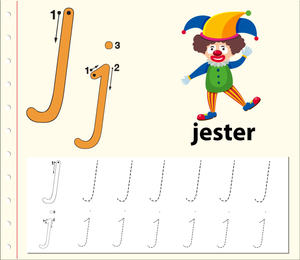
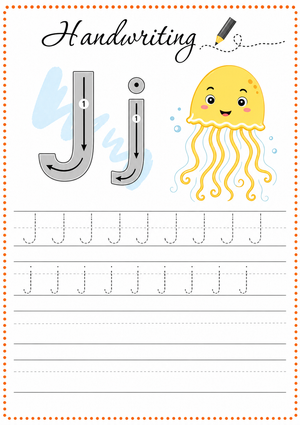
These 1st grade letter j handwriting pdf worksheets give teachers a focused practice set for one of the more mechanically demanding letters in early handwriting instruction — a letter with a below-baseline descender, a left-facing hook, and a tittle that first graders routinely misplace, reverse, or skip entirely. Each worksheet targets uppercase and lowercase J across primary ruled lines, moving students from traced models to independent production. The set fits morning warm-ups, writing centers, and targeted small-group work without requiring any modifications from the teacher.
Stroke Mechanics: What Makes the Letter J Distinctive
The uppercase J introduces two decisions that trip students up: where to stop the vertical stroke and which direction to curve. Instruction begins at the top headline, pulling a straight vertical line down to just above the baseline before curving left. Some curricula — Zaner-Bloser among them — include a horizontal crossbar at the headline, which has genuine functional value: it visually separates uppercase J from capital I and lowercase l, three characters that look nearly identical to six-year-olds still building their letter library.
The lowercase j is where most instructional time belongs. It begins at the dashed midline, drops straight through the solid baseline, continues into the descender space, then curves left to form the hook. The final step is placing the tittle — a clean dot — just above the midline. The depth of the descender is the detail first graders get wrong most consistently, and it is the detail these worksheets make most visible through clearly ruled descender lines.
Common Student Mistakes Teachers Should Anticipate and Address
The most persistent error is the right-facing hook. Because left-to-right directionality is drilled into early readers constantly, many students instinctively pull their pencil to the right at the bottom of the stroke — producing something closer to a mirror-image j. This is a motor habit, not a conceptual confusion, and it responds well to verbal cuing: pull down, then swing back left. Having students trace the curved portion slowly while saying the direction aloud tends to correct the habit faster than silent repetition.
A second consistent error involves spatial placement of the lowercase j. Students who correctly start at the midline still often stop the descending stroke at the baseline — treating it like a lowercase i — rather than continuing into the basement space. A quick and reliable intervention: before the student picks up a pencil, have them run a yellow highlighter along the descender line on their worksheet. That bright horizontal target gives the hook something to reach toward and dramatically reduces premature stops at the baseline.
The tittle deserves explicit modeling as well. Students with heavy pencil pressure will drag a short dash rather than placing a clean dot. Demonstrating the distinction side by side on the board — one quick tap versus a drag — is worth the thirty seconds before practice begins.
Working These Worksheets Into Your Lesson Plans
The first five to eight minutes of the school day are often underused for handwriting, and these worksheets fit that window cleanly. The format is predictable enough that students settle in without teacher direction, which frees time for attendance, transitions, and other morning logistics. Teachers who assign these 1st grade letter j handwriting pdf worksheets as a Monday morning entry task during the letter J instructional week often find that students arrive primed for the handwriting focus before whole-class instruction even begins.
Writing center rotations are a natural home for this practice. Sliding each worksheet into a dry-erase pocket lets students work with whiteboard markers, wipe clean, and repeat — extending usability across multiple rotations without consuming paper. For targeted work at the teacher table, watching a student move through the tracing sequence while seated close reveals grip issues, stroke direction errors, and posture problems that are invisible from across the room.
One pairing worth building into any lesson plan: a brief gross-motor warm-up before students pick up their pencils. Have the class trace a giant J in the air using a full arm sweep, saying the stroke sequence aloud — start at the top, pull straight down, swing left, dot. The transition from that large movement to pencil-on-paper almost always produces cleaner first attempts. It loads the motor plan into working memory just before the fine motor task begins.
Why the Letter J Belongs in First-Grade Handwriting Instruction
The letter J is one of the first letters students encounter that requires work across all three spatial zones on a primary ruled page: the headline-to-midline zone for the starting position, the midline-to-baseline zone for the vertical stroke, and the descender zone below the baseline for the hook. Nearly every other letter taught before J stays above or at the baseline. When J drops below it, students are navigating spatial territory they have almost no prior experience with — and the primary ruled lines are the only structural guide they have for understanding exactly where "below the baseline" is.
Cognitive load theory explains why isolated letter practice at this stage still matters. When first graders must consciously think about how to form a J, they cannot simultaneously attend to spelling, word choice, or sentence structure. Automaticity in letter formation — built through repeated, deliberate practice — is the prerequisite for putting mental energy toward writing as a composing act rather than a copying act.
Adjusting the Worksheets for a Range of Writers
For students still building basic pencil control, using only the tracing sequences as the full task — without moving to the copy and independent sections — is entirely appropriate. Repeated guided tracing builds the motor plan without the added pressure of independent recall. Enlarging the worksheet on the copier, say to 115 or 120 percent, gives these students more room to execute each stroke and reduces the demand on fine motor precision.
Students who have already internalized the letter's basic shape benefit from moving to word-level practice quickly. Have them write three or four J words below the letter practice — jump, jar, jet, jungle — then compose one sentence using one of those words. That move from isolated letter to word to sentence is where handwriting automaticity gets genuinely tested. If J formation slows the student down at the word level, that is useful diagnostic information. These 1st grade letter j handwriting pdf worksheets give teachers a concrete starting point; word- and sentence-level extension takes over from there.
Standard Alignment
These worksheets support CCSS.ELA-LITERACY.L.1.1, the first-grade language standard that includes production of legible writing with correct letter formation. State-level ELA frameworks typically place handwriting formation mastery in the first six to eight weeks of first grade, before writing workshop shifts emphasis from letters to composition. These worksheets fit that early-year placement precisely. They also function as documentation artifacts — keeping a dated sample from the tracing stage alongside one from the independent stage gives teachers concrete evidence of progression to present at parent conferences or intervention team meetings.
Frequently Asked Questions
Where exactly does the lowercase j start and end on primary ruled paper?
The stroke begins at the dashed midline. The pencil moves straight down through the solid baseline and continues into the descender space before curving left to form the hook. The tittle sits just above the dashed midline. Students who stop the stroke at the baseline are producing an incomplete letter — the finished lowercase j must reach the descender zone to be correctly formed.
How do I help students distinguish the lowercase j from the lowercase i?
The clearest explanation at this age is spatial: i lives above the baseline, and j goes below it. Showing both letters side by side on primary ruled paper — with the descender clearly dropping below the baseline on the j — makes the distinction concrete before students practice it. A verbal cue that holds up well in the classroom is i stops at the floor; j goes into the basement. Pairing that language with these 1st grade letter j handwriting pdf worksheets, which show the ruled zones explicitly, gives students both a verbal anchor and a visual one.
Can these worksheets be used for left-handed students without modification?
The stroke sequence is identical for left-handed writers. The adjustment is positional: left-handed students should tilt the paper slightly clockwise — opposite the counterclockwise angle typically recommended for right-handed students — so they can see the line forming rather than covering it with their writing hand. The worksheets themselves require no alteration; the primary ruled lines and letter models serve both equally well.