




























Views
Downloads
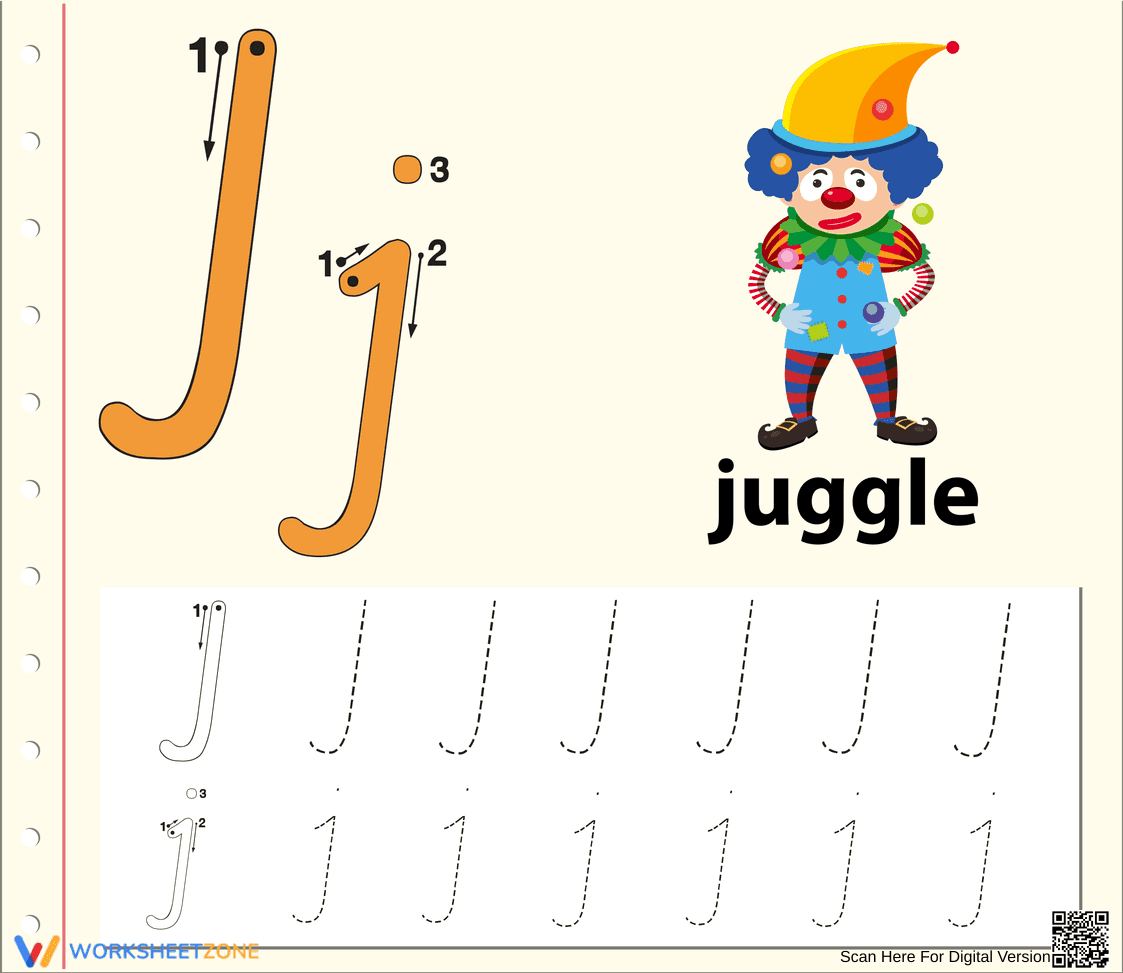

Letter J Tracing Worksheet | Essential Grade K Ready

Paste this activity's link or code into your existing LMS (Google Classroom, Canvas, Teams, Schoology, Moodle, etc.).
Students can open and work on the activity right away, with no student login required.
You'll still be able to track student progress and results from your teacher account.
This Kindergarten Letter J tracing worksheet provides young learners with structured practice to master uppercase and lowercase letter formation. By following numbered directional arrows, students develop the fine motor control necessary for legible handwriting. This resource ensures students can confidently identify and write the letter J while connecting it to the word juggle.
At a Glance
- Grade: Kindergarten · Subject: Handwriting
- Standard:
CCSS.ELA-LITERACY.L.K.1.A— Print many upper- and lowercase letters accurately- Skill Focus: Letter J formation
- Format: 1 page · 14 problems · Answer key included · PDF
- Best For: Morning work or literacy centers
- Time: 5–10 minutes
This single-page PDF features large, clear models of both uppercase 'J' and lowercase 'j' with numbered stroke guides. Below the models, students find two rows of dashed-line tracing tasks: seven for the capital letter and seven for the lowercase version. A colorful illustration of a clown juggling provides a visual mnemonic for the letter's sound and usage, helping to bridge the gap between phonics and penmanship.
Teachers can implement this activity in under 2 minutes. First, print the single-page PDF for your entire class. Second, distribute the sheets during morning arrival or as a transition activity. Third, review student stroke order as they work to ensure they follow the 1-2-3 directional cues. This no-prep design makes it an ideal emergency sub plan or quick formative assessment for early childhood classrooms.
The primary focus is `CCSS.ELA-LITERACY.L.K.1.A`, which requires students to "Print many upper- and lowercase letters." This worksheet specifically targets the mechanics of the letter J, ensuring students understand the hook and crossbar components. Both standard codes can be copied directly into lesson plans, IEP goals, or district curriculum mapping tools to track student progress toward foundational literacy benchmarks.
Use this worksheet during the "You Do" phase of a gradual release handwriting lesson. After demonstrating the letter on the board, have students complete the 14 tracing tasks independently. It also serves as an excellent formative assessment tool; observe if students start their strokes at the top or bottom to identify who needs additional 1-on-1 support. Completion typically takes 8 minutes for most Kindergarten students.
This resource is designed for Preschool, Kindergarten, and Grade 1 students who are beginning their literacy journey. It is particularly helpful for students requiring fine motor intervention or those following a D'nealian-style curriculum. Pair this with a "Letter J" alphabet song or a tactile salt tray activity for a multi-sensory learning experience that reinforces letter recognition and motor memory.
According to the RAND AIRS 2024 report on early literacy, consistent and repetitive tracing practice is fundamental for developing the muscle memory required for automaticity in writing. This worksheet targets CCSS.ELA-LITERACY.L.K.1.A by providing 14 specific opportunities for students to practice the distinct strokes of the letter J. Research from Fisher & Frey (2014) emphasizes that guided practice with clear visual cues, such as the numbered arrows included here, significantly reduces cognitive load for novice writers. By isolating the letter J, students can focus on the specific hook motion without the distraction of complex sentence structures. This targeted approach ensures that foundational handwriting skills are solidified before students move on to more advanced composition tasks. The inclusion of both cases supports comprehensive alphabet mastery essential for early reading success and long-term academic achievement.


