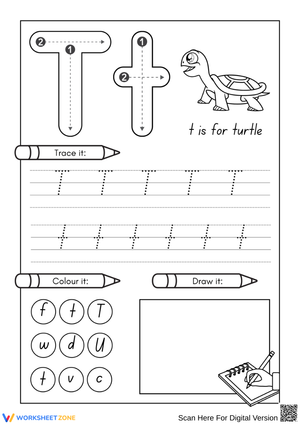
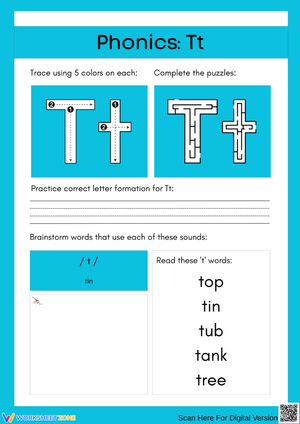
These 1st grade letter t handwriting worksheets put uppercase and lowercase T practice directly in students' hands, with primary ruled lines, guided stroke sequences, and room for independent writing built into each worksheet. Each worksheet addresses one formation challenge at a time, keeping the visual field clean enough for beginning writers who still need to see exactly where strokes start and stop.
What Each Worksheet Targets
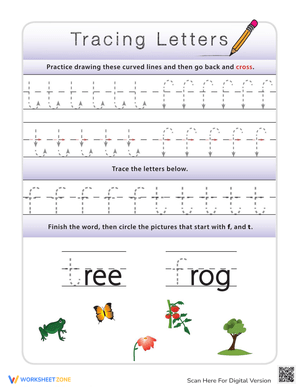
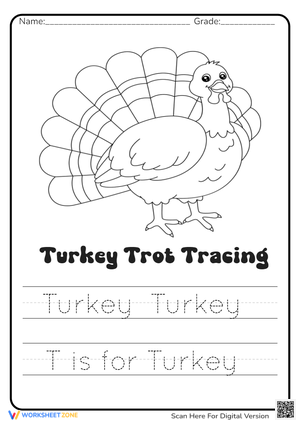
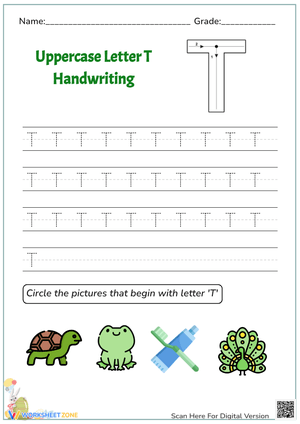
The 1st grade letter t handwriting worksheets in this collection target formation on primary ruled paper, with separate practice for uppercase and lowercase T so students work through each stroke sequence without conflating the two. For uppercase T, the sequence is vertical first — a full line from top rule to baseline — then a horizontal crossbar sitting exactly at the top rule. For lowercase t, the critical challenge is ascender height: the vertical stroke rises above the midline but stops short of the top rule, and the crossbar sits at midline, not at the top. Each worksheet also includes word-level writing using high-frequency words students encounter in their earliest decodable texts: the, to, ten, and top.
- Uppercase T: two-stroke formation from top rule to baseline
- Lowercase t: ascender height and midline crossbar placement
- Starting point identification on three-line primary paper
- Letter T in initial-position high-frequency words
- Graduated practice from traced model to freehand production
Why First Grade Teaches T When It Does
T arrives early in first-grade instruction because it demands no curved motor movement. A child who can draw a vertical line and a horizontal line can build the letter. That simplicity makes T a useful entry point before students tackle letters like b, d, or g, which require curves combined with lines and stronger directional control. The lowercase t earns its place for a different reason: it introduces students to the idea that crossbar position changes the letter. A crossbar at the top rule and a crossbar at the midline produce different letters — lowercase t versus something resembling a plus sign. That lesson about placement matters for f, later on, and for maintaining the distinction between ascender and mid-zone letters throughout the year. The letter also appears in words first graders read from the first week of instruction; writing T is not abstract practice when students use it in the and that the same day they trace it.
Frequent Mistakes Students Make—And What They Tell You
The most persistent error is a lowercase t crossbar placed at the top rule instead of the midline. Students who have just learned uppercase T apply the same logic — the crossbar goes at the top — and produce something readable but technically wrong. Because the error doesn't prevent recognition, students don't self-correct. Teachers need to name the midline explicitly: the crossbar belongs at the same height as the body of letters like a and o, not at the ceiling of the letter.
A second pattern surfaces during observation rather than paper review: students who draw the vertical stroke from the bottom upward. The finished letter looks correct on the page, so the error hides until a teacher watches the pencil move. Stroke direction matters for fluency and for writing speed at the word level, so catching it early is worth the extra attention. Circulating during practice with the specific purpose of watching pencil direction — not just letter shape — is the only way to catch this in time.
Building These Worksheets Into Your Weekly Routine
Three spots in the school day accommodate handwriting practice without displacing other instruction. Morning arrival is the most reliable: a single worksheet on the desk gives students a defined task while the teacher handles attendance, and the quiet focus it creates tends to carry into morning meeting. Literacy center rotation works well for independent practice — letter formation requires no teacher direction once students know the sequence, making it a strong independent station while the teacher runs guided reading. The eight minutes before a transition, when there's not enough time to begin new content, also works; the freehand lines at the bottom of each worksheet give faster finishers purposeful work without any additional instruction.
For small-group use, teachers can pair 1st grade letter t handwriting worksheets with a whiteboard or sand tray so students alternate between large-motor and fine-motor practice in the same block. That alternation is particularly useful for students who can produce the letter on a whiteboard but can't yet transfer the movement to paper at pencil scale.
Standard Alignment
These worksheets address CCSS.ELA-LITERACY.L.1.1.A, which requires first graders to print all upper- and lowercase letters. In instructional terms, this standard sits at the boundary of handwriting and early encoding: as letter formation becomes more automatic, students free up working memory for spelling patterns and word-level decision-making. Research from Reading Rockets connects handwriting fluency directly to spelling outcomes — students who write letters without laboring over strokes encode words more accurately. Each worksheet moves within a single session from traced models to freehand production, building toward that automaticity in a contained and measurable way.
Differentiating Practice Across the Range of Learners in the Room
Students who are still developing pencil control benefit from pre-writing preparation: finger-tracing on the desk, then air-writing with the full arm, before picking up a pencil. Placing a small dot at the starting point on each line reduces the number of decisions their hand has to make and keeps attention on the stroke itself rather than the starting position.
Students who form T correctly but lack fluency need volume, not more tracing. Give them the independent writing lines with a word target — write ten five times, the five times — and move on. Students who are already fluent at letter level are ready for sentence context: ask them to write two sentences using words that begin with T, then check whether formation holds under the added demand of composing. For most students it doesn't hold immediately, and that gap is useful data about where instruction needs to go next.
Frequently Asked Questions
What verbal cue works best for the lowercase t crossbar?
The most grounded cue is positional: "cross at the middle line, where the short letters live." Students already know that a, e, and o fit between the baseline and midline. Connecting the crossbar to that same midline gives them a reference they can cross-check against letters they already write reliably. Cues like "not too high, not too low" leave the decision entirely to the student and tend to produce the same error repeated with more deliberation.
Do left-handed students need different instruction for T?
The stroke sequence stays the same regardless of handedness — vertical first, then horizontal crossbar running left to right. Left-handed students may rotate the paper to avoid smearing, which is appropriate. Watch for a wrist hooked over the top of the letter; repositioning the paper at an angle, rather than adjusting the stroke sequence, usually resolves that without creating new habits to undo later.
How do these worksheets support a quick formative read at the end of the week?
Collect a set and sort them into three groups: crossbar at midline, crossbar at top rule, and crossbar inconsistent. The sort takes about two minutes and immediately tells you which students need another week of letter-level practice and which are ready for word-level work. A completed tracing page tells you only that a student can follow a model — the independent writing lines at the bottom of each worksheet are where the real diagnostic information lives.
What should teachers do when a student's lowercase t consistently looks too short?
Students who don't bring the vertical stroke above the midline are grouping lowercase t mentally with non-ascender letters. A direct side-by-side comparison helps: write a lowercase t and a lowercase a on the whiteboard and ask which one crosses into the tall zone. Once students can identify the difference visually, a worksheet with the ascender zone lightly shaded gives their pencil a zone to pass through rather than an abstract line to remember. This is exactly the kind of focused correction the 1st grade letter t handwriting worksheets in this collection are built to support — one formation variable per worksheet, with enough visual structure to make the feedback land on the right error.