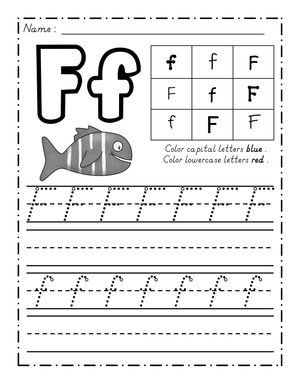
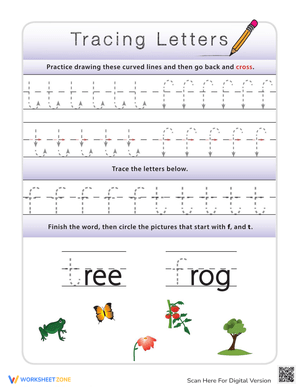
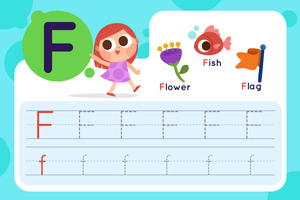
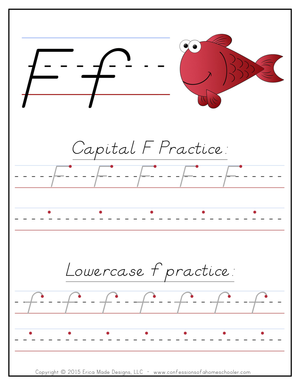
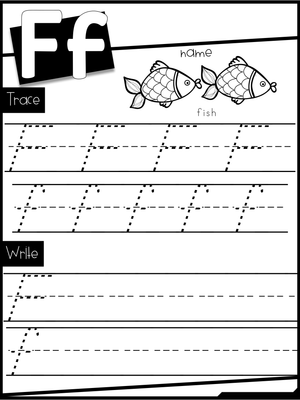
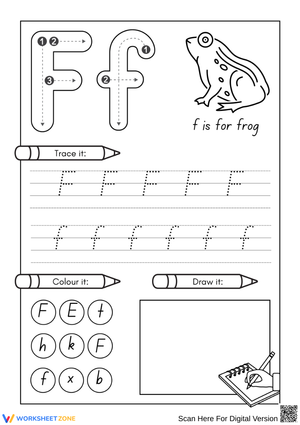
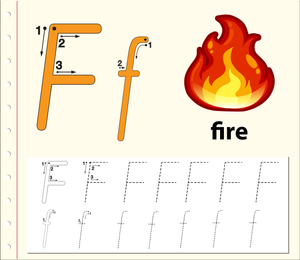
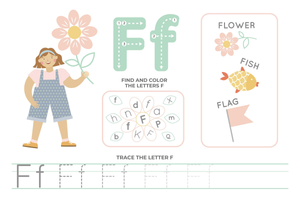
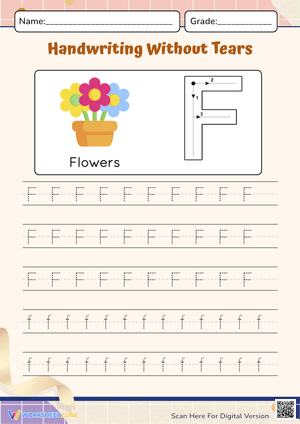
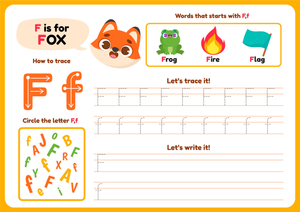
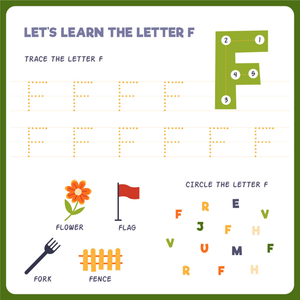
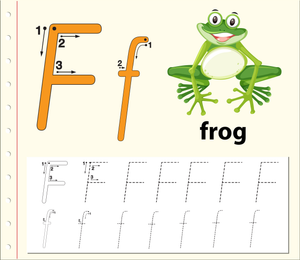
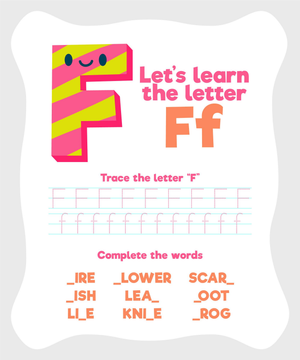
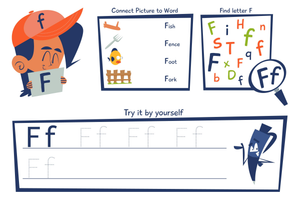
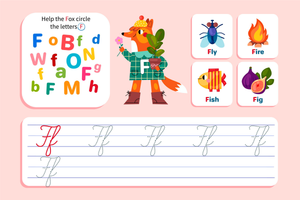
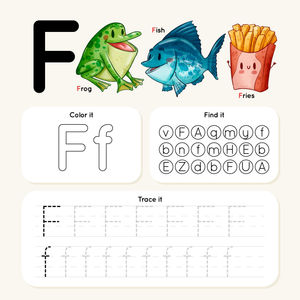
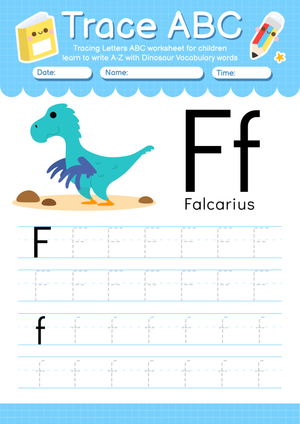
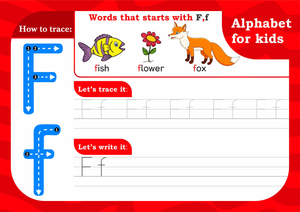
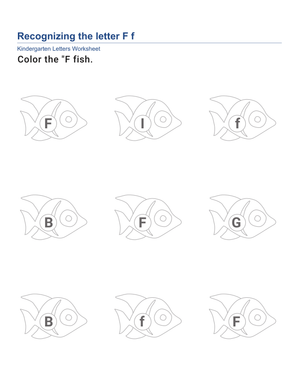
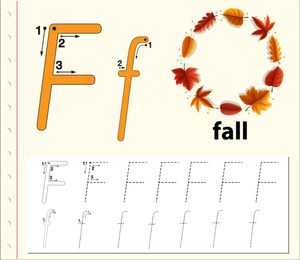
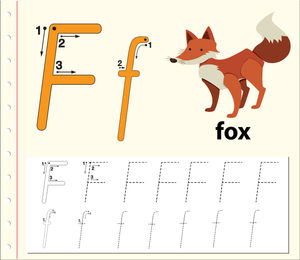
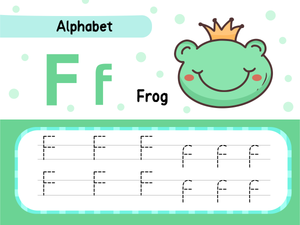
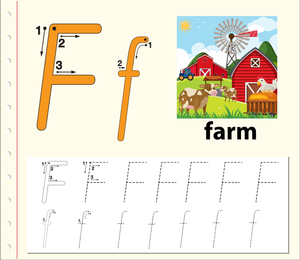
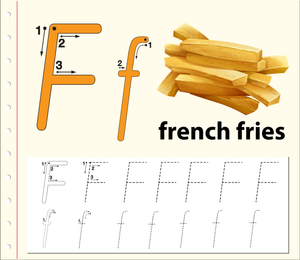
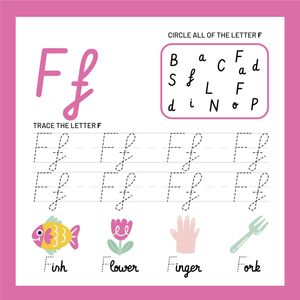
These 1st grade letter f handwriting worksheets give first graders focused practice on a consonant whose stroke pattern causes more confusion than teachers expect — the letter looks simple until students put pencil to paper and discover that the uppercase version demands three strokes with proportionally different crossbars, while the lowercase is an ascender with a precisely placed crossbar that students routinely miss. Each worksheet moves from tracing rows with directional arrows to independent writing rows on properly lined paper, so teachers can see exactly where automaticity has taken hold and where it hasn't.
The Specific Skills Each Worksheet Targets
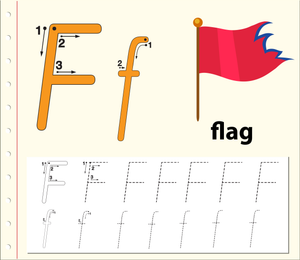
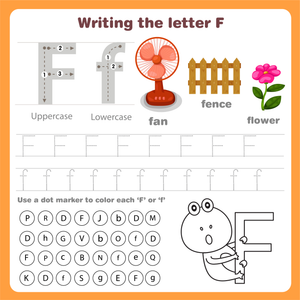
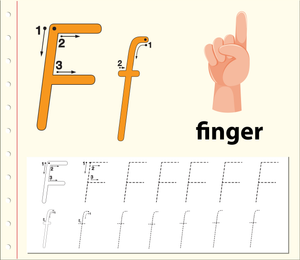
The set addresses both letter forms with close attention to the details that actually matter for legibility and efficiency. Uppercase F practice focuses on the three-stroke sequence: a full downstroke from the top line to the baseline, a top horizontal crossbar spanning the full cap height, and a shorter middle crossbar sitting exactly on the dotted midline. Lowercase f practice works through the ascending curve, the downstroke through the baseline, and the midline crossbar — each step given tracing support before students write without guidance.
Beyond isolated letter repetition, each worksheet includes brief word-level writing using familiar vocabulary: fish, frog, fun, five, friend. Connecting stroke practice to phonics words already encountered in decodable readers helps students transfer the letter form to actual writing tasks, which is where the habit needs to live.
Why the Lowercase f Warrants Slower Instruction
Most uppercase letters follow a predictable top-to-bottom, left-to-right logic that first graders internalize quickly through whole-class instruction. The lowercase f breaks that pattern in two places: students must start just below the top line, curve upward to touch it, and then pull back down — a direction reversal that contradicts the "start at the top, pull down" rule they have been practicing all year. Then the crossbar has to land on the midline, not at the top of the letter and not at its visual midpoint, but at the specific dashed guide between the two solid lines.
Before students use a worksheet at all, having them air-write the full lowercase f with their whole arm — crossing the body's midline — encodes the stroke sequence through large-motor movement first. That two-minute step consistently reduces the number of students who start from the baseline and push upward, which is the most stubborn error pattern we see at this grade level.
Error Patterns That Show Up Consistently in Student Work
The uppercase F produces one highly reliable error: the middle crossbar drawn as long as the top crossbar. The result looks like a capital E, and students often don't notice until the teacher points to it. The verbal cue "short middle line" paired with the arrows printed on the worksheet addresses this, but it needs reinforcement across the first several sessions — not just day one.
With the lowercase f, the crossbar placement problem splits into two distinct patterns. Some students place the crossbar high, near the curve at the top of the letter, because they treat the curve's endpoint as "the middle." Others skip the crossbar entirely under time pressure, especially during sentence writing when attention shifts to the message. Both patterns are visible in the independent writing rows of each worksheet, which is precisely where catching them matters — before those habits solidify through a year of daily writing.
A third error worth noting: students who reverse the horizontal strokes so they point left. This appears most often in students who are still sorting out directionality broadly, but it also shows up in students who read right-to-left scripts at home. The directional arrows printed on every tracing stroke give those students an ongoing visual reference rather than relying solely on verbal reminders.
Building These Worksheets Into Your Instructional Week
A ten-minute handwriting block three or four times per week produces more consistent improvement than a single long session. These worksheets fit that rhythm: one worksheet per sitting, used during morning work or the first minutes of a literacy block, with the class comparing their independent rows before moving to the day's reading lesson. The routine itself carries a significant share of the instructional load.
During the first two or three days of letter F instruction, use each worksheet as a guided whole-class activity — the teacher models each stroke at the board or document camera while students follow on paper. Once students can sequence the strokes with minimal prompting, the worksheet moves cleanly into a center rotation while the teacher pulls small groups for phonics or fluency work. The 1st grade letter f handwriting worksheets in this set include enough visual information on the page — starting dots, numbered arrows, lined rows — that a student working independently can self-correct without needing teacher proximity.
Standard Alignment
CCSS.ELA-LITERACY.L.1.1a requires first graders to print all upper- and lowercase letters. That standard's brevity understates its instructional weight: students need to form every letter consistently enough that their writing communicates without the teacher watching over their shoulder. The letter F sits squarely in the middle of that challenge — errors in a single stroke (the middle crossbar length on uppercase, the crossbar position on lowercase) produce a character that reads as a different letter entirely. Consistent targeted practice through 1st grade letter f handwriting worksheets supports the automaticity that the standard implies even when it doesn't state it outright, freeing students to direct cognitive attention toward spelling and sentence composition rather than stroke recall.
Adjusting Practice for the Range of Learners in Your Classroom
Students who are still developing pencil grip and fine motor control start with worksheets that use larger letter boxes and bold tracing lines. Reducing the spatial precision required lets those students focus on the stroke sequence before they work on proportion. If the standard worksheet format consistently causes frustration — which it sometimes does for students whose fine motor development is significantly behind grade level — having them trace the letter on sandpaper or in a shallow tray of salt first builds the movement pattern without the added demand of controlling a pencil on paper.
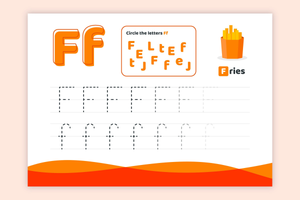
For students who have the stroke sequence down and are ready for extension, remove the tracing rows and use only the blank lined section. Add a brief reflection step: the student circles their three best letters and marks the one that still needs the most work. That self-assessment move takes thirty seconds and creates more durable self-correction habits than another full worksheet of tracing. Students who form both F and f fluently are better served by sentence-level writing using high-frequency F words than by additional letter repetition.
Frequently Asked Questions
What paper format produces the best results for teaching the letter F in first grade?
Three-line paper with a solid top line, dashed midline, and solid baseline is essential for this letter specifically. Both the proportional difference between uppercase F's two crossbars and the lowercase f's crossbar position depend on students being able to see and use the midline as a reference. Wide-ruled notebook paper, which lacks a midline, removes the spatial guide that makes self-correction possible.
How do I know when a student is ready to stop tracing and write independently?
When a student can consistently sequence the strokes in the correct order across three or four tracing rows without hesitating at each stroke, they are ready for independent rows. The benchmark isn't perfection of proportion — it's reliable sequence. Students who produce the letter differently each time they attempt it need more guided tracing; students who produce a consistent form, even if sizing is still rough, benefit from writing without the tracing support.
Do these worksheets work for students who are left-handed?
The directional arrows and stroke sequence are the same for left-handed students — the strokes still move from top to bottom and left to right. Left-handed students may need explicit instruction on tilting the paper slightly clockwise so their hand doesn't obscure their starting point, but the formation of the letter F itself does not change. The 1st grade letter f handwriting worksheets in this set include enough visual space around each letter that left-handed students can follow the stroke cues without their hand covering the arrows.
How long should letter F practice continue before moving to the next letter?
Three to five focused sessions is the typical window, assuming students reach consistent independent formation by the end of that period. If a significant portion of the class is still reversing strokes or misplacing the crossbar after five sessions, a brief re-teach using air writing and board modeling before the next session is more effective than simply extending practice time with the same format.