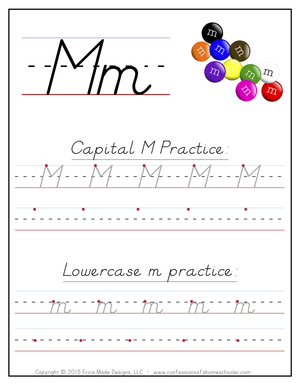
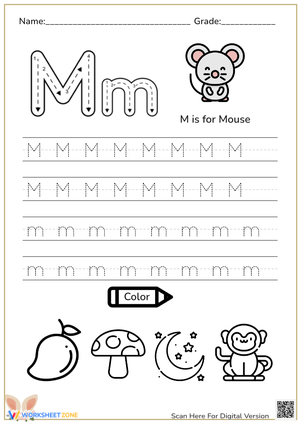
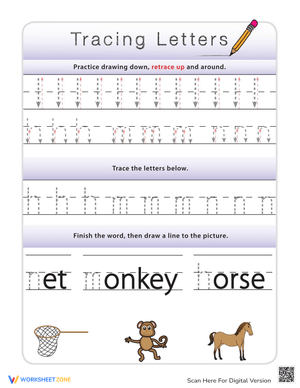
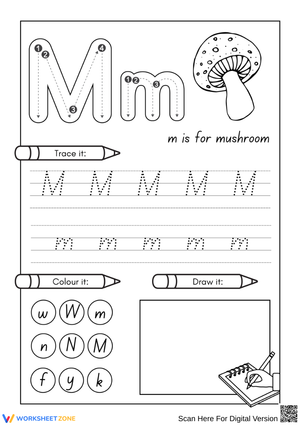
These letter m handwriting printable worksheets for 1st grade give teachers a focused set of pages that move students from tracing uppercase M and lowercase m to writing both forms independently on primary lines. Each worksheet pairs letter formation with familiar /m/ vocabulary — words like map, moon, and mouse — so students are working on alphabet knowledge and beginning sound-symbol connection at the same time. The pages print cleanly, require no prep beyond copying, and fit anywhere in the literacy block.
The Specific Skills Each Worksheet Targets
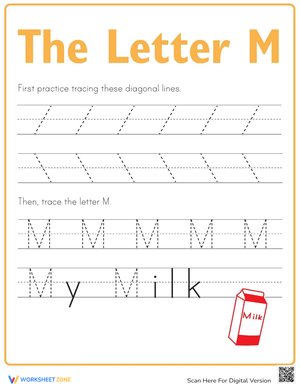
First graders need to form both M and m accurately — not just trace them. These worksheets give students a clear uppercase and lowercase model, a tracing row to internalize stroke order, and open copy lines where the dotted guides disappear and students write from memory. That progression matters: tracing without independent writing is only half the task, and many handwriting pages stop too early.
Beyond letter formation, each worksheet brings in word-level practice. Students write common /m/ words — map, milk, mop, moon — after completing the letter rows. That moves the lesson from isolated stroke practice into early reading and spelling territory, which is where first-grade literacy instruction lives.
- Uppercase M formation — four strokes: two verticals and two diagonals meeting at a center valley
- Lowercase m formation — two rounded humps beginning from the midline
- Letter size and line placement — M filling from baseline to top line; m staying within the midline
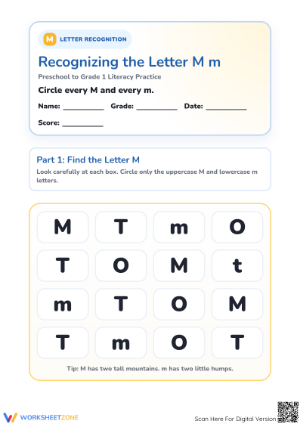
- Beginning sound identification — connecting the /m/ sound to the written letter before writing begins
- Word-level handwriting — writing familiar M words with consistent letter sizing and spacing
Student Errors to Catch Before They Become Habits
Lowercase m causes more confusion than most teachers expect. The most common error is collapsing the two humps into one, producing something that reads as lowercase n. A student who writes moon as noon in a journal is almost always carrying over an unresolved m/n formation error. A second pattern: students start the letter from the bottom of the line rather than the midline, which produces a backward looping shape that is difficult to undo once it is repeated across dozens of pages.
Uppercase M brings its own trouble. The two diagonal strokes that meet at the center — forming the V-shaped valley — regularly get flattened into a horizontal bar, making the letter read as something between M and H. Students who rush through tracing rows often miss this entirely; the error only surfaces on the open copy lines. That is exactly where letter m handwriting printable worksheets for 1st grade prove their instructional value — the transition from guided to independent writing creates a natural diagnostic moment teachers can act on in real time rather than discovering the error weeks later inside a writing folder.
Where These Worksheets Fit Into Your Literacy Block
In most first-grade rooms, these worksheets work best as a brief, repeatable routine rather than an isolated assignment. During the three to five minutes before a phonics lesson transitions to reading groups, the tracing section gives students something purposeful to begin without needing directions. The independent writing rows are a natural fit for literacy centers, where students can work without teacher support because the task is self-explanatory from the first row.
One classroom move worth building in: ask students to circle their single neatest letter on the independent writing row — not their favorite, their neatest. That thirty-second self-assessment does two things. It gives students a concrete standard to aim for on the next line, and it gives teachers an immediate visual during check-ins. The circled letter shows what the student already recognizes as careful work, which tells you more than scanning the whole row does.
For homework, a worksheet sent home with the word list already practiced in class keeps the task manageable and prevents students from drilling incorrect formation without any corrective feedback. Parents can reinforce by asking the child to say the /m/ sound before writing each letter — a low-lift addition that keeps the handwriting practice tethered to early phonics rather than treating it as a separate subject.
Adjusting the Work for a Range of First-Grade Writers
Students who are still building pencil control do best when the tracing portion uses bold, high-contrast dotted lines and rows hold three to four letters rather than six or seven. Crowding rows pushes students to rush, and rushed handwriting practice reinforces the wrong motor pattern instead of building the right one. For these students, completing the tracing section carefully is the full task — the independent writing rows can wait for the following session.
Students who already have stable letter formation can move quickly past the tracing row and spend most of their time on the open-line writing and the word practice section. A useful extension for this group: ask them to write an original sentence using one of the M words at the bottom of the page. That adds a composition layer without requiring a different worksheet entirely.
The letter m handwriting printable worksheets for 1st grade also support pull-out intervention without any modification. A specialist working with two or three students can use the tracing section as a walk-through, pause at the transition to independent lines, and give corrective feedback before a student practices a wrong formation more than once — which is the point at which intervention becomes much harder.
Standard Alignment
These worksheets address CCSS.ELA-LITERACY.L.1.1a, which requires first graders to print all upper- and lowercase letters. That standard sits at the intersection of handwriting and literacy — it is not only about legibility but about automaticity. When a student must concentrate hard on how to form a letter, that cognitive effort comes at the expense of spelling and composition. Repeated, accurate formation practice frees up working memory so it can go toward the harder work of putting words and ideas on a page — which is where first-grade writing instruction is actually headed.
Frequently Asked Questions
How many practice sessions does it typically take before letter M formation is consistent?
Formation accuracy varies considerably. Some students stabilize m and M after three or four focused sessions; others need two to three weeks of daily short practice before the motor pattern holds without the tracing guide. The more reliable indicator is whether the student's independently written letters match the model — not how many pages they have completed.
Can these worksheets be used with kindergartners or second graders?
Yes, with adjustment. Kindergartners who are developmentally ready can use the tracing rows as their primary task, skipping the open copy lines until fine motor control is more developed. Second graders with persistent formation errors benefit from the independent writing rows as a brief daily correction routine — two minutes of targeted practice is often more effective than a full reteaching session.
What is the most effective way to introduce the worksheet before students work on their own?
Model the formation at the board or document camera before students touch their pencils. Verbalize the strokes explicitly — "start at the top, pull straight down, go back to the top, slant down to the middle, slant back up, pull straight down again" — so students have a verbal anchor they can repeat internally when writing without the model in view. That verbal rehearsal, paired with watching the teacher's hand move, reduces the number of students who start from the wrong point on the letter and repeat the error across an entire row.
Do these worksheets work alongside structured literacy programs?
These letter m handwriting printable worksheets for 1st grade fit alongside any structured literacy program that introduces the alphabet in explicit, sequenced instruction. They are not tied to a specific program's scope and sequence, so teachers can insert a worksheet at whatever point letter M appears in their curriculum and use it to reinforce the formation work students are already doing in their core program.