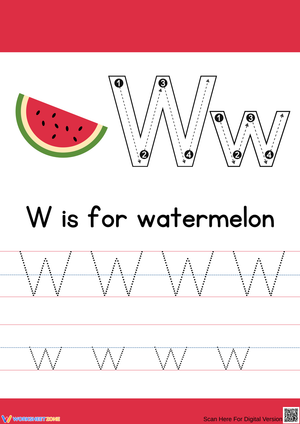
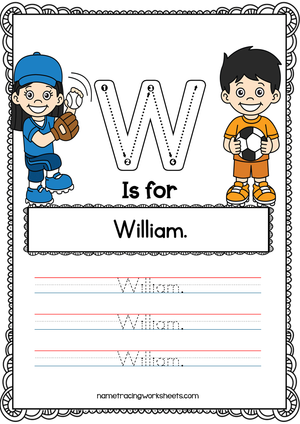
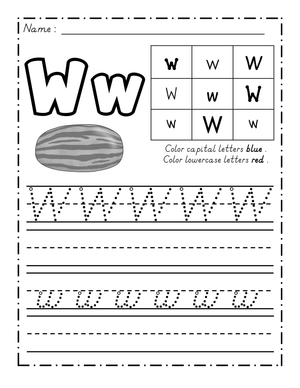
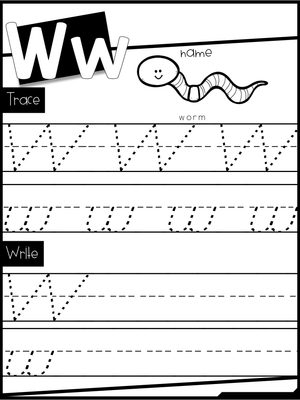
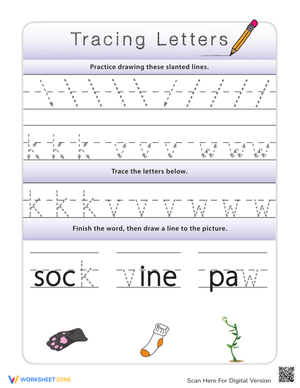
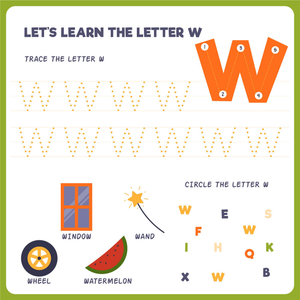
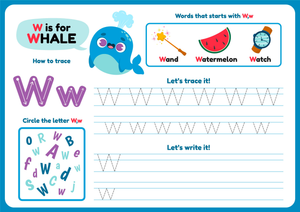
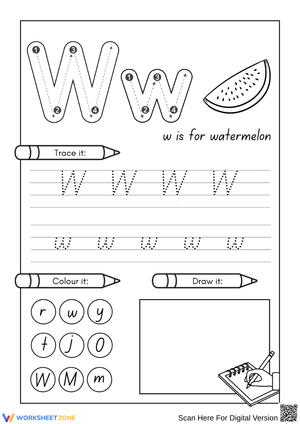
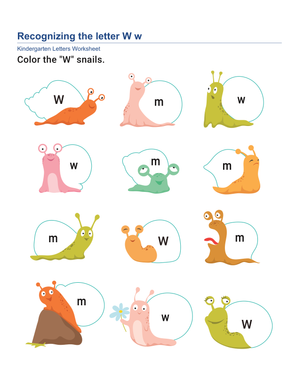
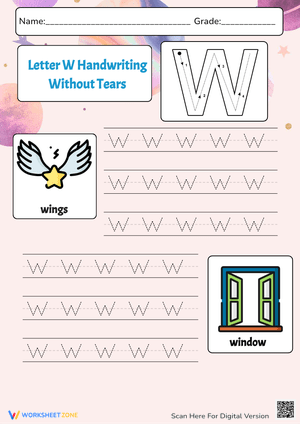
These 1st grade letter w handwriting printable worksheets give teachers focused, repeatable practice for one of the alphabet's more mechanically demanding letter formations — four consecutive diagonal strokes that require students to change direction sharply without lifting the pencil. The set addresses both uppercase and lowercase W on primary-ruled lines, making spatial placement explicit rather than assumed, and each worksheet moves students from traced models to independent writing within a single sitting.
The Specific Skills Each Worksheet Builds
The 1st grade letter w handwriting printable worksheets in this set take students through a deliberate progression: fully dotted tracing, partial-guidance writing, and then independent production — all on the same primary-ruled template. The skills are more precise than "write the letter W." Students practice executing four distinct diagonal strokes in sequence — down-right, up-right, down-right, up-right — with a sharp reversal at each valley and peak. The critical size distinction between uppercase W (headline to baseline) and lowercase w (midline to baseline) is built into every worksheet, so students encounter that spatial judgment repeatedly rather than encountering it once and drifting. Most worksheets in the set pair letter practice with word-level writing using high-frequency words like was, with, and went, connecting the stroke sequence to words students already recognize in print.
Student Mistakes Worth Catching Early
The single most predictable error is rounding the valleys. Students who have spent weeks forming O and U carry curved muscle memory directly into W, producing something that looks like a double U rather than a letter with two sharp, angled points touching the baseline. The fix is not more tracing — it is teaching students to stop deliberately at the bottom of each valley before reversing direction. Talking through the movement as they write — "down into the valley, stop, now back up" — gives the reversal point a conscious moment rather than letting the hand carry through on momentum and blur the angle.
The W/M reversal is the other issue that appears in first-grade work with predictable regularity. Because the two letters share the same shape and differ only in orientation, students who are still consolidating their sense of vertical directionality will flip them. A durable anchor: the letter W has its two points resting on the baseline like valley bottoms; the letter M has its two points pressing upward like mountain tops. Using those same words every time — valleys for W, mountains for M — and keeping a reference card posted at the writing station shortens the correction cycle considerably.
Fitting These Worksheets Into Your Lesson Plans
The most productive use of these worksheets starts before students touch paper. Have the class stand and sky-write the letter using a full arm sweep while calling out the stroke sequence aloud: "down into the valley, up to the ridge, down into the valley, up to the ridge." Two or three full-arm repetitions before sitting down registers the sharp directional change in a way that watching a demonstration on the board simply does not. The proprioceptive experience of that sudden reversal at the bottom carries into pencil grip and reduces rounded-valley errors from the first stroke of the session.
Within the weekly schedule, these worksheets work well as the settling activity during morning arrival or in the seven to eight minutes before whole-group reading begins. Friday review blocks are a natural fit too — students who have worked with the letter across the week can skip the dotted tracing rows and complete only the independent writing section, using it as a self-check on their own progress. For a literacy center setup, pair the writing station with a W word sort. Students move between the physical act of letter formation and the phonemic work of identifying where /w/ appears in spoken words, which strengthens both skills in the same block of time.
Standard Alignment
These worksheets align directly with CCSS.ELA-LITERACY.L.1.1a, which requires first graders to print all upper- and lowercase letters. In classroom terms, that standard means producing legible, correctly sized letters by end of year — not simply recognizing them on a page. The W sits in the final quarter of most alphabet-sequenced instruction, which means teachers reach it after students have already built foundational pencil habits and can handle a multi-directional stroke sequence. The uppercase and lowercase distinction built into each worksheet addresses both forms required by the standard within a single practice session, rather than splitting them across separate lessons.
Adjusting the Worksheets for a Range of First-Grade Learners
Students still developing fine motor strength benefit most from extra-wide primary-ruled versions with full dotted guides and directional arrows at each stroke transition. For these writers, two or three carefully executed letters per session is more productive than filling an entire row — hand muscles fatigue quickly at this age, and the diagonal strokes of W are more demanding than the vertical and horizontal strokes students practiced earlier in the year. Reduce repetitions, watch for grip changes as fatigue sets in, and return to sky-writing between written rows if the quality drops mid-row.
At the other end of the range, students who have already internalized basic formation move to narrower lines, bypass the tracing rows entirely, and write W within complete sentences — where maintaining consistent letter size and spacing alongside surrounding letters becomes the real challenge. One honest limitation: students who freeze when shown lightly guided space sometimes produce worse letters on the independent rows than on the traced rows, even after demonstrating solid formation with dotted support. For those students, a brief verbal prompt before the independent section — "valley, peak, valley, peak" — restarts the motor sequence more reliably than additional modeling does.
Frequently Asked Questions
How many letter W repetitions should a first grader complete per session?
Five to eight carefully executed letters per session outperforms two full rows of rushed ones. Diagonal strokes tire hand muscles faster than vertical lines, and the W requires four of them in unbroken sequence. A useful in-session signal: when the third and fourth letters in a row start drifting in size or losing the sharp angle at the valley, the hand is fatigued, not inattentive. A short break or a return to sky-writing resets the quality better than telling a student to slow down.
Do students need to master uppercase W before starting lowercase w?
Not strictly. Because the two forms share the same shape, many teachers introduce them side by side and distinguish them through placement on the ruled lines rather than separating them by weeks. The more important prerequisite is that students understand what the baseline, midline, and headline mean in practice before they try to size the letters differently. Once that spatial framework is in place, the 1st grade letter w handwriting printable worksheets address both forms clearly within a single session, and the contrast between the two sizes reinforces the line-placement concept rather than complicating it.
How do I correct a student who rushes through the directional change points?
Ask them to tap the pencil briefly at each valley before reversing direction. That physical pause interrupts the momentum that produces rounded curves. Mark the valley points on their worksheet with a small red dot before the session and give a concrete directive: "tap the red dot before you go back up." Most students who see their own rounded version placed directly beside a correctly angled model will self-correct within a session or two — the visual comparison does the instructional work more efficiently than verbal correction alone.
When should students stop using tracing support on these worksheets?
When a student produces a recognizable, correctly proportioned W in the guided rows without pressing on the dotted lines — meaning the dots are background reference, not a track being followed — they are ready to drop tracing support on the 1st grade letter w handwriting printable worksheets. Moving too early produces letters that drift in size and slope; waiting too long builds dependence on the dotted path. Most first graders reach independent formation readiness for the letter W around mid-year, after working through letters with simpler stroke requirements and building the directional control this letter demands.