




























Views
Downloads
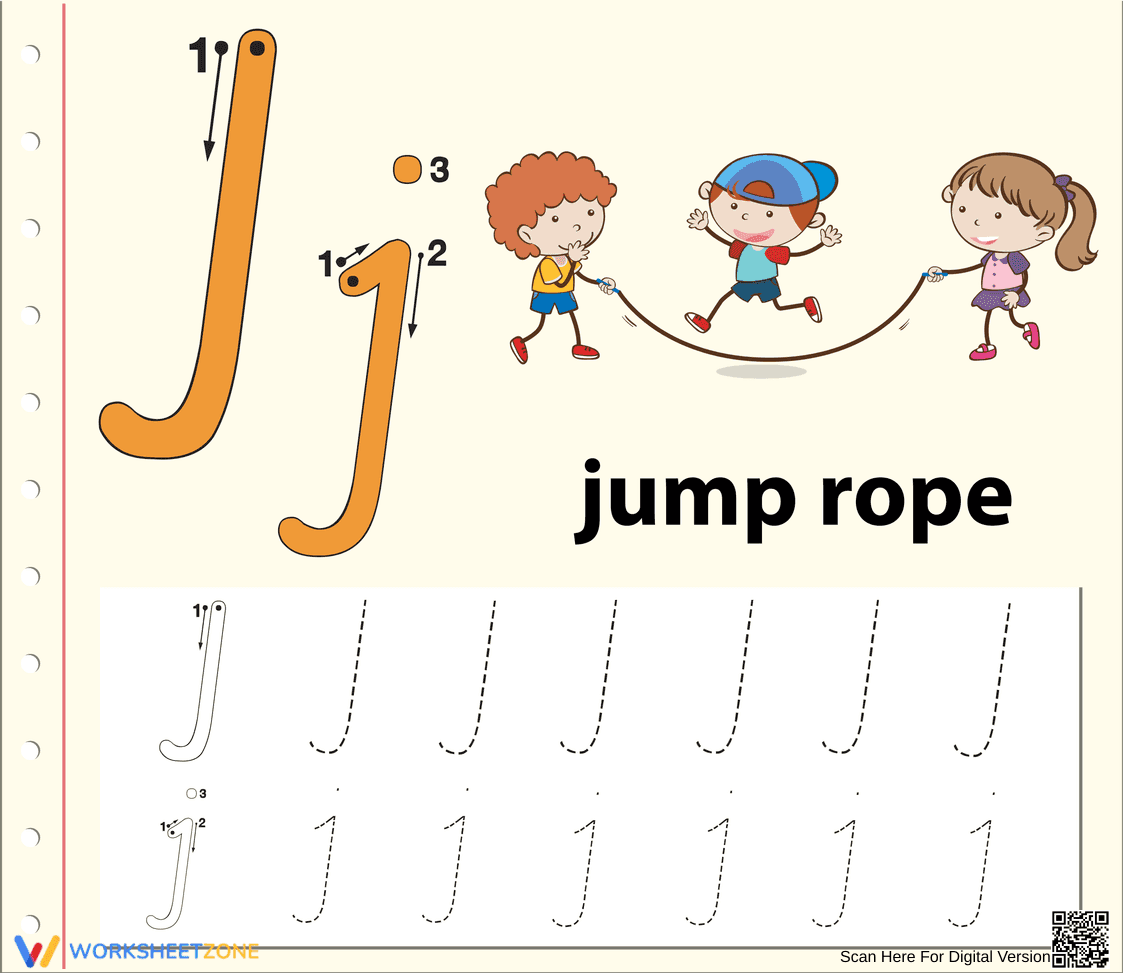

Letter J Tracing Worksheet | Essential Kindergarten Ready

Paste this activity's link or code into your existing LMS (Google Classroom, Canvas, Teams, Schoology, Moodle, etc.).
Students can open and work on the activity right away, with no student login required.
You'll still be able to track student progress and results from your teacher account.
This handwriting worksheet provides a focused approach to mastering the letter J through guided tracing and visual cues. By combining uppercase and lowercase practice with a memorable "jump rope" mnemonic, students develop the muscle memory required for fluid writing. This resource ensures early learners understand correct stroke directionality from the start.
At a Glance
- Grade: Kindergarten · Subject: Handwriting
- Standard:
CCSS.ELA-LITERACY.L.K.1.A— Print many upper- and lowercase letters accurately and legibly- Skill Focus: Letter J formation
- Format: 1 page · 14 problems · Answer key N/A · PDF
- Best For: Daily morning work or literacy centers
- Time: 5–10 minutes
The worksheet features a clear, large-scale model of both uppercase 'J' and lowercase 'j' at the top, complete with numbered arrows indicating the correct stroke sequence. Below the instructional models, students find two dedicated rows for practice. The first row contains 7 uppercase 'J' tracing opportunities, while the second row provides 7 lowercase 'j' tracing tasks. The inclusion of a "jump rope" illustration serves as a phonemic anchor, connecting the letter shape to a familiar "J" sound activity.
This resource is designed for a zero-prep classroom environment. To implement, simply print the single-page PDF (30 seconds). Distribute the sheets to students during your phonics or handwriting block (1 minute). Finally, review student work by checking for proper "hook" formation and dot placement on the lowercase 'j' (1 minute). Total teacher preparation time is under 2 minutes, making it an ideal choice for sub plans or transition periods.
This activity is directly aligned with `CCSS.ELA-LITERACY.L.K.1.A`, which requires students to print many upper- and lowercase letters. By providing dotted-line scaffolds and directional arrows, the worksheet supports the developmental transition from gross motor movements to refined fine motor control. This standard code can be copied directly into lesson plans, IEP goals, or district curriculum mapping tools.
Use this worksheet as a formative assessment during the "You Do" phase of a gradual release lesson. After demonstrating the letter J on the whiteboard, have students complete the tracing tasks independently. Alternatively, place the sheet in a dry-erase pocket within a literacy center for repeated practice. Observe if students follow the numbered arrows or if they begin the strokes from the bottom, which is a common error to correct early.
This resource is tailored for preschool and kindergarten students who are beginning their journey into literacy. It is also highly effective for Grade 1 students requiring remedial handwriting support or occupational therapy interventions. Pair this worksheet with a "Letter J" alphabet song or a physical jump rope activity to reinforce the letter-sound connection through multisensory learning.
Effective handwriting instruction in early childhood is a critical predictor of later writing success and reading fluency. According to the RAND AIRS 2024 report on foundational literacy, explicit instruction in letter formation—specifically using directional cues and stroke models—reduces the cognitive load on young writers, allowing them to eventually focus on higher-order composition tasks. Research by Fisher & Frey (2014) emphasizes that short, frequent bursts of guided practice, such as the 14-task sequence provided here, are more effective for motor skill acquisition than long, repetitive drills. By aligning with CCSS.ELA-LITERACY.L.K.1.A, this worksheet ensures that students meet national benchmarks for legibility. The integration of visual mnemonics, like the jump rope, further supports orthographic mapping, which is essential for long-term letter recognition and recall in diverse classroom settings.


