


























Views
Downloads
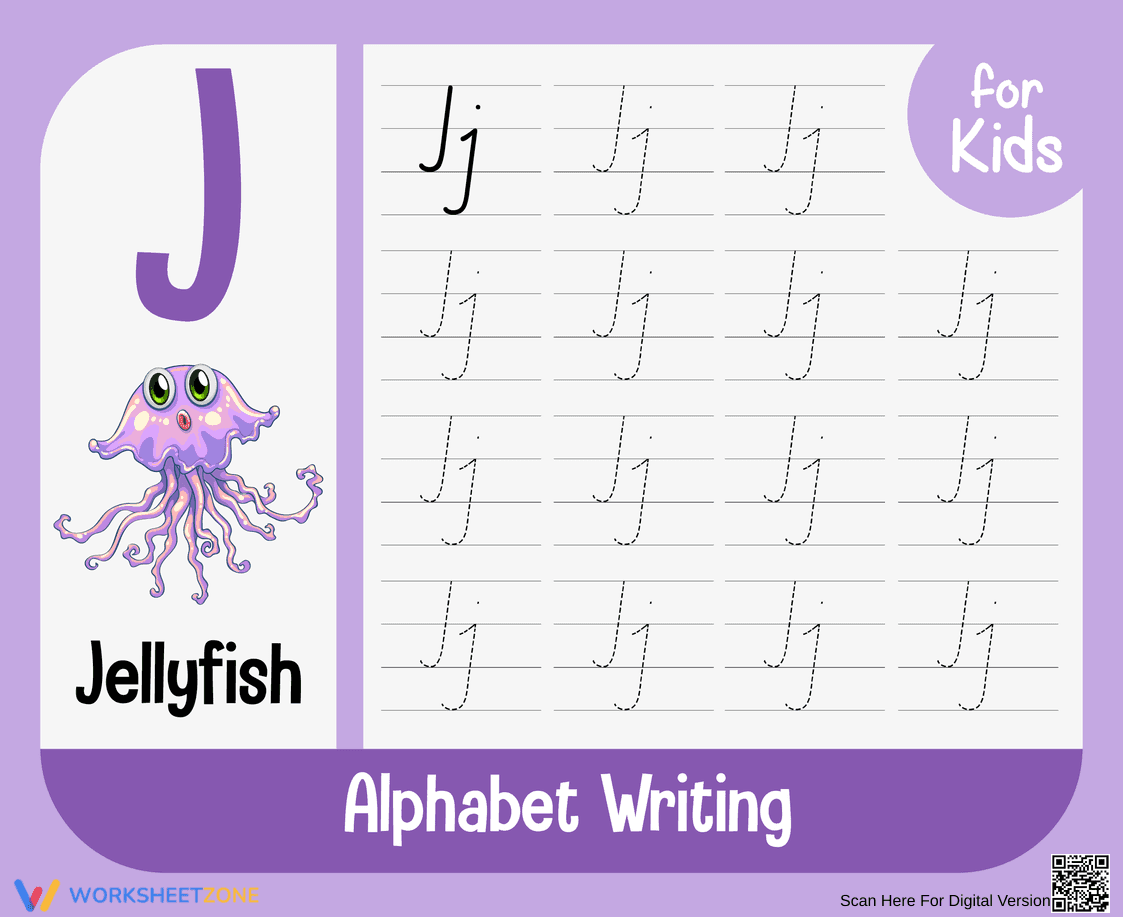

Printable Letter J Tracing Worksheet | Kindergarten ELA
Paste this activity's link or code into your existing LMS (Google Classroom, Canvas, Teams, Schoology, Moodle, etc.).
Students can open and work on the activity right away, with no student login required.
You'll still be able to track student progress and results from your teacher account.
This single-page handwriting worksheet helps early learners master the formation of the uppercase and lowercase letter J. By tracing guided D'Nealian-style letters, students develop fine motor control and muscle memory essential for fluent writing. The engaging jellyfish illustration provides a helpful phonetic anchor for letter recognition.
At a Glance
- Grade: Kindergarten · Subject: English Language Arts
- Standard:
CCSS.ELA-LITERACY.L.K.1.A— Print many upper- and lowercase letters.- Skill Focus: Letter Formation and Tracing
- Format: 1 page · 15 problems · No answer key needed · PDF
- Best For: Independent practice and morning work
- Time: 10–15 minutes
Inside this resource, educators will find a straightforward, highly focused tracing activity. The page features a large example of the letter J alongside a visual vocabulary cue (jellyfish). Below this, students are provided with fifteen sets of dotted uppercase and lowercase J pairs on standard primary writing lines. The continuous-stroke font style supports students transitioning toward cursive or D'Nealian handwriting, ensuring proper letter proportions.
Zero-Prep Workflow
This resource is designed for immediate classroom implementation, requiring under two minutes of total teacher preparation time.
- Print (1 minute): Download the PDF and print copies. The minimal graphics ensure low ink consumption.
- Distribute (1 minute): Hand out during morning routines. The visual instructions are self-explanatory.
- Review (Ongoing): Monitor student grip and stroke direction. No formal grading key is required, making it an ideal substitute teacher plan.
Standards Alignment
This handwriting activity aligns directly with CCSS.ELA-LITERACY.L.K.1.A: Print many upper- and lowercase letters. By providing structured, repetitive tracing paths, the worksheet ensures students practice the exact motor movements required to meet this foundational literacy standard. Both standard codes can be copied directly into lesson plans, IEP goals, or district curriculum mapping tools.
How to Use It
This tracing sheet is highly versatile. First, it serves as an excellent morning work activity; students can immediately begin tracing as they settle into the classroom. Second, it functions perfectly within a dedicated literacy center. As a formative assessment tip, teachers should observe students while they trace to ensure they start strokes from the top line rather than the bottom. Expected completion time is ten to fifteen minutes.
Who It's For
This worksheet is primarily designed for Kindergarten and Preschool students who are developing their fine motor skills and learning the alphabet. It is also highly beneficial for first-grade students who need targeted intervention or remediation in letter formation. For differentiation, teachers can provide textured surfaces underneath the paper for tactile feedback. This activity pairs naturally with a read-aloud book featuring words that start with the letter J or a classroom alphabet anchor chart.
Developing automaticity in letter formation is a critical precursor to expressive writing and reading fluency. According to Fisher & Frey (2014), explicit instruction and repeated practice in handwriting significantly reduce the cognitive load required for transcription, allowing young learners to allocate more mental resources to idea generation. This targeted practice aligns with CCSS.ELA-LITERACY.L.K.1.A, which requires students to print many upper- and lowercase letters accurately. By engaging in structured tracing exercises, students build the necessary muscle memory and fine motor control to produce legible text independently. Consistent, brief periods of handwriting practice yield better long-term retention of letter shapes. Integrating this foundational skill work into daily routines ensures early learners establish the physical mechanics of writing, setting a strong trajectory for future academic success.


