


























Views
Downloads

Letter J Flashcards & Tracing | Printable Kindergarten
Paste this activity's link or code into your existing LMS (Google Classroom, Canvas, Teams, Schoology, Moodle, etc.).
Students can open and work on the activity right away, with no student login required.
You'll still be able to track student progress and results from your teacher account.
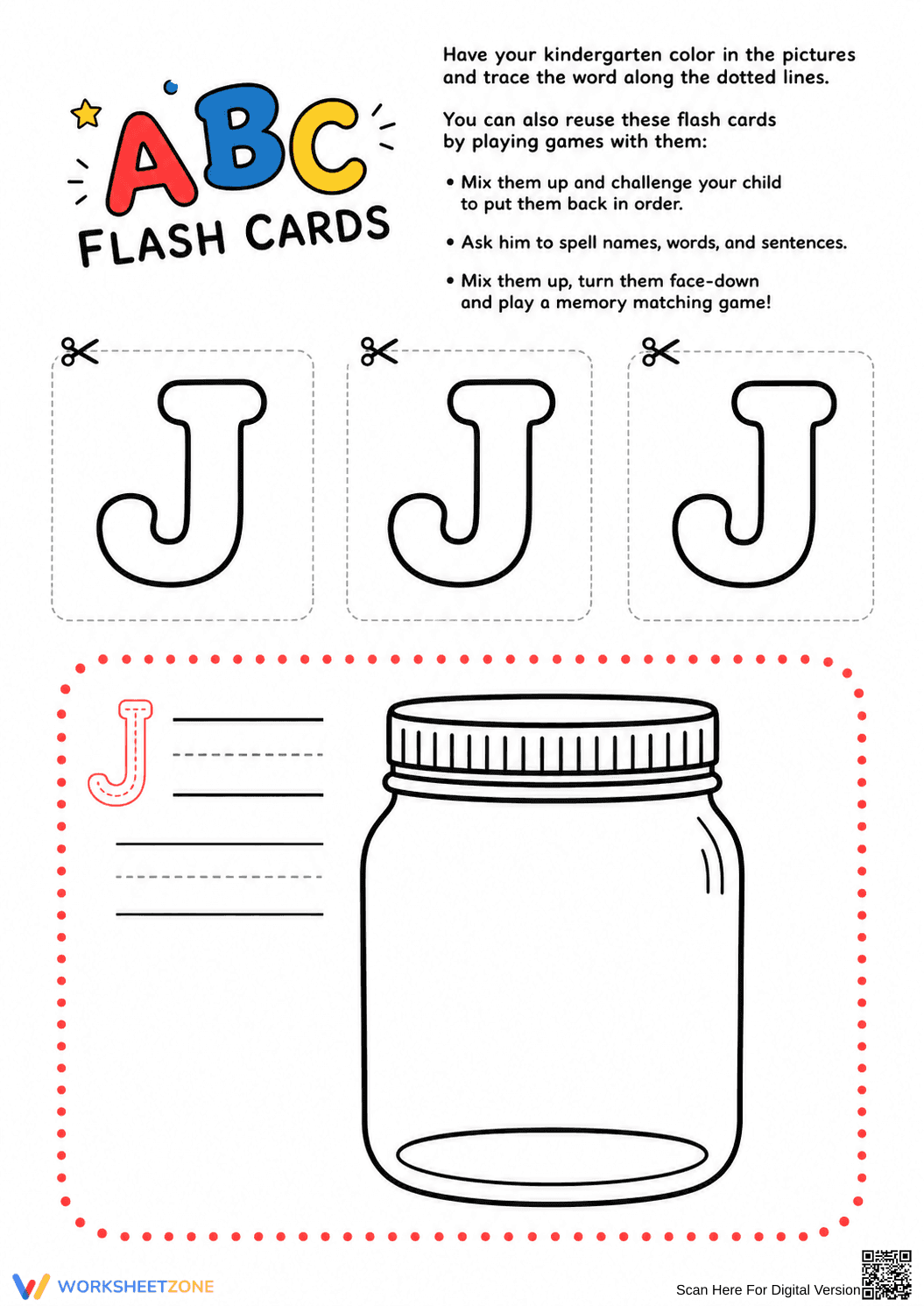
This printable Kindergarten worksheet helps students recognize, trace, and sound out the letter J. By combining hands-on flashcards with guided handwriting practice, young learners build foundational phonics and fine motor skills. The engaging format keeps early readers focused while reinforcing essential alphabet knowledge.
At a Glance
- Grade: Kindergarten · Subject: ELA
- Standard:
CCSS.ELA-LITERACY.RF.K.1.D— Recognize and name all upper- and lowercase letters.- Skill Focus: Letter J recognition and tracing
- Format: 1 page · 3 tasks · No answer key · PDF
- Best For: Independent practice or centers
- Time: 10–15 minutes
This single-page resource features three distinct activities to reinforce letter recognition. The top section includes three cut-out letter J flashcards for memory games or sequencing. The bottom section provides guided tracing lines for handwriting practice alongside a large illustration of a jar for students to color, connecting the letter to its beginning sound.
Zero-Prep Workflow
This worksheet requires minimal teacher preparation.
- Print (1 minute): Simply print the single-page PDF. Requires only scissors, crayons, and pencils.
- Distribute (1 minute): Hand out the worksheets during literacy centers or morning work. The visual instructions make it easy for young learners to begin independently.
- Review (1 minute): Quickly check the tracing section for proper letter formation and ensure the flashcards are cut correctly.
With under two minutes of total prep time, this resource is an excellent addition to any emergency sub plan or busy morning routine.
Standards Alignment
This resource is directly aligned to CCSS.ELA-LITERACY.RF.K.1.D, requiring students to recognize and name all upper- and lowercase letters of the alphabet. It also supports foundational phonics skills by connecting the letter J to a familiar object. Both standard codes can be copied directly into lesson plans, IEP goals, or district curriculum mapping tools.
How to Use It
This worksheet fits perfectly into morning work or literacy centers. Before direct instruction, teachers can use the flashcards to introduce the letter J and assess prior knowledge. During independent practice, students can complete the tracing and coloring sections while the teacher circulates to observe pencil grip and stroke direction. As a formative assessment tip, ask students to name the letter and its sound before they begin coloring the jar. Expect completion in 10 to 15 minutes.
Who It's For
Designed for Kindergarten students developing early literacy and fine motor skills. It also serves as a helpful intervention tool for first graders who need additional support with letter recognition and handwriting. For differentiation, teachers can pre-cut the flashcards for students struggling with scissor skills. This worksheet pairs naturally with an anchor chart featuring other "J" words or a read-aloud focused on the same letter.
Effective early literacy instruction relies heavily on explicit teaching of letter-sound correspondences and letter formation. According to a 2024 report by EdReports, integrating multisensory activities—such as cutting, tracing, and coloring—significantly improves retention of foundational reading skills in early childhood settings. This resource supports that methodology by targeting CCSS.ELA-LITERACY.RF.K.1.D, which asks students to recognize and name all upper- and lowercase letters. By combining tactile flashcard manipulation with guided handwriting practice, educators can provide a comprehensive approach to alphabet mastery. The inclusion of a familiar visual cue, like the jar, further reinforces the phonetic connection, ensuring that young learners build a robust framework for future decoding and encoding tasks. This targeted, hands-on practice is absolutely essential for developing confident, fluent readers who can easily transition into more complex phonics instruction.


