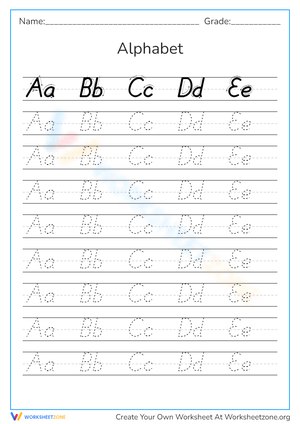
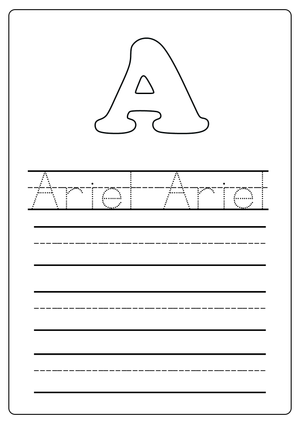
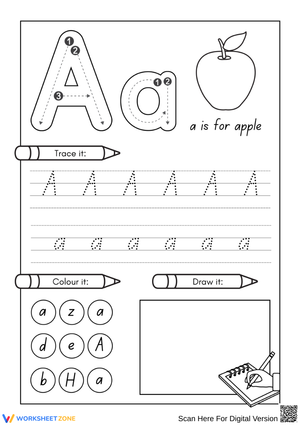
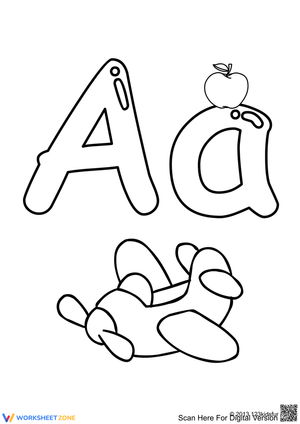
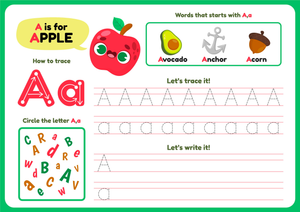
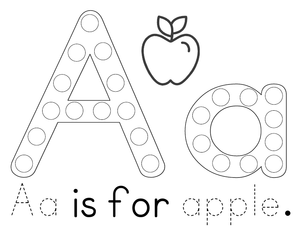
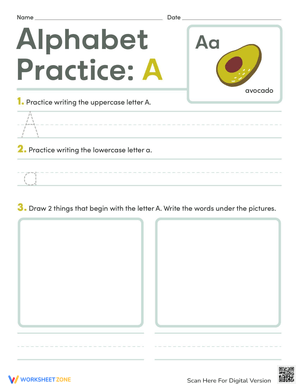
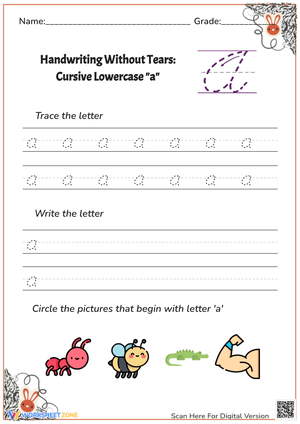
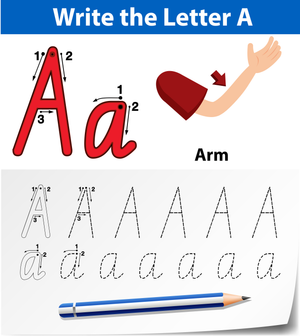
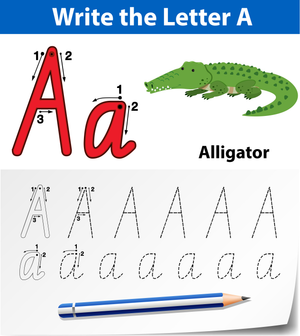
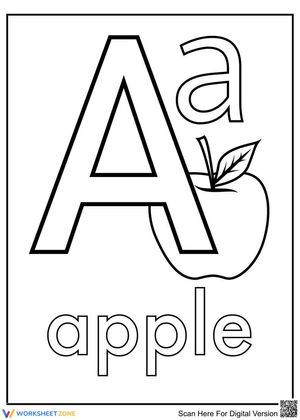
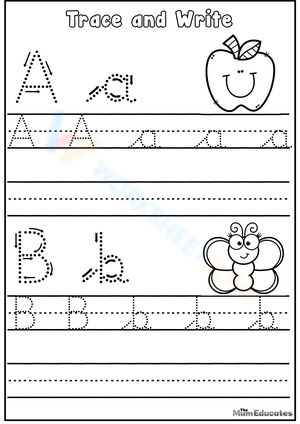
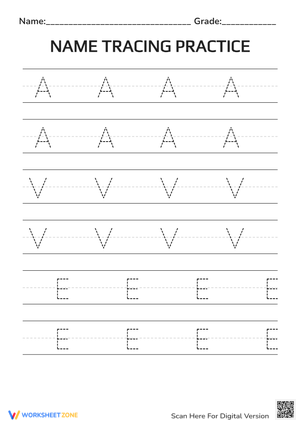
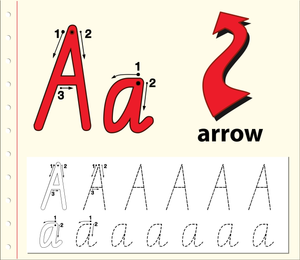
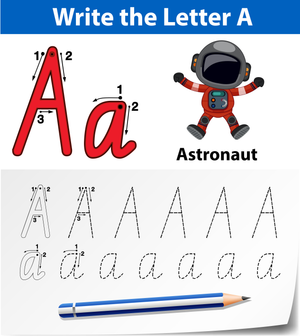
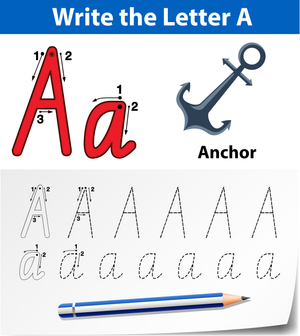
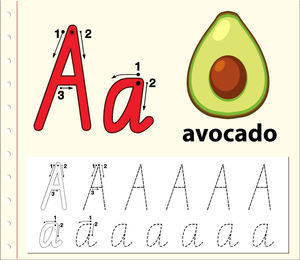
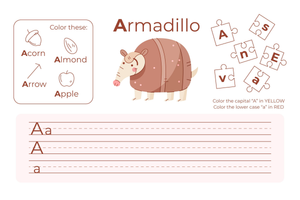
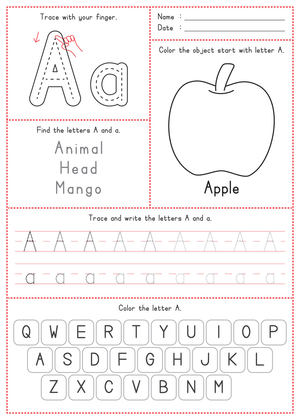
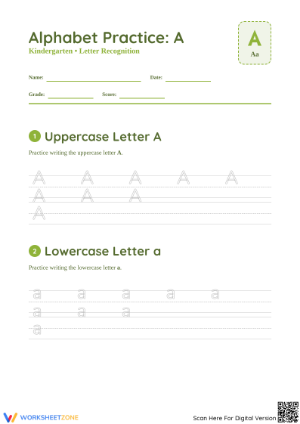
1st grade letter a handwriting pdf worksheets give teachers a print-ready set of formation practice covering both uppercase and lowercase forms — the same two shapes students will write hundreds of times across every journal entry, sight word activity, and phonics task they encounter in first grade. Each worksheet isolates a specific aspect of letter A formation so teachers can assign exactly the practice a student needs rather than cycling through a generic handwriting packet.
The Specific Skills These Worksheets Build
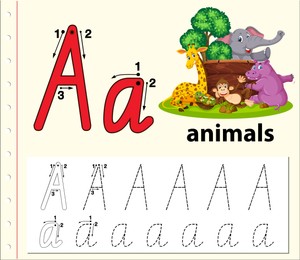
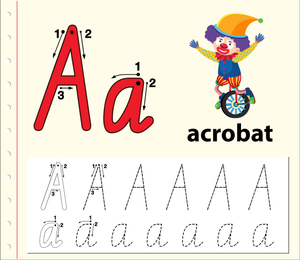
The set builds four distinct but connected skills. First, stroke sequencing: students learn to begin the uppercase A at the apex, pull two diagonal lines outward and down, then add a horizontal crossbar at mid-height. Second, lowercase circle-and-tail formation: the circular portion of a must close completely before the tail drops from the midline to the baseline. Third, letter sizing within ruled space — specifically, understanding that uppercase A fills the full writing height while lowercase a sits entirely between the midline and baseline. Fourth, consistent spacing when writing A inside CVC words like cat, bat, and map.
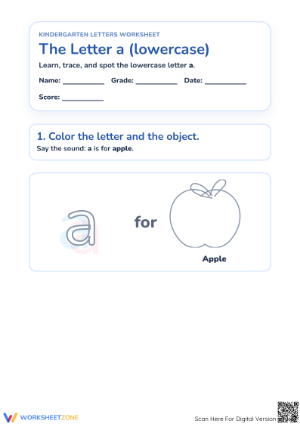
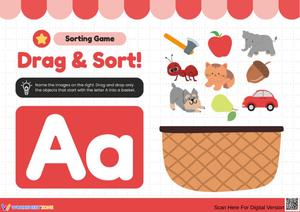
Several worksheets pair the letter directly with short-vowel phonics images — an apple, an ant, an axe — so students trace the letter while rehearsing the /æ/ sound it represents. Connecting orthographic form to phoneme during handwriting practice strengthens the same neural pathway used during reading, which is why this format outperforms isolated tracing drills for long-term retention. Students who write and say the sound simultaneously are doing literacy work, not just penmanship work.
Why Letter A Formation Is Harder Than It Looks at This Age
Most 6-year-olds handle vertical and horizontal strokes before they handle diagonals, because diagonal lines require the hand to move at an angle that doesn't align with the natural wrist pivot. Uppercase A is one of the first letters that demands two diagonal strokes meeting at a precise peak — a motor challenge distinct from anything students practiced in kindergarten's curved and straight-line letters. The lowercase form adds a second complication: the circle must close cleanly before the tail is drawn. Students who learned to write lowercase a in isolation will often rush the closure when writing inside a word, producing a shape that reads as ci or u to anyone trying to decode it.
Fitting These Worksheets Into the School Week
The most reliable placement for focused letter formation practice is the 10-to-12 minutes after morning meeting, before the reading block begins. Students are seated, the transition cost is low, and the task serves as an intentional warm-up for the fine motor work that follows in writing workshop. 1st grade letter a handwriting pdf worksheets work equally well as a literacy center station — one group traces and writes while another works with magnetic letters or reads decodable text — which lets the teacher pull a small group for close observation without the rest of the class waiting.
For whole-class introduction, a document camera changes the experience considerably. Projecting a worksheet and narrating the stroke sequence aloud — "start at the top, slide left, slide right, crossbar at the waist" — gives students an auditory anchor they can repeat independently. After the model, circulate during the first row of tracing. That first row is when grip errors and stroke reversals surface, and catching them before students complete a full page of reinforced bad habits is far more efficient than correcting them later.
Errors Worth Watching For Before They Calcify
The crossbar on uppercase A consistently lands too low. Students who correctly execute both diagonal strokes will still draw the horizontal bar near the bottom third of the letter rather than at mid-height, producing something closer to a capital lambda (Λ) with a low cross. The fix is concrete: mark a dot at mid-height on the first few practice letters so students have a target to aim for rather than an estimate to make. The verbal cue "bar at the waist, not the knees" is one those students remember.
For lowercase a, the most persistent error is an open circle — the pencil approaches the starting point but never quite closes the loop, leaving a gap at roughly the 1 o'clock position. The resulting letter is ambiguous in any word where a sits next to a tall consonant. A second pattern: students who write with heavy pencil pressure will sometimes flatten the bottom of the circle into a near-straight line, giving the letter an egg shape. Both errors are visible immediately during the first row of practice, which is the right moment to address them.
Adjusting the Worksheets for Students at Different Stages
Students who are still developing pencil control benefit from enlarged copies printed at 115–120% scale, which gives them more room to form letters without cramping. 1st grade letter a handwriting pdf worksheets that feature dotted-line tracing with clear directional arrows provide the most support for these learners; they should work through every tracing row before attempting independent lines. An honest limitation of the tracing-heavy format: students who already form the letter accurately find it passive, and the pages hold little value for them beyond a quick warm-up.
For students who already write the letter correctly, the useful challenge is producing A within real words at normal spacing, then self-evaluating for consistency — circling the strongest example in each row and noting one thing that makes it their best. That metacognitive step tends to build more lasting precision than additional tracing at this stage. Students who need the most support sometimes respond well to tracing with a highlighter first; the broader tip reduces the precision demand just enough to establish initial confidence before pencil work begins.
Standard Alignment
These worksheets address CCSS.ELA-LITERACY.L.1.1a, which requires first graders to print all upper- and lowercase letters. In instructional terms, this standard sits at the intersection of handwriting mechanics and early writing fluency — teachers typically introduce each letter as part of the alphabetic sequence while reinforcing it through phonics and word work. Letter A, as the most frequently appearing short vowel in decodable texts, is usually addressed in the first weeks of Grade 1 and revisited throughout the year wherever word-level writing tasks appear. Meeting this standard in first grade reduces the cognitive load students carry in second grade, when attention needs to shift toward composition rather than letter formation.
Frequently Asked Questions
Does the lowercase 'a' in these worksheets match the print form used in most early readers?
Yes. The lowercase a is the standard two-stroke print form — circle plus tail — which matches the typeface in most leveled readers and decodable texts first graders use. This is distinct from the single-story a found in some digital fonts, which can create brief confusion when students encounter it on a screen. Aligning handwriting instruction to the print form students read most reduces letter recognition interference during decoding.
How many minutes of practice per session is appropriate for a 6-year-old?
Ten to fifteen minutes is the practical ceiling before hand fatigue begins to degrade letter quality — and degraded quality practiced repeatedly is exactly what teachers are trying to prevent. 1st grade letter a handwriting pdf worksheets are sized so that one worksheet fits comfortably within that window. Short daily sessions across four or five days produce more durable formation habits than a single extended block, because distributed practice gives motor memory time to consolidate between attempts.
What should I do if a student has already developed an incorrect stroke sequence for the letter A?
Re-teach the stroke sequence explicitly using a multisensory approach before returning to paper. Have the student trace a large model on the whiteboard, narrate the sequence aloud, then sky-write the letter several times using a full arm movement. The goal is to interrupt the existing motor pattern by rehearsing a competing sequence at a scale where the incorrect habit is less entrenched. Once the correct sequence feels natural at large scale, the transition back to fine-motor paper practice goes considerably faster.












 Interactive Worksheet Maker
 Quiz Maker
 Word Search Maker
 Crossword Puzzle Maker
 Word Scramble Generator
 Sentence Scramble Generator
 Handwriting Worksheet Generator
 Name Tracing Generator
 Fill In The Blank Generator