


























Views
Downloads

Printable Letter J Worksheet | Kindergarten ELA
Paste this activity's link or code into your existing LMS (Google Classroom, Canvas, Teams, Schoology, Moodle, etc.).
Students can open and work on the activity right away, with no student login required.
You'll still be able to track student progress and results from your teacher account.
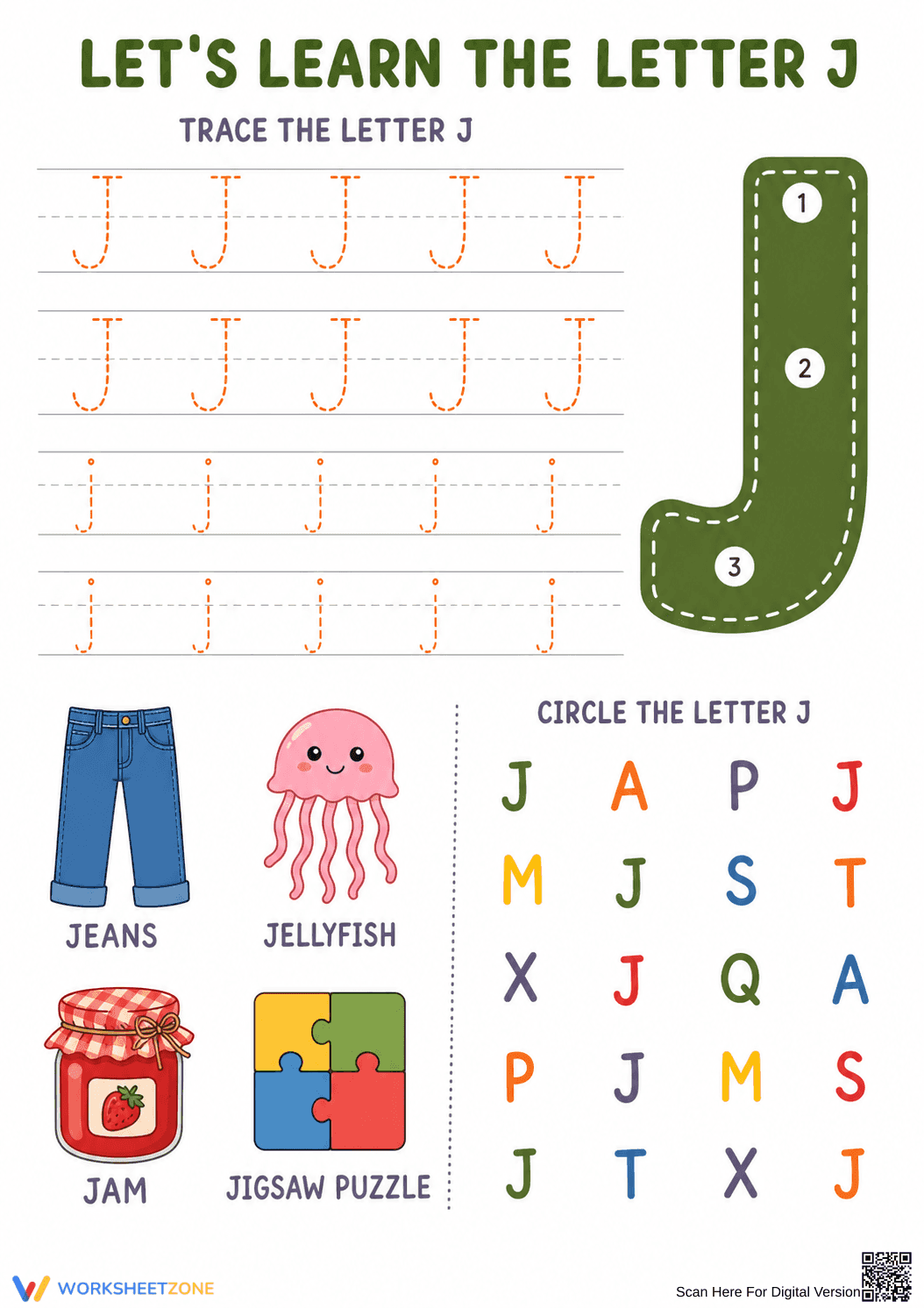
This printable Kindergarten phonics worksheet helps students master the letter J through targeted handwriting practice and visual recognition tasks. By tracing forms and identifying the letter among distractors, early learners build essential alphabet fluency and fine motor skills required for reading readiness.
At a Glance
- Grade: Kindergarten · Subject: ELA
- Standard:
CCSS.ELA-LITERACY.RF.K.1.D— Recognize and name all upper- and lowercase letters.- Skill Focus: Letter J recognition and tracing
- Format: 1 page · 27 problems · No answer key · PDF
- Best For: Independent morning work
- Time: 10–15 minutes
What's Inside
This single-page resource features three activity zones. The top section provides 20 guided tracing opportunities for uppercase and lowercase J on standard handwriting lines. The bottom left introduces four beginning sound vocabulary words—jeans, jellyfish, jam, and jigsaw puzzle. Finally, the bottom right contains a letter hunt grid where students visually discriminate and circle seven instances of the letter J hidden among other characters.
Zero-Prep Workflow
This worksheet requires zero teacher preparation.
- Print (1 min): Download the PDF and print. The high-contrast design ensures clear reproduction.
- Distribute (1 min): Hand out sheets with pencils. Instructions are intuitive for non-readers.
- Review (1 min): Scan the letter hunt grid and tracing lines to check accuracy.
Total teacher prep time is under two minutes, making this an excellent emergency sub plan.
Standards Alignment
This activity is directly aligned to CCSS.ELA-LITERACY.RF.K.1.D, requiring students to recognize and name all upper- and lowercase letters of the alphabet. It also supports early writing standards by having students print upper- and lowercase letters. Both standard codes can be copied directly into lesson plans, IEP goals, or district curriculum mapping tools.
How to Use It
Teachers can utilize this resource as independent morning work to establish a focused routine while reinforcing the letter of the week. Alternatively, it serves as an effective literacy center station following direct instruction. As a formative assessment tip, observe students while they complete the tracing section to ensure they are starting their strokes at the top line and moving downward, correcting pencil grip as necessary. Most K-1 students will complete this worksheet in 10 to 15 minutes.
Who It's For
This worksheet is primarily designed for Kindergarten students developing foundational phonics and handwriting skills. It is also highly beneficial for preschool students who are ready for structured letter practice, or first-grade students requiring targeted intervention on letter reversals or recognition. For differentiation, teachers can provide textured materials like glitter glue for tracing, or pair this worksheet with a tactile alphabet anchor chart to support kinesthetic learners.
Mastering alphabet recognition and proper letter formation is a critical milestone in early childhood literacy development. According to a comprehensive EdReports 2024 analysis of foundational reading skills, explicit instruction in letter-sound correspondence combined with physical handwriting practice significantly accelerates reading acquisition. This worksheet directly supports CCSS.ELA-LITERACY.RF.K.1.D by requiring students to recognize and name all upper- and lowercase letters. By integrating visual discrimination tasks—such as the letter hunt grid—with guided tracing exercises, educators provide the multimodal repetition necessary for orthographic mapping. The inclusion of beginning sound vocabulary further bridges the gap between abstract symbols and concrete language. Consistent practice with targeted resources like this ensures students build the automaticity required to decode more complex texts as they progress through primary grades, establishing a robust foundation for lifelong literacy success.


