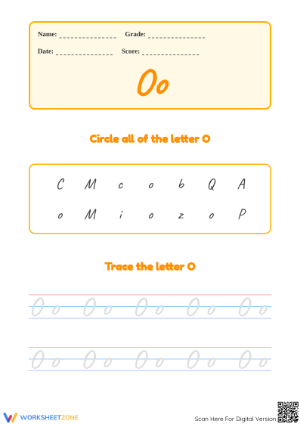
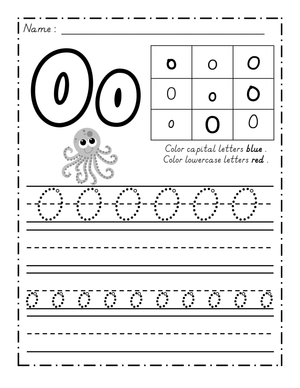
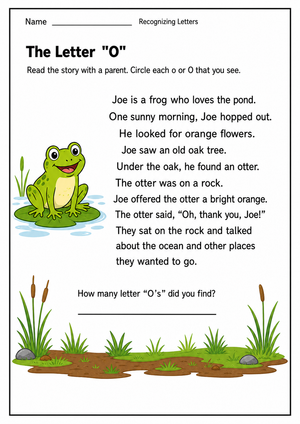
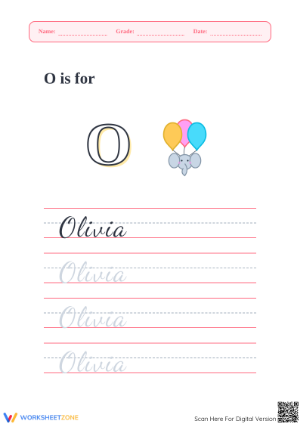
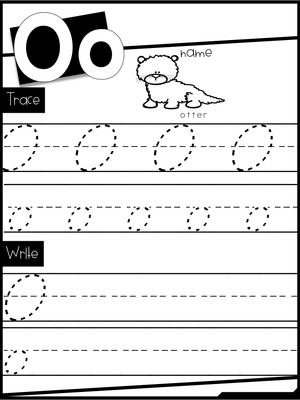
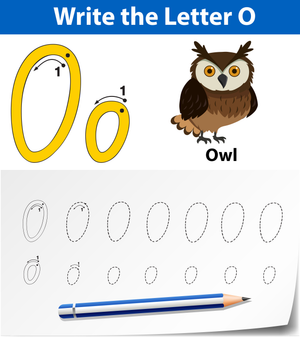
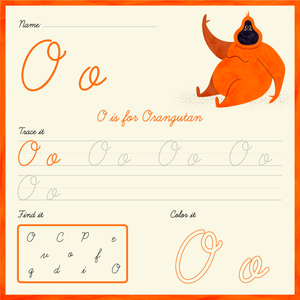
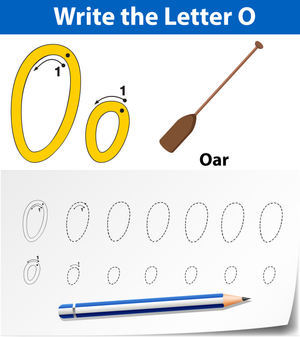
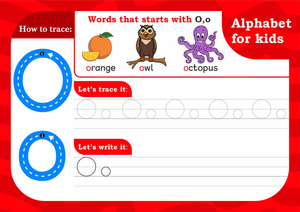
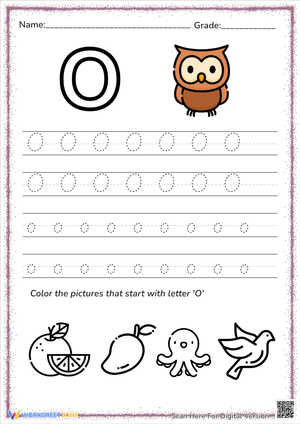
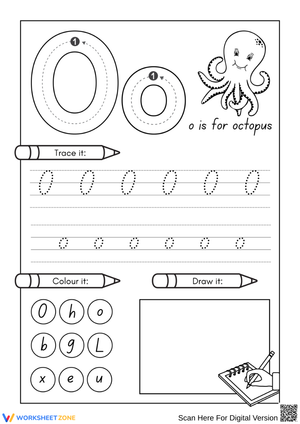
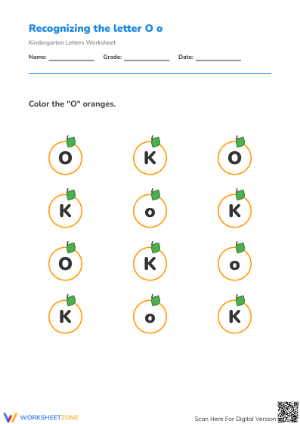
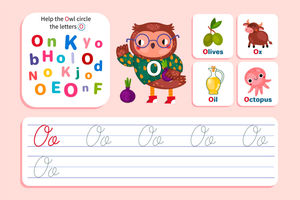
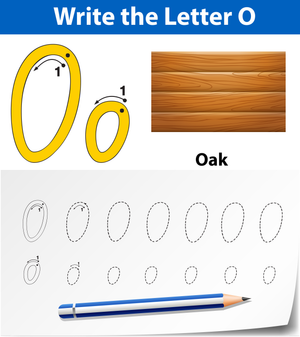
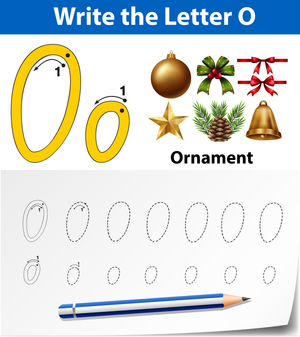
These letter o handwriting pdf worksheets for 1st grade target one of the most deceptively simple letters in the alphabet — a shape that looks like a quick circle but requires a precise, continuous counter-clockwise stroke that many six-year-olds have not yet automated. Each worksheet isolates uppercase and lowercase O formation on three-line primary paper, pairs the letter with short and long vowel vocabulary, and progresses from closely guided tracing toward independent production.
Why the Letter O Is Harder to Teach Than It Looks
First graders arrive with uneven fine motor histories. Some have drawn circles through years of preschool art; others are still building the wrist stability to hold a consistent arc. The letter O demands a single unbroken stroke: begin near the two o'clock position, arc down and to the left, sweep along the baseline, and return to close at the starting point. That closing moment — where the pencil must rejoin its own beginning without a bump or visible seam — is where most children lose control. Unlike straight-line letters such as L or T, the letter O offers no natural resting point to reset grip or posture. For students who hold the pencil in a fist rather than a tripod position, the counter-clockwise arc works against the natural outward rotation of the wrist. Add the spatial challenge of keeping the uppercase form between the top rule and baseline while confining the lowercase form between the midline and baseline, and O earns its place as a genuine instructional target rather than a warmup letter.
What's Inside the Set
- Tracing lines for uppercase O and lowercase o with directional arrows marking the two o'clock starting point
- Copy rows without arrows that require students to reproduce the stroke from memory
- Short-vowel O vocabulary words — ox, odd, otter — and long-vowel O words — open, oval, over
- Sentence-level practice that places uppercase O at the start of a sentence and lowercase o within words
- Letter recognition tasks where students circle every O in a short word list, reinforcing visual discrimination alongside formation
Each worksheet moves from higher support to reduced support within a single session. The first rows trace with directional arrows, the middle rows trace without arrows, and the final rows require the student to write from memory. That structure mirrors the gradual release of responsibility without requiring separate materials for different phases of instruction.
Errors Worth Anticipating Before You Distribute
The most persistent mistake is clockwise rotation. Students who have drawn suns, faces, and casual circles outside of school tend to default to a clockwise sweep because it aligns with the natural outward roll of the wrist. A clockwise O can look nearly correct in isolation — the problem becomes more obvious once the student writes words and the slight rightward tilt compounds across letters. Intercept this on the first attempt, not after a full row. Waiting means the motor pattern has already repeated six or eight times, and muscle memory at age six consolidates fast.
A second error is the two-stroke O: the student draws a C on one pass and closes the right side on a separate stroke. Watch for a faint pencil lift at the top right, or simply listen — students who use two strokes often produce a small audible tap when they reposition. The two-stroke habit disrupts writing flow once letters are placed inside words. The directional arrows on these worksheets address it visually, though that does not replace direct observation during a student's first guided attempts.
Fitting These Worksheets Into Your Writing Block
The most reliable placement for letter o handwriting pdf worksheets for 1st grade is the warm-up slot at the start of the writing block — roughly the first five to eight minutes before the day's composition focus begins. Students who open with a focused formation task transition into sentence and story writing more smoothly because the hand is already moving. Handing out a worksheet while taking attendance works as a quiet, purposeful entry task with no additional setup.
For phonics integration, distribute a worksheet during the same week the class studies short vowel O. When a child writes otter while hearing the /ŏ/ sound modeled aloud, the phonological and orthographic memories reinforce each other — a pairing backed by multisensory literacy research. The Friday review slot also works well: return a completed worksheet and ask students to circle their three best-formed O letters. That two-minute self-assessment builds attention to letter quality in ways that passive repetition does not.
Standard Alignment
These worksheets address CCSS.ELA-LITERACY.L.1.1a, which requires first graders to print all uppercase and lowercase letters legibly. Within that standard, the letter O sits at a specific developmental juncture: first grade is when students are expected to move past copying traced models into deliberate, independent production. Classroom patterns suggest that O formation is a useful informal benchmark near the middle of the year — students who still revert to two-stroke or clockwise formation in January often need additional fine motor attention before second grade's heavier writing demands arrive.
Adjusting the Set for Your Full Range of Learners
For students writing above grade level, skip the traced rows and assign only the independent writing lines, then extend the task by asking them to write two original sentences using O words they generate themselves. For students who find letter o handwriting pdf worksheets for 1st grade challenging at the standard entry point, add a pre-writing step: have the student trace a large O outline drawn on sandpaper, or move one finger through a shallow tray of salt before picking up the pencil. The tactile resistance slows the hand and makes the counter-clockwise direction more concrete than printed arrows can accomplish on their own.
English Language Learners still building vocabulary benefit from a small picture glossary attached to the worksheet — images of an otter, an oval, and an octopus provide a visual anchor for the vocabulary words before writing begins. If printing from a PDF editor, dual-language labels take under a minute to add before distributing.
Frequently Asked Questions
When should I correct a student's stroke direction — during the attempt or after the row is complete?
During the attempt, always. Once a student finishes a row of clockwise O letters, the incorrect pattern has already repeated eight or more times. Motor habits at age six form quickly, and a clockwise O practiced through a full row is harder to undo than one caught on the first stroke. Circulate during the first minute of independent practice specifically to intercept direction errors before they settle in.
Can these worksheets be used with kindergartners who are working above grade level?
Yes. The line sizing and vocabulary in letter o handwriting pdf worksheets for 1st grade are calibrated for first grade, but advanced kindergartners already writing on primary-ruled paper handle them without difficulty. The only adjustment worth making is a brief oral introduction to vocabulary words like oval and open, which may be unfamiliar to five-year-olds even when the letter formation itself is within reach.
How many practice sessions does it typically take for letter O formation to feel automatic?
Research on motor learning in early childhood places the range for new fine motor automaticity at roughly 30 to 50 correct repetitions. A single worksheet typically provides 20 to 30 correct attempts. Two or three sessions spread across a week — rather than massing all practice into one sitting — produce more durable retention because the motor memory consolidates between sessions. That spacing also gives the teacher a chance to see whether errors from the previous session have carried over into new work.