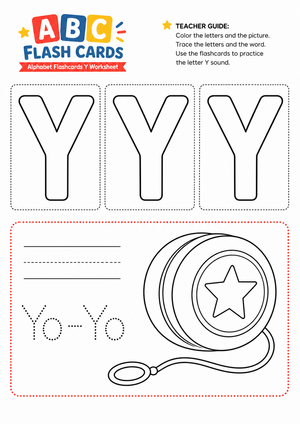
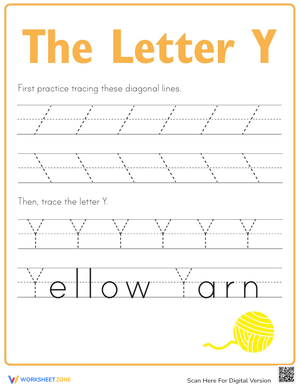
These 1st grade letter y handwriting worksheets give teachers targeted, ready-to-use practice for one of the more spatially demanding letters in the print alphabet — a letter that asks first graders to manage a midline junction, two diagonal strokes, and a descending tail that must drop below the baseline rather than sit on it. Each worksheet stands alone and covers both uppercase Y and lowercase y, moving students from traced models through guided copying and into independent writing on primary ruled lines.
The Specific Skills Targeted
Each worksheet focuses on a discrete piece of the letter or its application in words and sentences. Across the set, students practice:
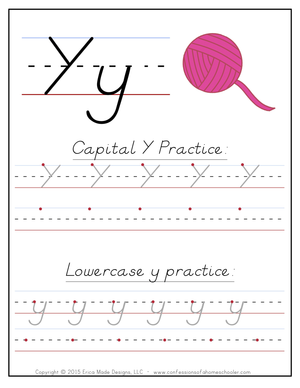
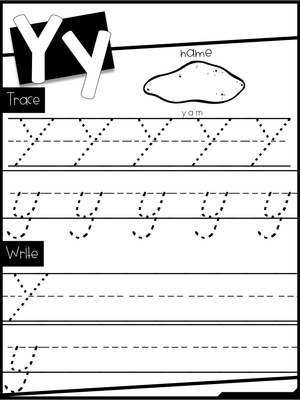
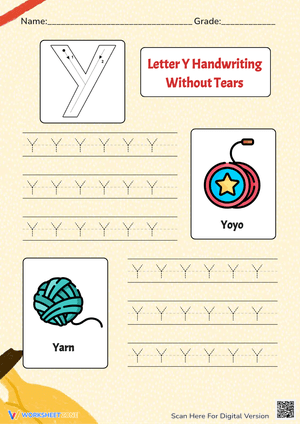
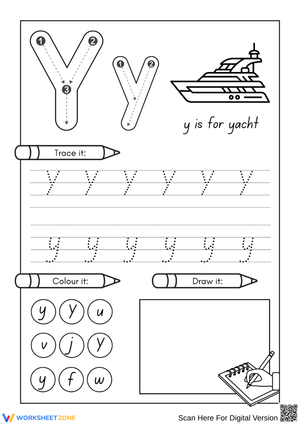
- Uppercase Y formation: Two diagonal strokes that meet at the midline, followed by a vertical stem dropping cleanly to the baseline. Numbered arrows on each model letter show correct sequence and directionality.
- Lowercase y formation: The diagonal slide, the crossing stroke, and the descending tail that extends into the basement zone below the line — the move most first graders resist.
- Letter discrimination: Sorting tasks that ask students to identify y among visually similar letters — v, u, and x — building recognition alongside motor memory.
- Word-level writing: Students write phonetically controlled words beginning with Y, such as yak, yarn, and yes, reinforcing the /y/ sound alongside the motor pattern.
- Sentence copying: Short sentences like The yak has yellow yarn give students practice with word spacing and line management while keeping the target letter frequent.
Why the Descender Is the Real Instructional Target
First graders encounter descender letters — g, p, q, j, and y — after spending most of kindergarten and early first grade on letters that sit entirely between the baseline and midline or ascend above it. When lowercase y arrives, it asks students to deliberately send a stroke below a line they've been trained to treat as a floor. That spatial reversal is counterintuitive at this age, which is why the descender error dominates student work on this letter well into the spring semester.
The 1st grade letter y handwriting worksheets in this set address that directly by using primary-ruled paper with a shaded basement zone printed on every practice row. When the visual cue lives on the page, students don't have to hold the teacher's verbal reminder in working memory at the same moment they're managing stroke direction and pencil pressure. That reduction in competing demands shows up quickly in work quality — students who have the spatial zone marked on their paper produce fuller, more accurate descenders within the first few practice lines.
Mistakes Students Make That These Worksheets Are Built to Catch
The dominant error is a compressed lowercase y that never actually descends. Students who have internalized the midline-to-baseline zone from practicing letters like n, h, and r bring that same spatial habit to y — the letter starts correctly with a diagonal, but the descending stroke stops at the baseline instead of continuing through it. The result resembles a lowercase v with a short stem, sitting neatly on the line but missing the letter's defining feature entirely.
A second pattern appears in uppercase Y. Some students form both diagonal arms all the way down to the baseline before adding the vertical stem, producing a shape that looks like a wishbone with a tail beneath it. The numbered-arrow models on each worksheet interrupt this before the wrong motor pattern has a chance to solidify.
A third error shows up specifically in sentence-level practice rather than isolated letter rows. Students write the y in yellow correctly when it's the only letter they're thinking about, then revert to the compressed form in the next word as attention shifts to spelling. The sentence practice rows exist precisely because that's where formation transfer breaks down — and catching it in context is more instructionally useful than tallying perfect isolated letters.
How to Fold These Worksheets Into Your Instructional Week
The most productive entry point is pairing a worksheet with gross motor pre-writing during the week y appears in your phonics sequence. Before students pick up pencils, have them trace the letter in the air with a full arm sweep — diagonals meeting at the midline, then a long drop below the imaginary baseline. That two-minute kinesthetic step maps the descender path in muscle memory and dramatically reduces how often students stop at the baseline when they move to paper. It's the difference between correcting eight students mid-row and correcting two.
During literacy centers, each worksheet in this 1st grade letter y handwriting worksheets set functions as an independent station while the teacher pulls a small reading group. Because no worksheet depends on completing a previous one, a student who spends extra time on the discrimination sort doesn't fall behind — they simply finish fewer rows, which is fine.
For early finishers, ask them to identify their three strongest letters on the page and put a light X through the one they'd most want to redo. That self-assessment move — naming what worked and what didn't — transfers directly into revision habits later in the year. Avoid saving these worksheets for the last five minutes before lunch or dismissal. Fine motor fatigue combined with a distracted room is exactly how compressed, floated letters become entrenched, and a rushed worksheet does more damage than skipping the day entirely.
Standard Alignment
These worksheets address CCSS ELA-LITERACY.L.1.1.A, which requires first graders to print all uppercase and lowercase letters legibly. In most classroom sequences, that standard receives its most concentrated attention in the spring semester, after students have cycled through the full alphabet once and are returning to individual letters with attention toward consistency. Lowercase y tends to land late in that review cycle because it demands spatial awareness — specifically the descender concept — that takes the first half of the year to develop. The functional goal is automaticity: when students no longer have to think about stroke sequence, that working memory becomes available for spelling, sentence construction, and idea development.
Adjusting the Set for a Range of Writers
Students with developing fine motor control do better on worksheets that use wider primary lines and larger model letters. Tracing a model that's proportionally large enough to follow with a standard pencil grip — rather than pinching a tiny printed letter — builds more accurate motor patterns at the start. If the line size is too narrow for a student's current control level, the practice produces frustration rather than improvement, and frustration with handwriting at this age is a quick path to avoidance.
Students who are already forming the letter accurately benefit most from the sentence-level rows rather than additional tracing. Extend the task by asking them to write a second sentence of their own using a Y word they choose — that move shifts the cognitive demand from reproduction to application without requiring any extra materials. For English language learners, the picture-word pairings on the vocabulary rows ground the letter's sound in a concrete referent; pointing to the image and saying the word aloud before writing it meaningfully supports phonemic connection for students still acquiring English oral vocabulary alongside print conventions.
Frequently Asked Questions
My students keep stopping the lowercase y tail at the baseline instead of going below it. What actually works?
Draw a thick yellow or green highlighter line along the baseline of their practice rows and tell them the tail has to cross through it. The physical act of breaking through a visible line makes the spatial target concrete in a way that verbal reminders rarely accomplish on their own. Most students self-correct within one session once they can see exactly where the stroke is supposed to land.
How many repetitions of the letter are appropriate per practice session?
Stop before fatigue sets in — for most first graders, that means two rows of tracing and two rows of independent writing, not five of each. A fatigued writer produces compressed, irregular letters that look identical to the formation errors you're trying to correct, so pushing past a student's stamina threshold works against the goal. The structure of each worksheet in this 1st grade letter y handwriting worksheets set is calibrated to stay within that range.
Is it worth correcting stroke order if a student has already learned the letter a different way?
Yes — and earlier is far better than later. Stroke-order errors are motor habits, and motor habits become significantly harder to undo with each repetition. Have the student trace the numbered-arrow model with a finger while narrating each stroke aloud — "diagonal down, cross, tail below the line" — before touching pencil to paper. Multisensory repetition of the correct sequence overwrites the wrong one faster than pencil practice alone, usually within a few focused sessions.