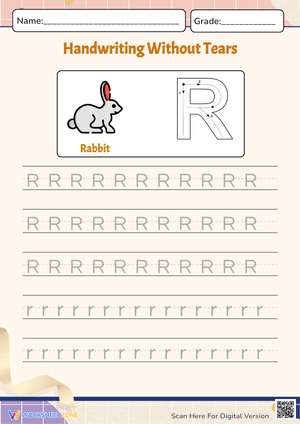
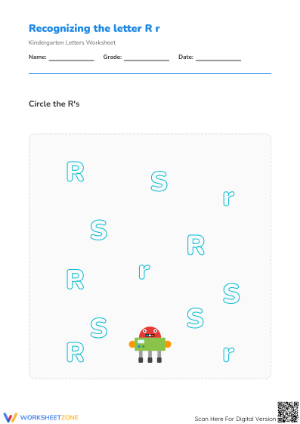
These 1st grade letter r handwriting worksheets give teachers a focused set of exercises for one of the alphabet's more technically demanding letters — separate worksheets for the uppercase and lowercase forms that move students from guided tracing toward independent production on standard ruled lines. Each worksheet targets a distinct phase of formation rather than cycling through the same trace-and-copy loop: students leave each session having practiced a specific stroke component, not simply having filled in letters.
What Each Worksheet Has Students Do
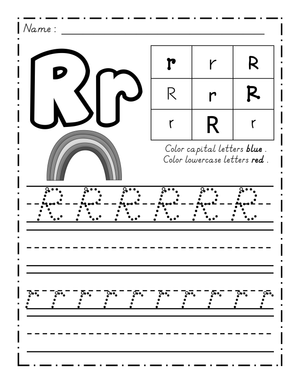
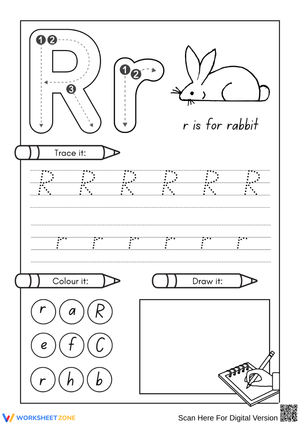
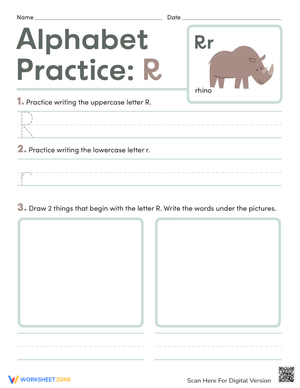
The sequence within each worksheet moves deliberately. Students trace dotted letterforms guided by numbered stroke arrows, then copy the letter in boxes that include baseline, midline, and top-line rules. Final rows ask for independent writing alongside a short R word — run, red, rabbit, rope — tying the motor practice to phonics vocabulary students already know. Most worksheets open with a letter-recognition row: students circle every uppercase R and lowercase r in a mixed line of letters before picking up a pencil, activating visual discrimination before the motor work begins.
Why the Letter R Is Technically Demanding at This Grade Level
Uppercase R is a three-stroke letter — more complex than most of what 1st graders have learned before it. The correct sequence: a straight vertical line from the top rule to the baseline, then a forward bump from the top rule to the midline (the same arc as uppercase P), and finally a diagonal leg that kicks toward the bottom right. That leg is where student work consistently breaks down. It must originate at the midpoint of the bump, not the baseline — students who miss this produce something that reads as P, F, or an unidentifiable shape. The lowercase r adds a different challenge entirely: it is a retraced stroke, meaning the pencil travels from the midline down to the baseline, then reverses along the same path before curving right into a short shoulder. Any pencil lift during that reversal collapses the letter form.
Formation Errors Worth Anticipating in 1st Grade Work
The most consistent error with lowercase r is conversion to n. Students curve the shoulder all the way back to the baseline, completing a full arch. The verbal cue "bump and stop" — delivered before pencil touches paper — addresses this directly. A comparison row built into each worksheet reinforces it visually: a correctly formed r sits next to the student's own attempt, making the arch error legible without requiring per-letter teacher commentary. For the uppercase, the diagonal leg frequently attaches at the wrong point on the bump, giving the letter an ambiguous shape. In sentence context this matters: a handwritten "red" is genuinely hard to decode when R reads as P with an extra stroke. The 1st grade letter r handwriting worksheets include an isolated leg-practice row where students trace only the final stroke of the uppercase form repeatedly, targeting that error without requiring a full letter restart each time.
Starting-point confusion is a subtler but equally persistent problem. A student who knows the letter's general shape will still place the pencil at the baseline for a lowercase r instead of the midline, stretching the letter beyond its ruled space. A bold starting dot at the correct line removes this ambiguity. Teachers who add these dots in marker to printed worksheets report a noticeable drop in malformed letters during independent rows — the student's attention shifts from where do I begin? to how do I move?, which is where it belongs.
Building These Worksheets Into Your Instructional Week
The most practical slot is the first eight minutes of a literacy block, before center rotations begin. One worksheet per session is the right scope — Grade 1 stamina is real, and once grip fatigue sets in, students are rehearsing a malformed letter rather than building accurate muscle memory. Teachers who use the 1st grade letter r handwriting worksheets as a dedicated literacy center activity report that pairing the sheet with a word-sort task (R-initial words vs. a contrasting letter) extends the phonics exposure without adding time. Morning arrival is another natural fit: a worksheet already at the desk signals the transition from hallway to work mode and gives the first ten minutes a clear, self-directed structure that doesn't require teacher orchestration.
For homework, the numbered stroke arrows on the tracing rows communicate formation expectations to families in concrete terms — parents see exactly what sequence their child should follow, which prevents well-meaning adults from coaching the wrong stroke order at home.
Standard Alignment
CCSS.ELA-LITERACY.L.1.1.A requires first graders to print all upper- and lowercase letters. In classroom sequencing, this standard is addressed during explicit handwriting instruction in the first and second marking periods, when letter formation runs alongside phonics lessons. R typically lands in the second or third letter cluster — after students have built motor control on simpler two-stroke letters like L, T, and I — because the three-stroke uppercase and the retraced lowercase require steadier grip and directional awareness than most early-alphabet letters do. These worksheets serve the explicit-instruction phase of that sequence and then function as formative review once instruction moves to new letters and the teacher needs a quick retention check.
Making These Worksheets Work Across a Mixed-Readiness Classroom
Students still developing fine motor control work only the tracing rows, repeating them across multiple sessions before attempting the independent boxes. A highlighted baseline — yellow tape or a highlighted strip along the bottom rule — gives these students a physical reference for letter height that reduces the need for constant verbal prompts. At the other end of the readiness range, students move through the 1st grade letter r handwriting worksheets more quickly and extend the task: writing two sentences using words from the printed R word bank at the bottom of each sheet. This keeps advanced writers working at a higher cognitive level — managing sentence construction, spacing, and word choice — while classmates complete the guided rows. Both groups use the same worksheet; what differs is how far in they go and what extension follows.
Frequently Asked Questions
How many repetitions per session are appropriate for a 1st grader?
One full worksheet — usually two or three rows of each letter form — within a 10-to-15-minute block is appropriate. Beyond that, grip fatigue degrades formation quality and the student is practicing a tired, malformed letter rather than a correct one. Brief daily sessions produce better results than longer weekly ones: spaced repetition consolidates the motor pattern more reliably than a single extended block.
How do I know when a student is ready to move from tracing to writing independently?
Watch for two consecutive sessions where traced letters stay within the ruled lines and the uppercase R's diagonal leg consistently originates at the midpoint of the bump rather than the baseline. Consistency — not speed — is the readiness signal. Moving a student to independent rows before that consistency appears tends to lock in a malformed letter that takes considerably more effort to correct later.
Can these worksheets support a 2nd grader who is still struggling with R formation?
Yes. The worksheet format doesn't announce a grade level in its design, so an intervention student working on letter formation during a literacy block isn't visibly marked as behind peers. The stroke-sequencing exercises address the root of most persistent R errors — wrong starting point, missed retrace, misanchored diagonal leg — directly and without preamble. That makes them as appropriate for a struggling 2nd grader as for a 1st grader meeting the letter for the first time.