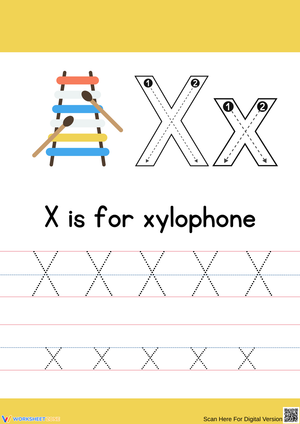
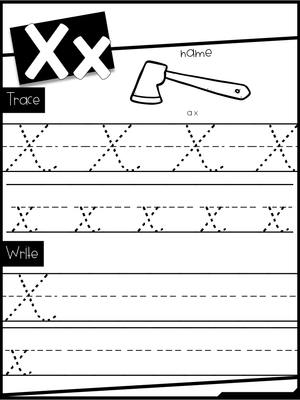
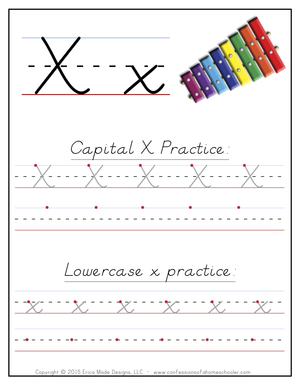
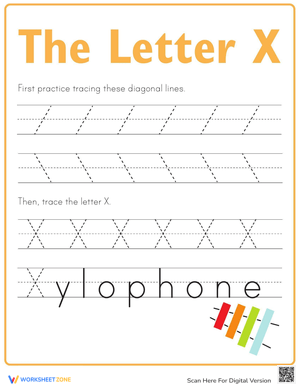
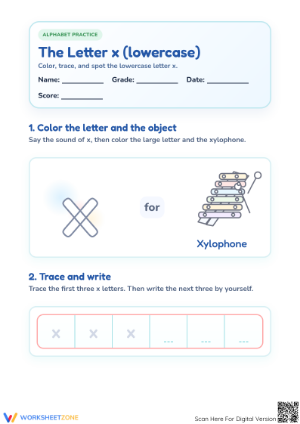
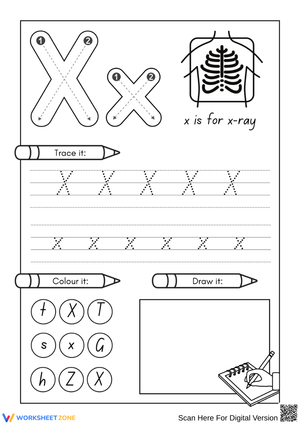
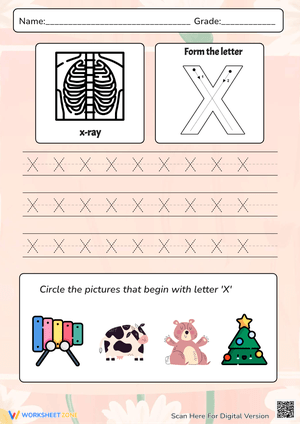
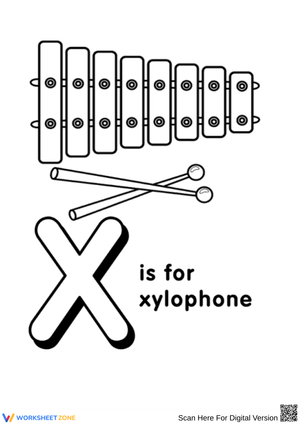
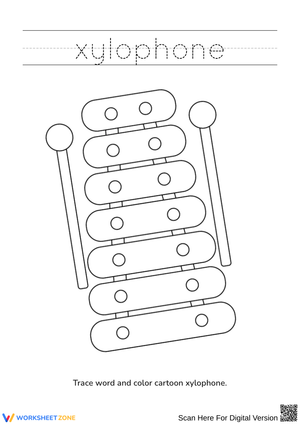
These letter x handwriting printable worksheets for 1st grade address the one letter in the English alphabet built entirely from diagonal strokes — a motor demand that sits a developmental step above the vertical pull-downs and horizontal push-acrosses most first graders have already steadied. X also requires a full pencil lift between its two strokes, which shifts the cognitive task from continuous line-following to stop-and-reposition, an interruption that catches students off guard. Teachers get a focused set of worksheets covering uppercase X and lowercase x, stroke-by-stroke directional cues on primary-ruled lines, and word-level practice built around the ending sounds where X actually appears in decodable first-grade text.
The Specific Skills These Worksheets Build
Each worksheet isolates a distinct layer of X formation so students don't face every challenge at once. Across the set, students:
- Trace uppercase X using a two-stroke sequence, with a clearly marked lift point between strokes so the pencil-up habit is built into the task from the start
- Trace and then independently write lowercase x within the midline-to-baseline zone — a smaller, more constrained space than the uppercase version requires
- Land the intersection at the true center of the letter, the single most common error point, which the guided tracing models address with a reference dot before the second stroke begins
- Write X and x inside real words: box, fox, six, mix, and wax, so phonics and letter formation reinforce each other in the same task
- Compare uppercase and lowercase letter height directly on primary-ruled lines, which surfaces the size confusion students frequently carry into independent sentence writing
The word-level emphasis reflects a genuine instructional decision: unlike most consonants, X almost never opens a decodable first-grade word. These letter x handwriting printable worksheets for 1st grade lean into ending sounds — the /ks/ blend — because that is where the letter earns its keep in early literacy. Writing fox five times does more instructional work than writing a contrived X-initial word once, and it keeps the handwriting practice connected to text students are actually reading.
Where Students Go Wrong — and How These Worksheets Surface It
The most persistent error is a misplaced intersection. Students draw the first diagonal from top-left to bottom-right correctly, then begin the second stroke too close to the center of the letter rather than from the top-right corner. The result looks like a check mark with a hat — the crossing point falls in the lower third of the letter instead of dead center. The tracing models include a small reference dot at the midpoint precisely because students need a visual target before committing to the second stroke, not a correction after the fact.
A second problem surfaces when students skip the pencil lift. Because kindergarten writing instruction rewards continuous motion for letters like e and a, some children try to loop through the center of X without stopping. That produces a rounded intersection that reads as a small cursive arch rather than a clean cross. A verbal cue delivered at the moment the first stroke lands — "pencil up, find the corner" — interrupts the habit before it gets practiced across a full worksheet. Teachers who watch for this during the first two or three letters in a row catch it before it settles in.
Lowercase x carries a third error category worth noting: size inflation. Students who form the letter correctly still place it so it grazes or crosses the headline, treating it like a tall letter. On primary-ruled lines, lowercase x belongs entirely between the midline and the baseline — the same zone as a, c, and o. Students who write six and render the x as tall as the s are showing a letter-height confusion that affects overall line legibility. Worksheets with clearly shaded midline zones make that boundary visible to the student, not just to the teacher scanning from across the room.
Fitting These Worksheets Into the Instructional Day
The strongest placement for X practice in a first-grade day is the opening block of the literacy period, before the cognitive load of phonics instruction and guided reading accumulates. Handwriting at that point acts as a physical warm-up — fine motor activation before the heavier symbolic work of decoding. Morning work tables are a workable alternative, but the tradeoff is that students complete the worksheet without direct teacher observation, which matters for a letter like X where stroke order errors are invisible in the finished product.
A sand tray or textured surface session immediately before the paper worksheet sharpens the diagonal movement through kinesthetic memory. Students trace the X shape with one finger three or four times, feel the two distinct directional changes, then move to the worksheet while that sensation is still active. This two-step sequence is worth the extra two minutes it adds — the quality of pencil strokes on the worksheet improves noticeably when the motor pattern has been primed through touch first. For letter x handwriting printable worksheets for 1st grade to pay off fully, the physical and paper-based practice need to be close together in time, not separated by other activities.
Peer comparison is another practical tool once students have completed an independent writing row. Ask each student to circle the letter X on their paper that shows the clearest center crossing. Then partners compare their circled letters. The exchange takes under three minutes, builds metalinguistic awareness of what correct formation looks like, and turns a solitary task into a low-stakes peer conversation. Students become more deliberate on subsequent rows because they know they will be evaluating their own work.
Differentiating the Set Across a Range of Learners
For students with limited fine motor stamina or significant difficulty holding a diagonal slant, the tracing rows alone are a complete and appropriate task. There is no instructional obligation to push every student to the independent writing rows in the same session. A slightly thicker pencil or primary crayon reduces grip tension at this age, and keeping the directional arrows visible throughout the session gives students a consistent reference instead of asking them to recall stroke direction from memory before they're ready.
Students who move through tracing quickly and produce clean independent letters can extend the task by generating their own X-word list and copying each word into a sentence. This shifts the cognitive demand from motor reproduction to language-level thinking while keeping handwriting active. For the strongest writers, covering the directional arrows on the reference model with a strip of paper — and asking students to form the letter from recall — builds retention more durably than repeated guided tracing does. The step-by-step format of the tracing rows remains visible as a fallback if they need it.
Teachers working with multilingual learners should note that in several writing systems, diagonal crossing strokes either don't exist or carry different letter meanings than they do in English. Students transferring from a script without diagonal letter forms often need additional repetitions with the verbal stroke cue spoken alongside the physical motion: "start top-left, slide to bottom-right — pencil up — start top-right, slide to bottom-left." Naming the corners before each stroke anchors the spatial reasoning for students who are still mapping direction on a flat page in a new script.
Standard Alignment
CCSS.ELA-LITERACY.L.1.1a requires first graders to print all upper- and lowercase letters. Letter X sits inside this standard alongside 51 other letter forms, but its diagonal-only construction places it among the last letters most students fully control — typically in the second half of first grade, after vertical and horizontal strokes have stabilized in letters like I, L, T, and F. The standard does not sequence individual letters, which gives teachers latitude to schedule focused X practice once that earlier foundation is in place. Zaner-Bloser and Handwriting Without Tears both sequence X later in the year for exactly this developmental reason, and these worksheets are structured to serve that second-half placement rather than function as an early-year introduction.
Frequently Asked Questions
Does stroke order matter if the finished letter looks correct?
It does, and this is worth holding firm on in first grade. Students who form X by starting from the bottom or by creating a continuous looping stroke can produce a letter that looks acceptable in isolation but slows them down and generates inconsistency in connected writing. The two-stroke, top-to-bottom sequence is what allows the letter to be formed quickly and repeatably at writing speed. A child who arrives at a correct-looking X through an inefficient sequence will face compounding problems later, and motor habits are substantially harder to retrain after months of practice.
How do these worksheets handle the difference between Zaner-Bloser and D'Nealian styles?
For the letter X, the difference between major US handwriting programs is minimal. Both styles require two diagonal strokes meeting at the center. The forward slant of D'Nealian affects some letters significantly — particularly tall letters with ascenders — but X's diagonal structure means it looks nearly identical across both programs. Teachers do not need to modify the worksheets based on their district's adopted curriculum; the core formation transfers directly.
My students covered X earlier in the year. Is revisiting it worth the time?
Spaced retrieval practice is well-supported by motor learning research, and letter formation is no exception. A student who encountered X in September and hasn't written it deliberately since December has likely developed some drift in stroke quality by February — the intersection drifts off-center, or the pencil lift disappears. A focused letter x handwriting printable worksheets for 1st grade session mid-year functions as retrieval practice, not remediation. The peer-comparison strategy described above works especially well in this context because students who remember the correct form can articulate what they're noticing in their partner's work, which deepens their own retention.
How many repetitions per session produce reliable results?
Six to eight letters per row, written with deliberate attention, produces better results than racing through every row on a worksheet. The moment a student's grip tightens and strokes become ragged — which typically happens after several minutes of sustained pencil work at this age — additional repetitions produce fatigued, inaccurate letters rather than stronger motor memory. Short, attentive sessions across four or five consecutive days outperform a single extended session, which is why these worksheets are structured to be used across a week rather than completed in a single sitting.