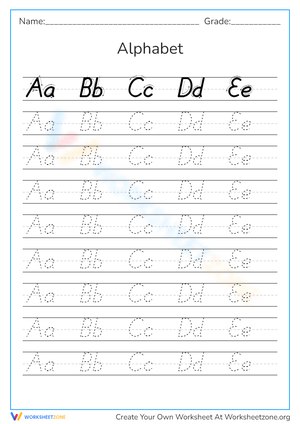
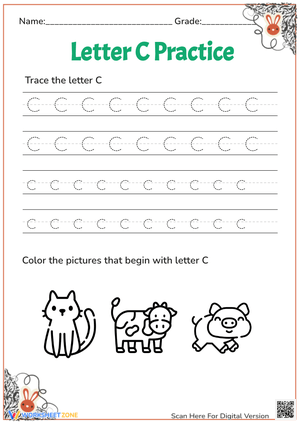
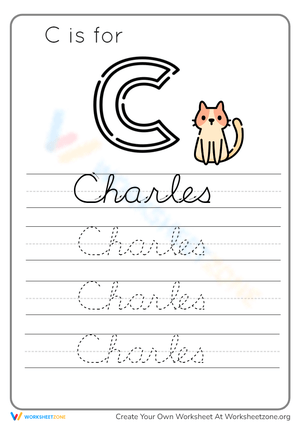
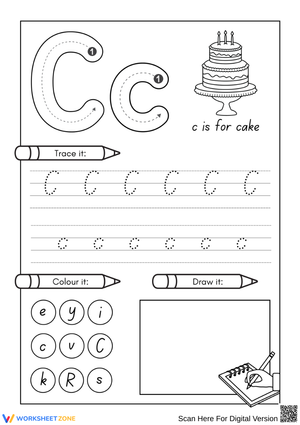
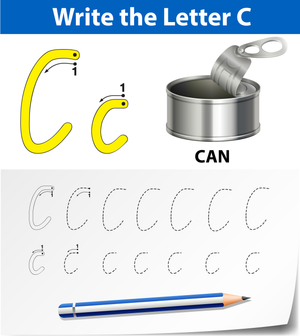
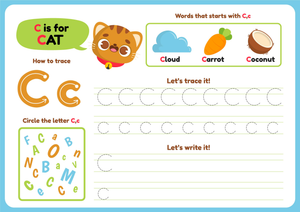
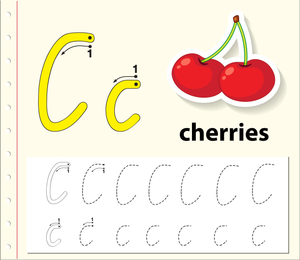
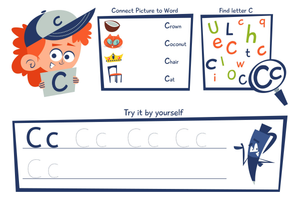
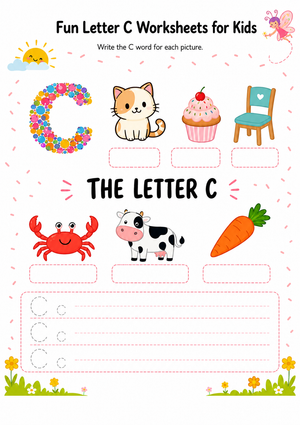
These 1st grade letter c handwriting worksheets give teachers a ready-to-print set built around the counterclockwise curve stroke — the foundational pencil motion behind a full third of the lowercase alphabet. Each worksheet focuses on either uppercase C or lowercase c, moving students through a deliberate progression from traced formation to independent writing on primary-ruled lines. The set runs in short daily sessions, not as a standalone unit — that rhythm is how lasting motor habits actually form in first grade.
The Stroke Behind the Letter — and Why It Matters More Than It Looks
The C is often the first curved stroke a first grader attempts with real directional control. The path is specific: start near the top at roughly the 2 o'clock position, swing left and downward in a single uninterrupted arc, and rest the bottom of the curve on the baseline without lifting the pencil. That sequence is short, but it is the same core motion students will use to form lowercase a, d, g, q, and e — letters they will write thousands of times across the school year. Getting the arc right now means less remediation later.
The worksheets move students through four distinct stages of formation fluency:
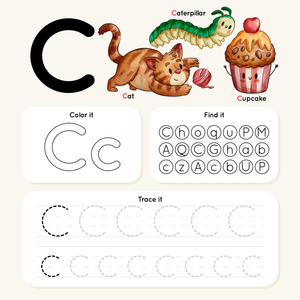
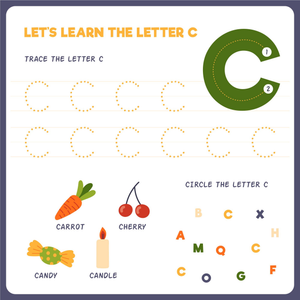
- Tracing solid letter models with embedded directional arrows marking the 2 o'clock starting point
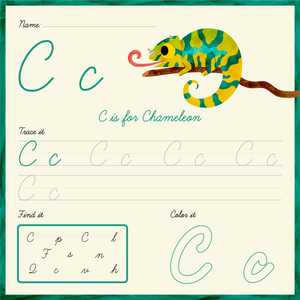
- Tracing dotted outlines at standard first-grade line height with a dashed midline guide
- Copying from a model printed at the left margin while the midline guide remains present
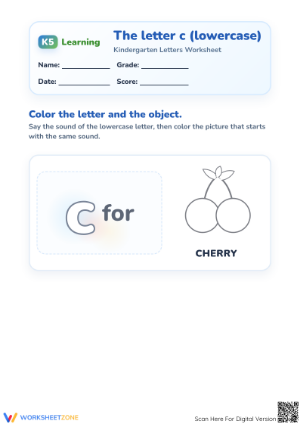
- Writing independently on blank ruled lines with only a header example for reference
The word-picture pairs embedded alongside the formation practice — images of a cat, a cup, a carrot — are not filler. They prompt students to say the word, hear the /k/ sound, and link that phoneme to the shape they are physically forming. That pairing takes three seconds per word, but across a week of daily practice it substantially reinforces the letter-sound connection without requiring a separate activity.
Frequent Student Errors Worth Anticipating and Correcting
The starting point is where most first graders go wrong with C. Students who begin at 12 o'clock rather than 2 o'clock produce a letter that opens too wide at the top — a small error that compounds when the same stroke is applied to G or O, where the opening must stay controlled. A second error is more diagnostic: students who lift the pencil mid-arc to "fix" the curve are drawing C rather than writing it. They are treating the letter as a picture to be corrected rather than a motion to be executed. In that mindset, fluency never develops. The worksheets with directional arrows address this directly by making the intended stroke path explicit and continuous.
Watch for size creep in the later rows of any practice page. After four or five repetitions, letters often grow taller and the opening shifts from facing right to facing upward. That drift signals hand fatigue more than directional confusion — it tells you the student needs shorter sessions, not additional pages.
How to Build These Worksheets Into Your Instructional Week
The most effective placement is the five to seven minutes after morning meeting before the structured literacy block begins. That window is too short for a read-aloud or phonics lesson, but it is exactly right for a focused formation warm-up. Students are settled, the transition is natural, and the short duration prevents the hand fatigue that longer sessions produce in first graders.
A practical weekly sequence: introduce the stroke direction Monday using an anchor chart and shared air-writing, use the tracing-level worksheets on Tuesday and Wednesday, shift to the copy-from-model version Thursday, and run the independent-writing version Friday as a quick formative check. That Friday sheet — students writing C from memory on ruled lines — shows clearly who has internalized the starting point and who is still approximating. The 1st grade letter c handwriting worksheets files in this set include a no-tracing version built for this purpose, so no modification is needed to use it as an informal assessment tool.
For literacy center rotations, laminate a tracing worksheet and pair it with a dry-erase marker. The same sheet runs all week without additional printing. Position it alongside a small model card showing the stroke arrow, and students work through the center independently while you pull small reading groups.
Why Focused Letter Practice at This Grade Level Is Not Optional
By first grade, most students can hold a pencil and approximate letter shapes — but approximation is not automaticity. Research on handwriting fluency (Graham & Weintraub, 1996) documents a consistent finding: when letter formation has not yet become automatic, it draws on the same working memory needed for composing. A child still thinking about how to form C while writing "cat" in a journal entry is spending cognitive effort on motor execution rather than on meaning. Explicit, repeated letter practice at this stage is not remedial preparation — it is the mechanism by which formation becomes automatic enough to stop competing with thinking.
First-grade programs introduce C early for a concrete reason: the stroke is short, follows a single path, and produces an immediately recognizable result. That early success with a simple curved letter gives students the confidence and muscle memory they need before they tackle the more complex strokes in B, R, K, and S.
Standard Alignment
CCSS.ELA-LITERACY.L.1.1 addresses command of the conventions of standard English, which at the classroom level includes producing legible, correctly formed letters. In practice, first-grade teachers use explicit handwriting instruction through at least the first semester so that by mid-year, students write full sentences in response to prompts without stopping to puzzle over letter construction. Letter C practice fits into this arc in late September or October in most Common Core-aligned pacing guides — after the straight-stroke letters (I, L, T, H) have been introduced and before the full curved-stroke family is consolidated.
Adjusting the Set for Students at Different Points in Fine Motor Development
Students who are still developing pencil grip need a different entry point than their peers. For them, the oversized versions in this set — where the letter body spans a full two-centimeter writing space — allow practice of the arc direction without the added demand of miniaturization. That is not a lesser task; it is the same stroke at a scale that matches their current motor precision. The 1st grade letter c handwriting worksheets versions with thick tracing paths and enlarged letter bodies serve this group without requiring you to locate separate materials.
Students with stronger pencil control but inconsistent sizing benefit most from the worksheets that retain the dashed midline without providing a dotted tracing path — they must judge the letter's height independently, but the midline gives them a concrete spatial reference. For students who have already internalized direction and just need fluency work, remove the model entirely. Hand them a page of ruled lines and ask them to write C from memory, then self-check against the classroom anchor chart. That self-correction step — compare, identify the discrepancy, try again — builds the internal monitoring that eventually transfers to independent writing without any teacher prompt.
Frequently Asked Questions
Should uppercase C or lowercase c be introduced first?
Most first-grade programs introduce uppercase letters first because they are larger and sit fully between the baseline and the headline, giving students more room to control the arc. Lowercase c requires the same motion but at half the height, contained between the baseline and midline. If students have solid control of the uppercase stroke, lowercase typically follows quickly. The 1st grade letter c handwriting worksheets set includes both in a matched sequence so teachers move from one to the other without switching materials.
What line size works best for first graders?
Standard first-grade primary ruled paper uses a one-inch writing space — baseline to headline — with a dashed midline at the halfway point. Students who are new to ruled writing generally need that full inch to control the arc without cramping the letter. By mid-year, many first graders work comfortably on three-quarter-inch lines. The worksheets in this set are built on the one-inch standard, which matches the paper most schools stock for first grade.
How do these worksheets connect to a phonics-based reading program?
The word-picture pairs on each worksheet use consonant-vowel-consonant words with a hard C — cat, cup, corn — which aligns with the phonics scope and sequence in programs like CKLA, Fundations, and most structured literacy curricula. Students practice letter formation at the same point in the year they are decoding and encoding CVC words with the /k/ phoneme. That timing is deliberate: the physical act of writing reinforces the phoneme-grapheme connection in a way that visual recognition alone does not.