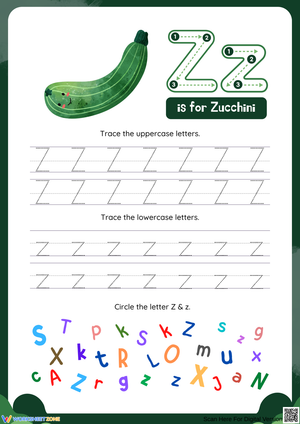
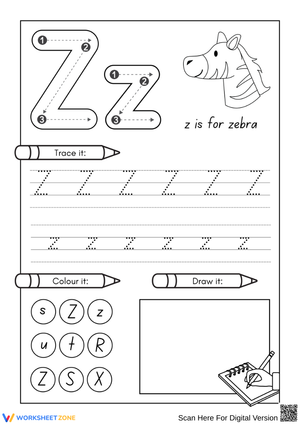
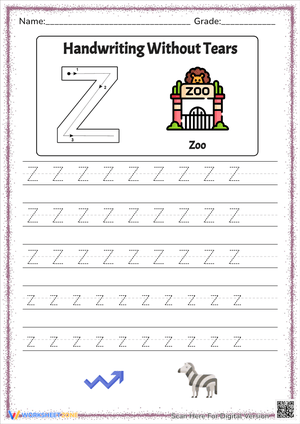
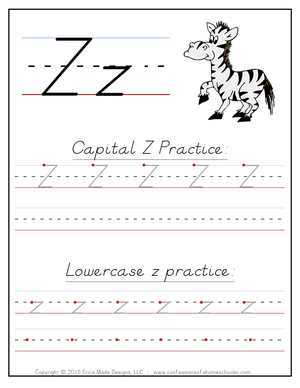
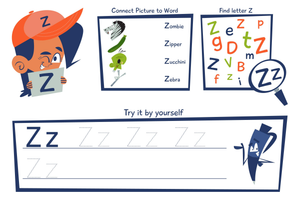
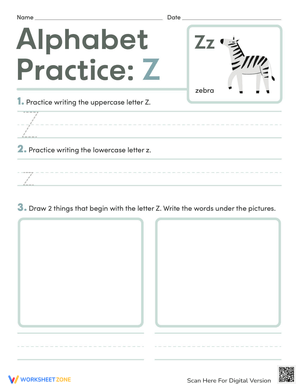
These letter z handwriting worksheets for 1st grade give teachers printable practice pages that target uppercase Z and lowercase z formation, recognition, and basic phonics connection in a single, repeatable session. The set moves students from traced letter models to independent writing on primary lines, with enough structure for students still working on stroke direction and enough open space for those ready to write without a visual prompt. Because Z arrives at the end of the alphabet sequence and gets far less incidental exposure than letters like A or S, focused repetition matters more here than with most letters.
What's Inside Each Worksheet
The core components across the set include a letter model at the top, dotted tracing letters, primary-ruled writing lines for independent practice, and a recognition task — typically circling or underlining Z among visually similar letters. Several worksheets also include picture clues tied to common Z words (a zipper, a zebra, a zero) to anchor the /z/ sound without crowding the practice space.
- Letter models: Uppercase Z and lowercase z appear together at the top so students can compare the two forms directly before tracing.
- Dotted tracing letters: The tracing path makes stroke sequence visible, not just overall shape.
- Independent writing lines: Primary-ruled lines give students the correct proportions for letter height and placement.
- Recognition tasks: Circling or marking Z in a mixed-letter row builds perceptual fluency alongside motor practice.
- Picture or word support: Simple images connect the letter to its sound without turning the page into a vocabulary exercise.
The recognition tasks are worth noting separately. First graders who trace Z accurately sometimes still hesitate when asked to locate it in a mixed-letter row. Running tracing and visual scanning in the same session builds both motor memory and perceptual fluency around the same letter — a pairing that matters for early readers who need to connect written form to sound quickly.
Why Letter Z Demands More Dedicated Practice
Letter Z appears at the end of the alphabet, which means most first graders encounter it far less in natural reading and writing across the school year than they encounter letters like E, T, or A. That frequency gap shapes how teachers should approach this practice: students are not revisiting a familiar letter but returning to one that many of them have met only a handful of times. The forgetting rate is higher, and the transfer to real writing is slower.
The three-stroke structure of Z — horizontal, diagonal, horizontal — looks simple on paper, but it demands careful attention to directionality that students apply rarely. Unlike C or O, where the curved stroke provides its own motor feedback, Z requires an intentional left-to-right move at the top, then a descending diagonal in the opposite direction, then a second horizontal. Students who trace C correctly from the first attempt may still write Z incorrectly after a week of practice. That's not a focus problem; it's a frequency problem.
Mistakes Students Make That These Worksheets Help You Catch
The most common error in student Z work is a reversed diagonal. Students write the middle stroke from lower-left to upper-right instead of upper-left to lower-right — the result looks like a mirror image of Z or a stylized numeral 2. This error appears even in students who have practiced tracing, because following a dotted path does not always force attention to the direction of that stroke when the dots are faint or closely spaced. Watching a student trace, rather than only inspecting the finished product, catches this faster than any written assessment.
A second pattern worth watching: students who write lowercase z correctly in isolation revert to an incorrect form when writing quickly in a sentence context. The worksheet setting captures formation; the error resurfaces in real writing. A short verbal stroke cue — "top across, slash down, bottom across" — repeated during the worksheet session gives students language they can use to self-monitor when you are not nearby.
Uppercase Z and lowercase z also produce an unexpected confusion because they look similar, not different. Students occasionally carry uppercase Z into lowercase contexts, especially in animal names from phonics books ("Zebra" written mid-sentence with a capital Z). Addressing that distinction explicitly during the worksheet lesson — pointing to size and baseline placement, not just shape — prevents a habit that is harder to undo once it has settled in.
Building These Worksheets Into Your Instructional Week
Morning work is the most natural slot in most first-grade rooms. The task is self-evident, requires no oral setup, and fits the 8-10 minutes before morning meeting without rushing. Students who arrive at different times can begin at their own pace, and the familiar format keeps the start of the day calm.
For small-group phonics work, one worksheet supports a focused 10-12 minute block. Open by modeling the strokes on a small whiteboard — trace Z in the air, name each move — then move students to the tracing section while you observe pencil grip and starting position. Close with the recognition task as a group discussion rather than silent work, which gives you a second formative read on each student without adding time.
Letter z handwriting worksheets for 1st grade also work well in intervention. Keeping a printed stack in a reteach folder means you can pull a relevant, focused activity in the moment rather than building something new when a student's Z formation needs targeted attention mid-week.
Adjusting the Worksheets Across Ability Levels
Students still developing basic directional control benefit from worksheets with larger letter models, wider primary lines, and more tracing rows relative to independent lines. Keeping the session focused on one form at a time — uppercase Z in one sitting, lowercase z in the next — is more productive than asking for both when a student is still working on basic stroke sequence.
For students who form Z with confidence, the tracing rows function as quick review. Direct these students straight to the independent writing lines and add a word-writing extension: after the letter practice, they write one Z word from the picture on the page, or generate their own. The worksheet stays the same physical page; the entry point and the output expectation shift.
One structural move that works across a mixed class is to print two versions in advance — a tracing-heavy worksheet for students who need stroke guidance, and a worksheet with more open writing lines for students working toward independent production. Same skill target, same letter, two different amounts of built-in support, and no additional prep once the versions are sorted into the right folders.
Standard Alignment
Teachers looking for letter z handwriting worksheets for 1st grade with a clear standards anchor will find this set addresses CCSS.ELA-LITERACY.L.1.1a, which requires first graders to print all uppercase and lowercase letters. In classroom terms, that standard is typically assessed during end-of-year writing conferences or letter production checks, which means teachers need distributed practice across the year rather than a concentrated push close to assessment time. Returning to the same letter across several weeks — what researchers call spaced retrieval — produces stronger retention than massed practice in a single session, and a printable worksheet set makes that spaced return easy to manage without extra planning.
Frequently Asked Questions
How many tracing repetitions should a first grader complete before writing Z independently?
Most first graders benefit from 3-5 traced repetitions before moving to independent lines, though the number varies by student. A student still reversing the diagonal needs more tracing time; one who traces accurately from the first row can move to independent writing sooner. The marker for readiness is accuracy in the tracing, not the count of lines completed.
Is it worth addressing uppercase Z and lowercase z in the same session?
Yes, as long as the session does not overreach. Because both forms share the same three-stroke structure, comparing them directly reinforces both at once. The risk is cognitive overload if the student is also being introduced to the /z/ sound for the first time. For students entirely new to Z, address one form first and return to the second form in a follow-up session.
What does it mean when a student's Z formation deteriorates on the independent lines after accurate tracing?
That deterioration is the most diagnostic moment on the page. It signals that the student is relying on the dotted path for motor guidance rather than building an internalized letter form. Ask the student to trace one letter very slowly while narrating each stroke aloud, then immediately write the letter without looking at the model. The verbal sequence — "top across, slash down, bottom across" — bridges the gap between guided and independent production in a way that additional tracing alone does not.
Can these worksheets be sent home for family practice?
A printable worksheet is manageable for families — the task is self-contained and requires only a pencil. Letter z handwriting worksheets for 1st grade sent home give families a structured, clear way to support practice without requiring explanation or extra materials. Brief directions printed on the page itself make the task fully independent for most households, and the completed worksheet gives teachers a quick look at how the student performs outside the classroom setting.