


























Views
Downloads
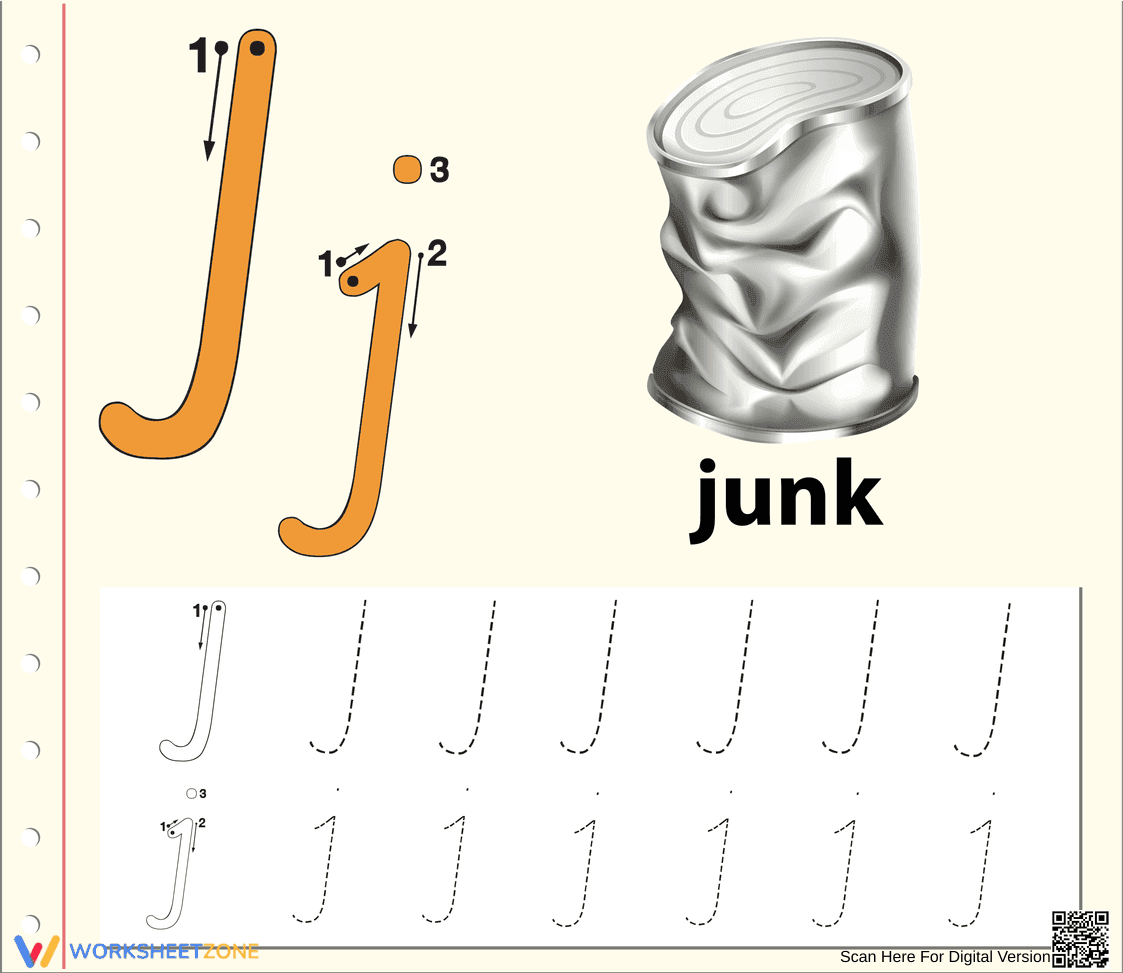

Letter J Tracing Worksheet | Essential Grade K Ready
Paste this activity's link or code into your existing LMS (Google Classroom, Canvas, Teams, Schoology, Moodle, etc.).
Students can open and work on the activity right away, with no student login required.
You'll still be able to track student progress and results from your teacher account.
This Grade K handwriting worksheet provides focused practice for mastering the letter J. Students develop fine motor control and letter recognition by tracing both uppercase and lowercase forms alongside a visual mnemonic. By completing these structured tracing paths, early learners build the muscle memory necessary for independent writing and foundational literacy success.
At a Glance
- Grade: Kindergarten · Subject: Handwriting
- Standard:
CCSS.ELA-LITERACY.L.K.1.A— Print many upper- and lowercase letters correctly- Skill Focus: Letter J formation
- Format: 1 page · 14 problems · Answer key not required · PDF
- Best For: Morning work or literacy centers
- Time: 5–10 minutes
What's Inside
The resource features a single-page layout designed for clarity and ease of use. It includes large directional models for both uppercase 'J' and lowercase 'j', complete with numbered arrows to guide stroke order. Below the models, students find two rows of dashed-line tracing tasks—7 for uppercase and 7 for lowercase—ensuring repetitive practice. A high-quality illustration of "junk" provides a phonics-based anchor for the letter sound.
Zero-Prep Workflow
Teachers can integrate this resource into their daily routine in under two minutes. Simply print the single-page PDF (30 seconds), distribute it to students during a literacy block or as a transition activity (1 minute), and provide immediate verbal feedback as you circulate the room (30 seconds). Its self-explanatory design makes it an ideal choice for emergency sub plans or quiet independent work that requires no teacher setup.
Standards Alignment
This worksheet aligns with CCSS.ELA-LITERACY.L.K.1.A, which requires students to print many upper- and lowercase letters. By focusing specifically on the unique hook and dot of the letter J, the activity supports the development of legible handwriting. Both standard codes can be copied directly into lesson plans, IEP goals, or district curriculum mapping tools.
How to Use It
Use this worksheet during the independent practice phase of a gradual release model after demonstrating the letter formation on a whiteboard. It serves as an excellent formative assessment tool; observe students to ensure they follow the numbered stroke order rather than drawing the letter from the bottom up. The activity typically takes 5 to 10 minutes to complete depending on student motor proficiency.
Who It's For
This resource is tailored for preschool and kindergarten students who are beginning their handwriting journey. It is also suitable for Grade 1 students requiring remedial fine motor support or occupational therapy practice. Pair this worksheet with a letter-sound anchor chart or a tactile sand-tracing activity to reinforce the multisensory learning experience for diverse learners.
Handwriting instruction remains a cornerstone of early literacy, as research from Fisher & Frey (2014) emphasizes the link between manual letter production and improved word recognition. This worksheet targets CCSS.ELA-LITERACY.L.K.1.A by providing 14 specific tracing opportunities for the letter J, helping students internalize the distinct strokes required for uppercase and lowercase forms. According to the RAND AIRS 2024 report, consistent, short-burst practice in letter formation significantly reduces cognitive load during later composition tasks. By using a clear visual anchor like "junk," the resource also supports phonological awareness alongside motor skill development. This structured approach ensures that students move beyond simple imitation toward fluent, automatic letter production, which is a critical predictor of future writing proficiency and reading speed in primary education settings.


