


























Views
Downloads

HS-LS3-2 Worksheet: Genetic Mutations — Grade 9-12 Aligned
Paste this activity's link or code into your existing LMS (Google Classroom, Canvas, Teams, Schoology, Moodle, etc.).
Students can open and work on the activity right away, with no student login required.
You'll still be able to track student progress and results from your teacher account.
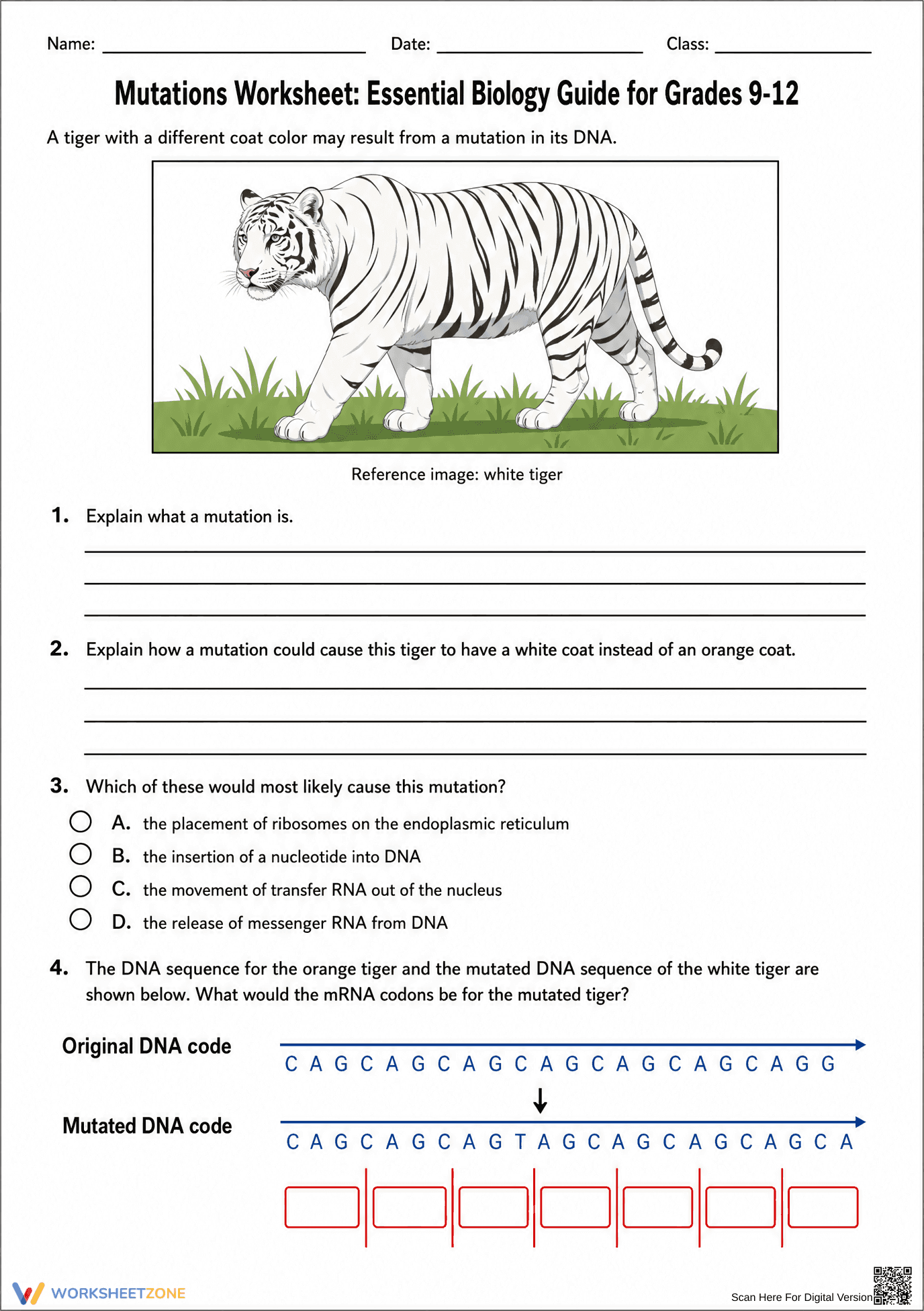
This high school biology resource provides a concise assessment of student understanding regarding genetic mutations and their phenotypic expressions. By analyzing the specific case of a white tiger's coat color, learners connect molecular changes in DNA to observable traits in organisms. Students demonstrate mastery by defining mutations and mapping nucleotide sequences to mRNA codons.
At a Glance
- Grade: 9-12 · Subject: Biology
- Standard:
HS-LS3-2— Make and defend a claim that inheritable genetic variations result from mutations- Skill Focus: DNA sequencing and mutation analysis
- Format: 1 page · 4 problems · Answer key included · PDF
- Best For: Post-lesson assessment or exit ticket
- Time: 15–20 minutes
What's Inside
This single-page PDF features a real-world application using the genetic variation of white tigers. It includes two open-ended conceptual questions, one multiple-choice question identifying mutation types such as insertion, and a detailed DNA-to-mRNA sequence analysis task. The provided answer key uses red-text overlays for immediate teacher reference and grading.
Zero-Prep Workflow
- Print: Generate copies of the single-page document for the class in under one minute.
- Distribute: Hand out the worksheet as a post-lesson check for understanding to gauge student progress.
- Review: Use the included answer key to review the DNA sequence mapping and codon separation with the whole group.
This streamlined structure makes it an ideal resource for sub-plans or quick formative checks during a busy unit.
Standards Alignment
The primary focus is HS-LS3-2, which requires students to explain how inheritable genetic variations may result from new genetic combinations through meiosis, viable errors occurring during replication, or mutations caused by environmental factors. This worksheet specifically targets the replication error and mutation aspect. This code can be copied directly into lesson plans, IEP goals, or district curriculum mapping tools.
How to Use It
Assign this worksheet immediately following a lecture on protein synthesis and genetic errors. It serves as an excellent formative assessment to identify if students can distinguish between DNA and mRNA sequences. For a quick check, observe students during the sequence mapping task; those struggling to group bases into triplets may need additional support with codon recognition.
Who It's For
This resource is designed for high school biology students, including those in Honors or AP tracks who need a quick refresher on mutation mechanics. It pairs naturally with a visual anchor chart showing the central dogma of molecular biology or a direct instruction lesson on point mutations versus frameshift mutations.
According to the ScienceDirect TpT Analysis (2024), high-quality biology worksheets that utilize real-world biological examples significantly increase student engagement. This worksheet aligns with HS-LS3-2 by requiring students to analyze how an insertion mutation alters the mRNA sequence, changing the protein product. Research indicates that structured practice in DNA-to-RNA transcription helps solidify the understanding of the genetic code. By providing a visual comparison between original and mutated DNA, this resource supports cognitive load requirements for secondary learners. The inclusion of an answer key ensures instructional fidelity and allows for rapid feedback, a critical component in mastering scientific literacy and evidence-based reasoning in the modern science classroom. This 1-page tool provides 4 targeted tasks that bridge the gap between abstract molecular biology and observable phenotypic traits.


