


























Views
Downloads

DNA Mutations Worksheet | Grade 9-12 Biology Essential
Paste this activity's link or code into your existing LMS (Google Classroom, Canvas, Teams, Schoology, Moodle, etc.).
Students can open and work on the activity right away, with no student login required.
You'll still be able to track student progress and results from your teacher account.
This high school biology worksheet provides hands-on practice with the central dogma of molecular biology, focusing on how DNA mutations affect protein synthesis. Students will transcribe DNA, translate mRNA into amino acids, and simulate random mutations to observe direct consequences on genetic traits and resulting proteins.
At a Glance
- Grade: 9-12 · Subject: Biology
- Standard:
HS-LS3-2— Analyze evidence of how genetic variations and mutations occur.- Skill Focus: Transcription, translation, and mutation analysis
- Format: 3 pages · 5 problems · Answer key included · PDF
- Best For: Independent practice and lab extension
- Time: 30–45 minutes
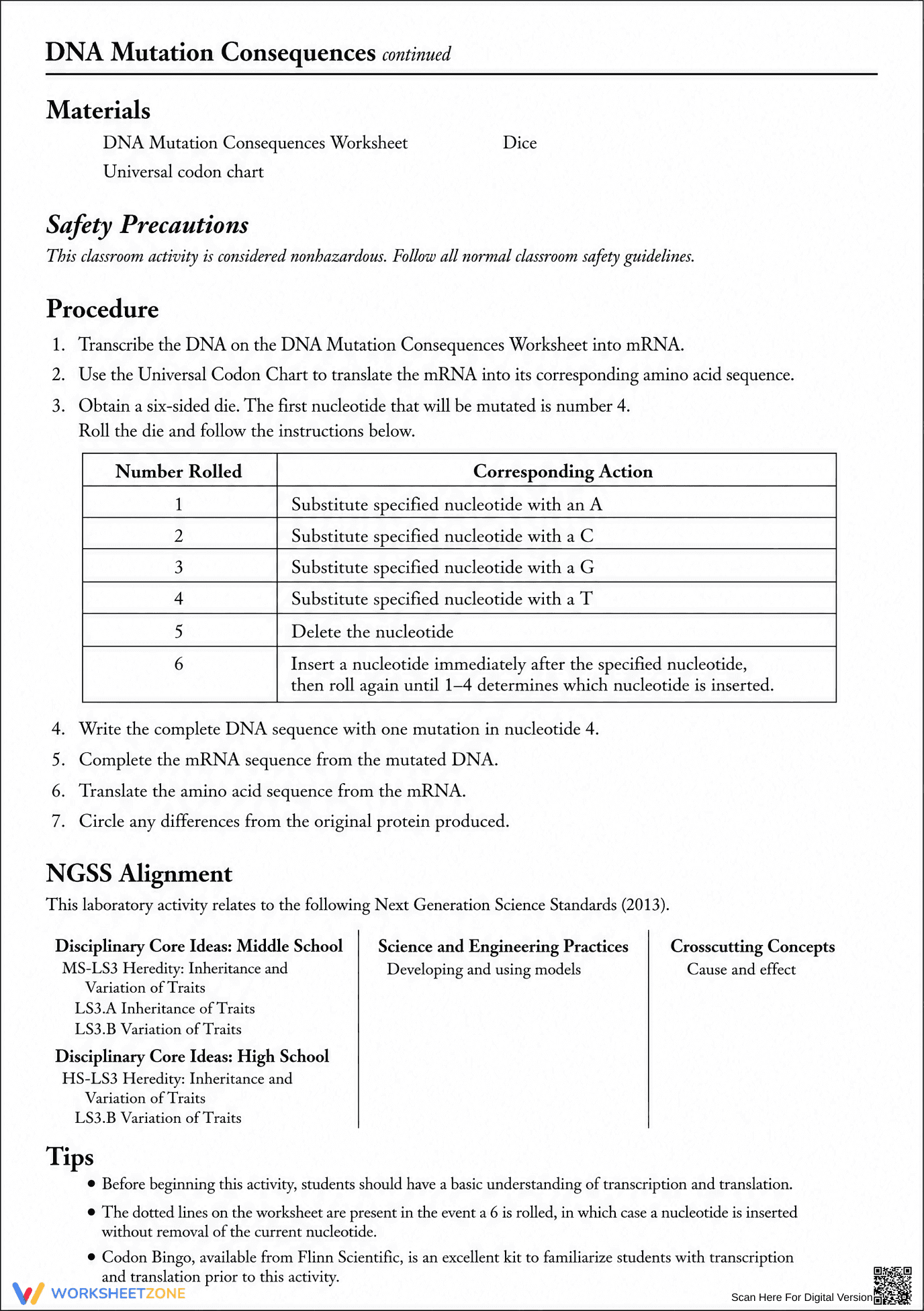
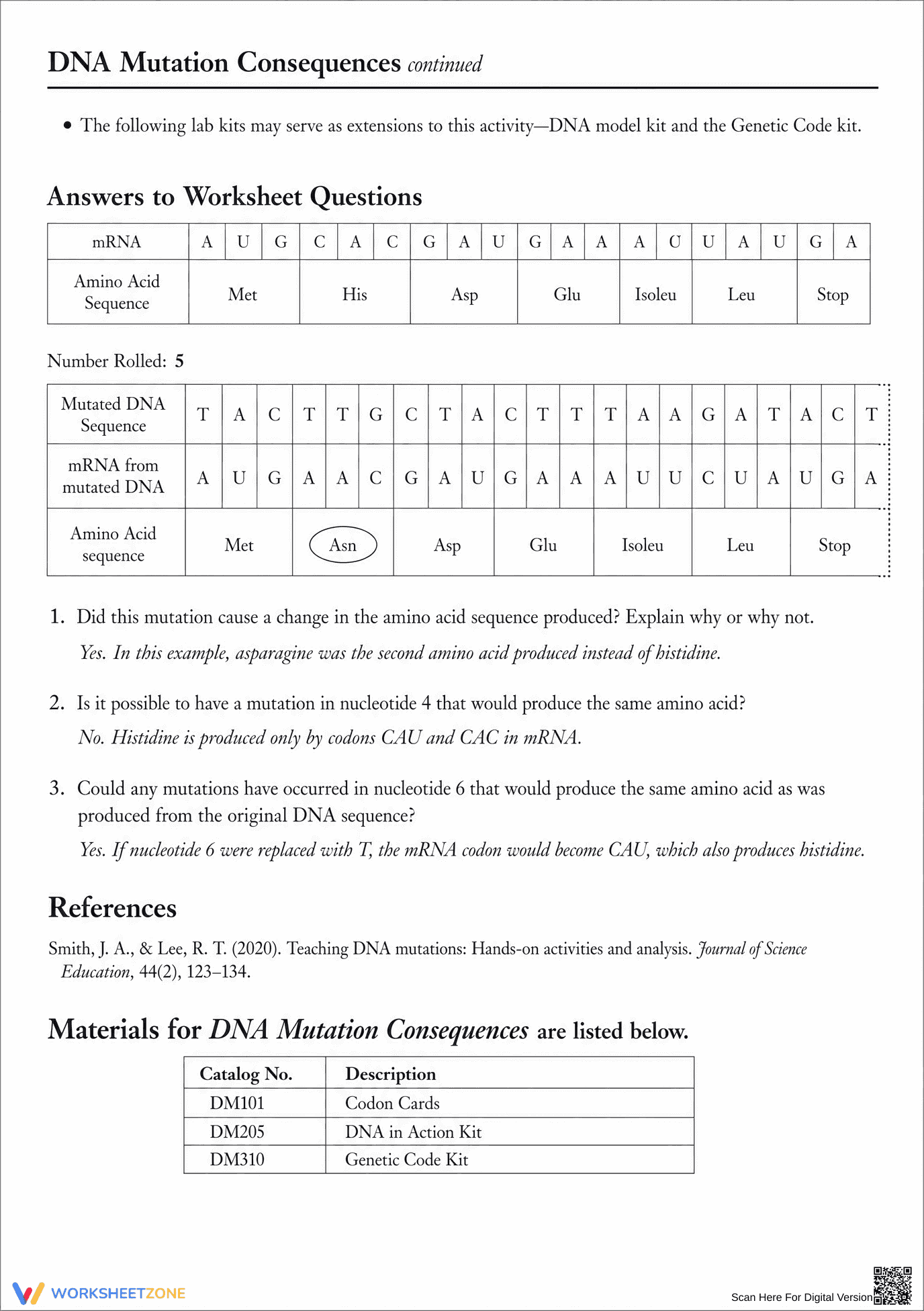
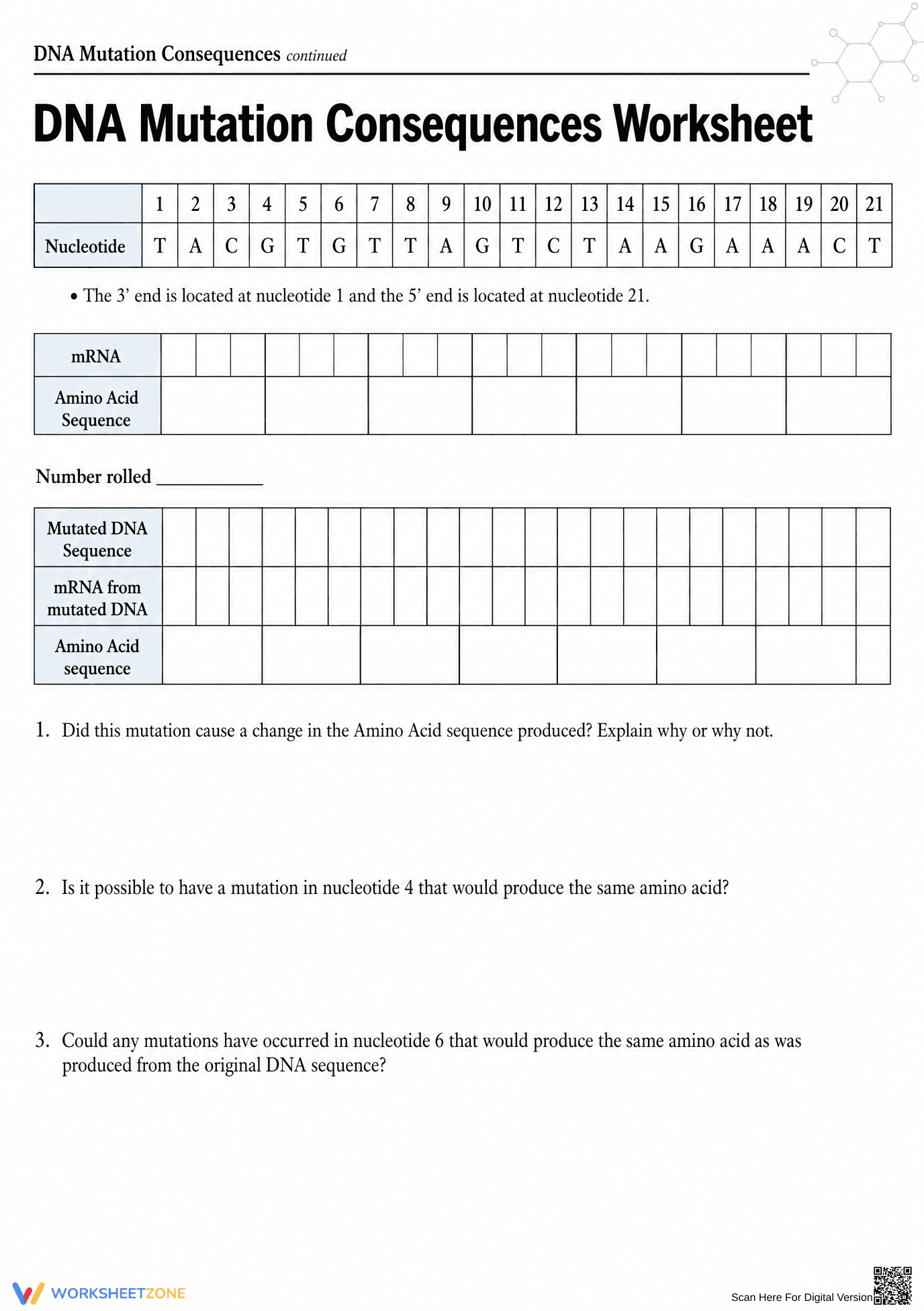
This comprehensive resource includes a detailed teacher procedure guide, a complete answer key, and a one-page student activity sheet. The student section features a 21-nucleotide DNA sequence for baseline transcription and translation. Using a six-sided die, students introduce a random point mutation (substitution, deletion, or insertion) and map the resulting changes through a second round of protein synthesis. Three short-answer questions prompt learners to evaluate the specific impacts of their simulated mutation.
- Guided practice: Students begin by transcribing and translating a provided baseline DNA sequence, establishing a clear understanding of normal protein synthesis.
- Supported practice: Using a dice-roll simulation, learners introduce a specific mutation (such as a frameshift or point mutation) and carefully map the new mRNA and amino acid sequence.
- Independent practice: Three analytical questions require students to compare the original and mutated proteins, explaining why certain nucleotide changes alter the amino acid while others do not.
This gradual-release approach ensures students master basic transcription before tackling complex mutation consequences.
This activity is directly aligned to HS-LS3-2: Make and defend a claim based on evidence that inheritable genetic variations may result from viable errors occurring during replication or mutations. It also supports middle school progression standards for heredity and trait variation. Both standard codes can be copied directly into lesson plans, IEP goals, or district curriculum mapping tools.
Deploy this worksheet during a genetics unit after introducing the universal codon chart and the concepts of transcription and translation. It serves as an excellent interactive classroom activity where students can work in pairs with dice to simulate random genetic errors. As a formative assessment observation tip, circulate the room while students answer the final three questions to ensure they correctly identify silent mutations versus missense or nonsense mutations. Expected completion time is 30 to 45 minutes.
This resource is designed for high school biology students mastering molecular genetics. The structured tables provide excellent visual scaffolding for learners who struggle with multi-step biological processes, keeping their sequence mapping organized. It pairs perfectly with a direct instruction lesson on the central dogma or a visual anchor chart displaying the universal codon chart.
Understanding the precise mechanisms of genetic variation is a fundamental cornerstone of secondary science education. Aligned with HS-LS3-2, this resource helps students analyze evidence of how genetic variations and mutations occur through hands-on simulation. According to a ScienceDirect TpT Analysis, interactive modeling activities that require students to physically manipulate variables—such as rolling dice to determine a specific DNA mutation—significantly improve retention of complex molecular concepts compared to passive reading. By bridging the abstract concepts of nucleotide substitution and frameshift mutations with concrete, step-by-step transcription and translation mapping, educators can foster deeper scientific literacy. This structured approach ensures learners not only memorize the steps of protein synthesis but also comprehend the profound biological consequences of microscopic genetic errors, preparing them for advanced biological studies and future laboratory work.


