


























Views
Downloads

Advanced Mutation Worksheet | Essential Grade 9-12 Biology
Paste this activity's link or code into your existing LMS (Google Classroom, Canvas, Teams, Schoology, Moodle, etc.).
Students can open and work on the activity right away, with no student login required.
You'll still be able to track student progress and results from your teacher account.
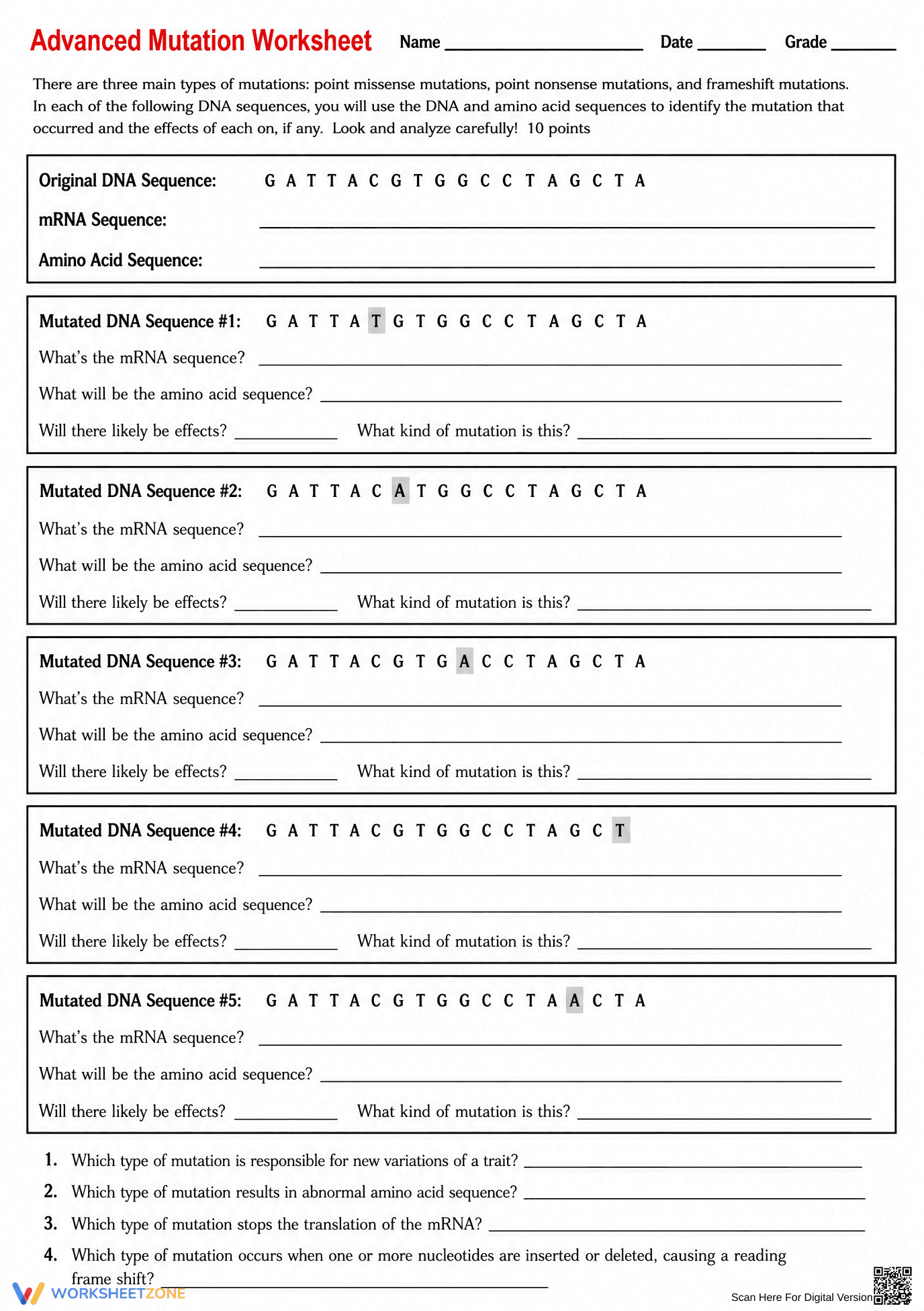
This advanced genetics worksheet empowers high school students to master the relationship between DNA sequences and protein synthesis. By analyzing specific genetic alterations, learners develop critical thinking skills to predict how molecular changes manifest as phenotypic variations. Students will transcribe and translate sequences to pinpoint exact mutation types and functional outcomes.
At a Glance
- Grade: 9-12 · Subject: Biology
- Standard:
HS-LS3-2— Make and defend a claim that inheritable genetic variations result from mutations- Skill Focus: DNA Mutation Identification
- Format: 1 page · 9 problems · Answer key included · PDF
- Best For: Molecular biology unit assessment or practice
- Time: 30–45 minutes
The single-page PDF features an original DNA sequence followed by five mutated variations. Each variation includes dedicated space for mRNA transcription, amino acid translation, and effect prediction. The layout provides clear visual cues for nucleotide changes, such as substitutions and deletions. Four synthesis questions require students to categorize mutation types based on their functional consequences on the resulting protein structure.
Skill Progression
- Guided Practice: The worksheet begins with a reference "Original DNA Sequence" to establish a baseline for comparison across three distinct molecular steps: DNA, mRNA, and Amino Acids.
- Supported Practice: Five mutated sequences highlight specific nucleotide changes, prompting students to perform transcription and translation to see the "silent," "missense," or "nonsense" results.
- Independent Practice: Four concluding conceptual questions require students to synthesize their findings and define mutation categories like frameshifts without direct sequence prompts.
This structure follows a gradual-release model, moving from mechanical sequence analysis to higher-order conceptual categorization and definition.
Standards Alignment
This resource aligns with `HS-LS3-2`, which requires students to explain how inheritable genetic variations result from new genetic combinations through meiosis, viable errors during replication, and/or mutations caused by environmental factors. It also supports HS-LS1-1 by reinforcing the role of DNA in coding for protein structure. Both standard codes can be copied directly into lesson plans or district curriculum mapping tools.
How to Use It
Use this worksheet during the "Explain" or "Elaborate" phase of a 5E instructional cycle. It serves as an excellent formative assessment after students learn the basics of the genetic code but before a unit exam. Teachers should observe students during translation to ensure they use the codon chart correctly for the mutated mRNA rather than the original DNA. Expected completion time ranges from 30 to 45 minutes.
Who It's For
This resource is designed for high school biology students, including those in Honors or AP Biology tracks who need rigorous practice with molecular genetics. It is an ideal pairing for a direct instruction lesson on protein synthesis or a laboratory activity involving DNA modeling kits and sequence manipulation.
According to the RAND AIRS 2024 report on science literacy, structured practice in molecular modeling significantly improves student retention of abstract biological concepts. This worksheet addresses that need by providing a concrete framework for analyzing HS-LS3-2 standards. By requiring students to perform the mechanical steps of transcription and translation for five different mutated sequences, the resource moves beyond rote memorization into functional analysis. Research from Fisher & Frey (2014) emphasizes that the gradual release of responsibility—moving from a baseline sequence to independent conceptual questions—is vital for mastering complex scientific processes. This worksheet provides exactly that scaffold, ensuring students can identify point mutations, frameshifts, and their subsequent effects on amino acid chains. It is a high-utility tool for any secondary science classroom focusing on the mechanisms of genetic variation and the fundamental principles of molecular biology.


