


























Views
Downloads
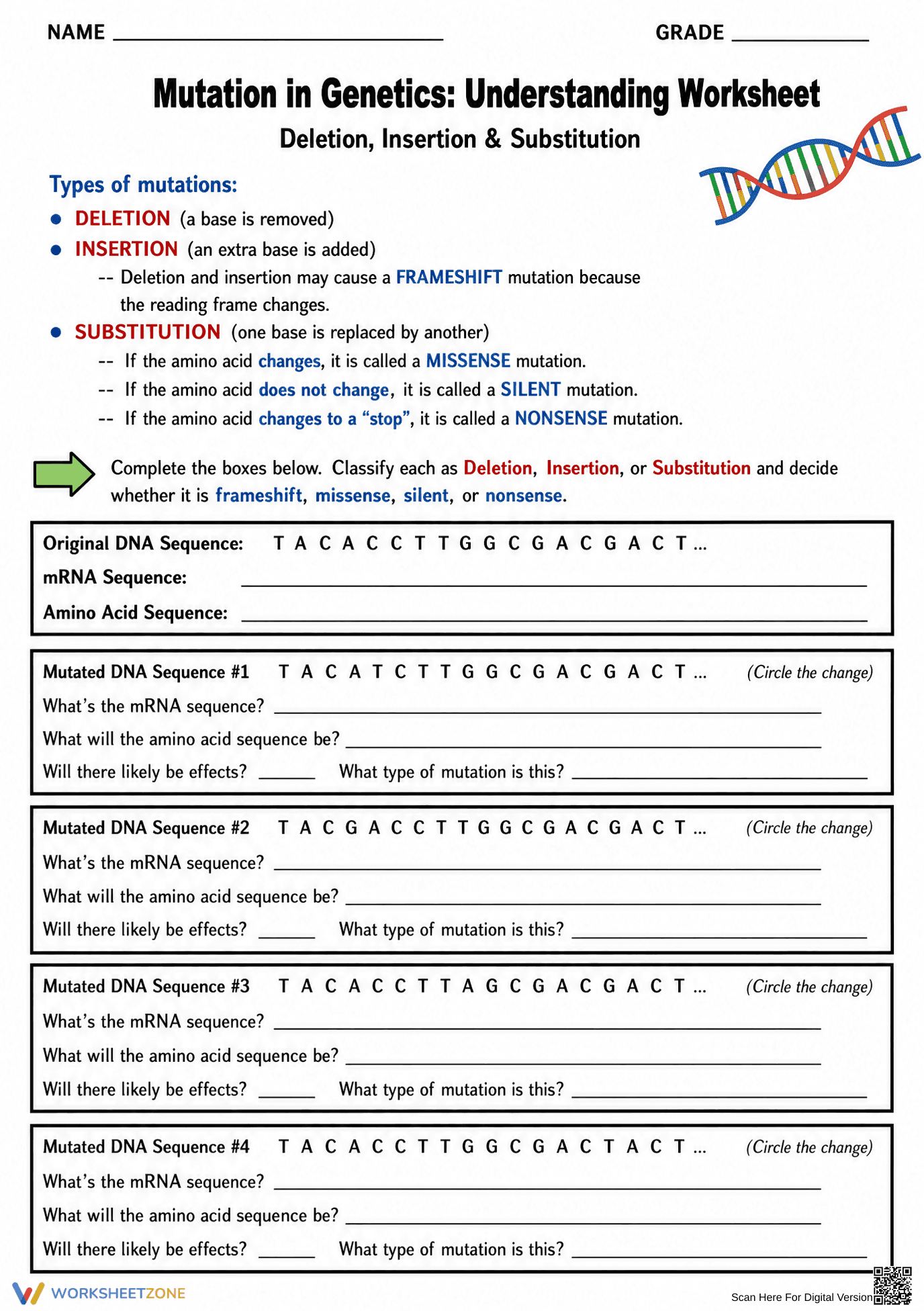

Printable DNA Mutations Worksheet | Grade 9 Biology
Paste this activity's link or code into your existing LMS (Google Classroom, Canvas, Teams, Schoology, Moodle, etc.).
Students can open and work on the activity right away, with no student login required.
You'll still be able to track student progress and results from your teacher account.
This Grade 9 biology worksheet provides students with targeted practice in identifying and analyzing genetic mutations. By transcribing DNA to mRNA and translating it into amino acids, learners will clearly see how deletions, insertions, and substitutions impact protein synthesis and determine the resulting mutation type.
At a Glance
- Grade: 9 · Subject: Biology
- Standard:
HS-LS1-1— Explain how DNA structure determines protein structure- Skill Focus: Transcribing and translating mutated DNA
- Format: 1 page · 4 problems · Answer key included · PDF
- Best For: Independent practice or sub plans
- Time: 20–30 minutes
What's Inside
This single-page resource features a concise reference guide at the top, defining deletion, insertion, and substitution, alongside frameshift, missense, silent, and nonsense mutations. Below the reference section, students are provided with an original DNA sequence and four mutated variations. For each variation, learners must determine the new mRNA sequence, find the corresponding amino acid chain, evaluate the potential effects, and classify the specific mutation type. A complete answer key is included for quick grading.
Zero-Prep Workflow
- Print (1 minute): Simply print the single-page PDF for each student. The built-in reference guide means no extra anchor charts are required.
- Distribute (1 minute): Hand out the copies at the start of independent work time or leave them in a folder for a substitute teacher.
- Review (5 minutes): Use the included answer key to quickly check student work or project it on the board for self-correction. Total teacher prep time is under two minutes, making this an ideal zero-prep solution.
Standards Alignment
Aligned to HS-LS1-1, this resource supports students as they construct an explanation for how DNA structure determines protein structure. By tracing changes from a mutated DNA sequence through transcription and translation, students gather direct evidence of how genetic alterations affect protein outcomes. Both standard codes can be copied directly into lesson plans, IEP goals, or district curriculum mapping tools.
How to Use It
This worksheet is highly effective as independent practice following direct instruction on protein synthesis and genetic mutations. Teachers can assign it as an in-class activity where students work individually or in pairs to decode the sequences. As a formative assessment tip, observe whether students correctly identify frameshift mutations caused by insertions or deletions, as this often requires more careful sequence tracking than simple substitutions. Expected completion time is 20 to 30 minutes.
Who It's For
Designed primarily for high school biology students, this resource is also appropriate for advanced middle school life science classes. To support learners who struggle with multi-step processes, teachers can provide a codon chart alongside the worksheet. It pairs perfectly with a hands-on DNA modeling lab or a direct instruction lesson on the central dogma of molecular biology.
Integrating structured sequence analysis into biology instruction significantly reinforces student comprehension of molecular genetics. Aligned with HS-LS1-1, this resource requires students to explain how DNA structure determines protein structure by actively transcribing and translating mutated sequences. According to a ScienceDirect TpT Analysis, providing students with immediate reference definitions alongside applied practice problems reduces cognitive overload and increases task completion rates in complex scientific workflows. By combining the definitions of missense, nonsense, and frameshift mutations with direct application on the same page, learners can independently bridge the gap between abstract genetic concepts and concrete biochemical outcomes. This targeted approach ensures that students not only memorize mutation types but also understand their functional consequences on protein synthesis, building a stronger foundation for advanced biological studies and standardized assessments.


