


























Views
Downloads

Essential Mutation Analysis Worksheet | Grade 8-12 Biology
Paste this activity's link or code into your existing LMS (Google Classroom, Canvas, Teams, Schoology, Moodle, etc.).
Students can open and work on the activity right away, with no student login required.
You'll still be able to track student progress and results from your teacher account.
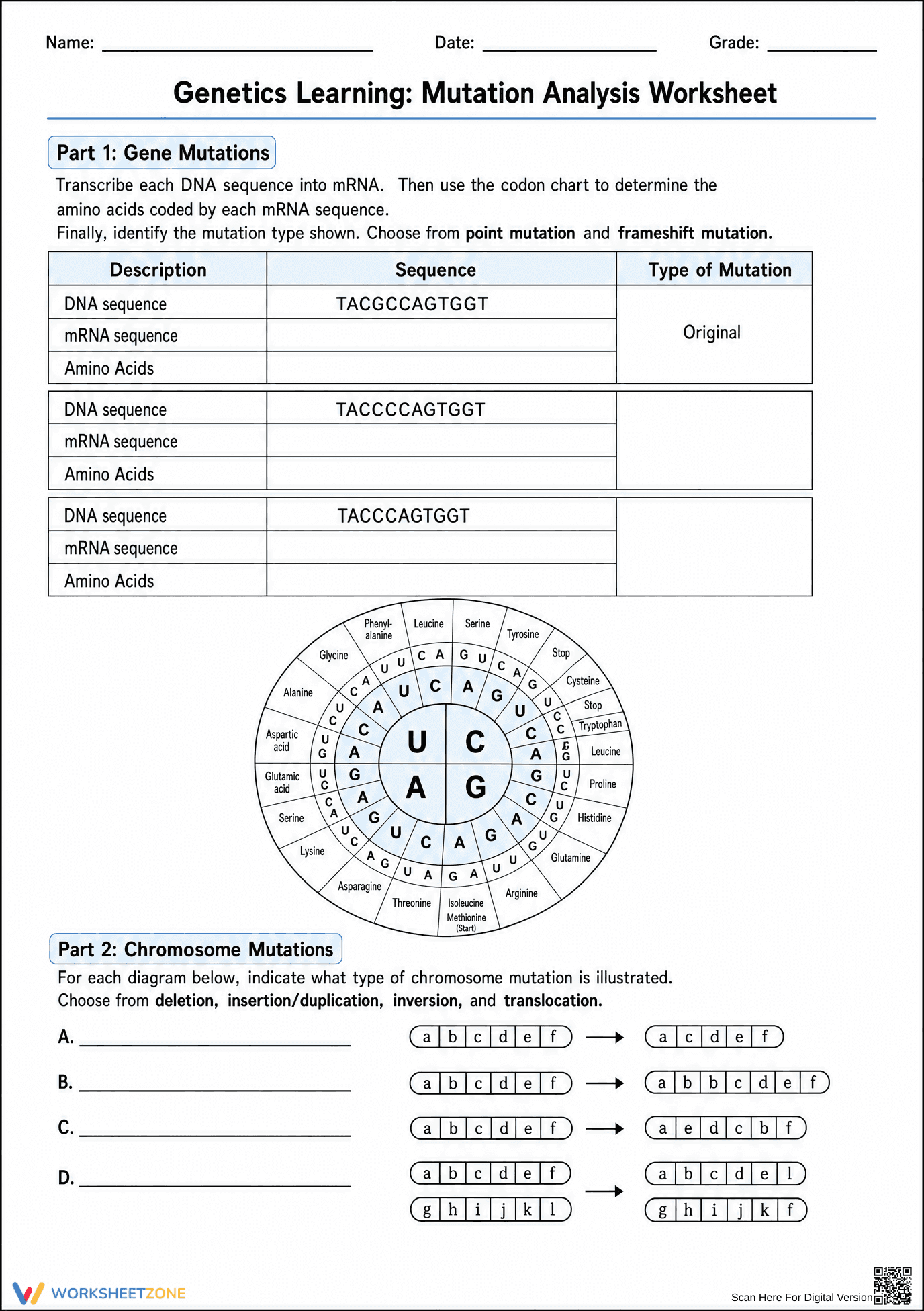
This comprehensive mutation analysis worksheet provides high school biology students with a structured environment to identify and classify genetic errors. By working through real-world sequence data, learners determine how specific changes in DNA nucleotides alter mRNA codons and resulting amino acid chains. This resource bridges the gap between abstract genetic theory and the concrete mechanics of protein synthesis.
At a Glance
- Grade: 8-12 · Subject: Biology
- Standard:
HS-LS3-2— Explain how DNA mutations lead to genetic variation in organisms- Skill Focus: Gene and Chromosome Mutations
- Format: 1 page · 14 tasks · Answer key included · PDF
- Best For: High school biology genetics unit practice
- Time: 20–30 minutes
What's Inside
The worksheet is organized into two distinct sections across a single, information-dense page. Part 1 features a gene mutation table where students transcribe DNA to mRNA and translate those sequences into amino acids using an integrated circular codon chart. Part 2 provides five visual diagrams representing chromosomal structures, challenging students to label deletion, insertion, inversion, and translocation events. A full answer key is provided to facilitate rapid grading.
Skill Progression
- Guided Practice: Students analyze an original DNA sequence to establish a baseline for transcription and translation using the codon wheel.
- Supported Practice: Learners compare mutated sequences to the original to identify specific point mutations and frameshifts across 6 sub-tasks.
- Independent Practice: Students transition to visual identification of complex chromosomal alterations like translocation and inversion without textual prompts.
This gradual-release model ensures students build confidence before tackling abstract chromosomal concepts independently.
Standards Alignment
This resource is directly aligned with HS-LS3-2, which tasks students with making and defending a claim based on evidence that inheritable genetic variations may result from mutations. The worksheet specifically targets the mechanics of how errors during replication lead to altered protein structures. Both standard codes can be copied directly into lesson plans, IEP goals, or district curriculum mapping tools.
How to Use It
Use this worksheet as a formative assessment immediately following a lecture on protein synthesis. It serves as an excellent check for understanding to ensure students can navigate a codon wheel before moving into more complex topics like biotechnology. Teachers should observe students during the translation phase to ensure they are reading the codon wheel from the center outward. Completion typically takes 20 to 30 minutes.
Who It's For
This resource is designed for Grade 8-12 biology students, including those in Honors or AP tracks who require a refresher on mutation mechanics. The visual nature of the chromosomal diagrams makes it accessible for English Language Learners (ELLs) who benefit from non-linguistic representations of scientific concepts. It pairs naturally with a DNA model building kit or a digital simulation.
The HS-LS3-2 standard requires students to demonstrate how mutations in DNA sequences can result in changes to proteins and affect the overall organism. This worksheet facilitates this by requiring active transcription and translation, moving beyond rote memorization to functional application of the genetic code. According to research from EdReports 2024, high-quality science materials must bridge the gap between molecular mechanisms and observable phenotypic changes. By providing both gene-level sequences and macro-level chromosomal diagrams, this resource supports a multi-scalar understanding of genetic variation. Students practice the specific cognitive tasks of pattern recognition and sequence analysis, which are foundational for advanced genetics and biotechnology coursework. The inclusion of a codon wheel ensures that the cognitive load remains focused on the impact of the mutation rather than the retrieval of amino acid names, aligning with modern pedagogical strategies for scaffolded scientific inquiry.


