


























Views
Downloads


DNA and Mutations Worksheet | Essential Grade 9 Biology
Paste this activity's link or code into your existing LMS (Google Classroom, Canvas, Teams, Schoology, Moodle, etc.).
Students can open and work on the activity right away, with no student login required.
You'll still be able to track student progress and results from your teacher account.
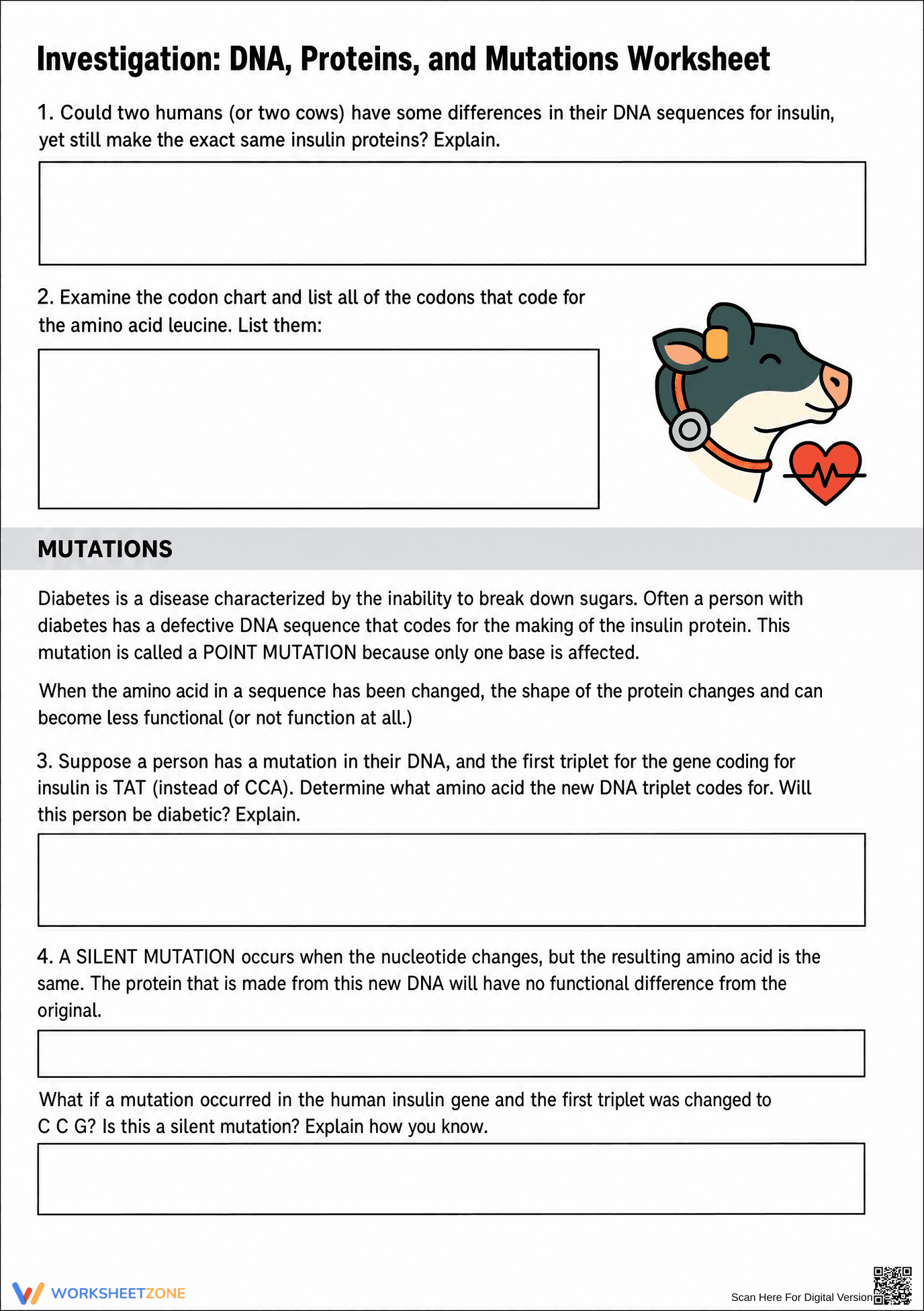
This Grade 9-10 biology worksheet guides students through the complex relationship between DNA sequences, protein synthesis, and genetic mutations. By investigating real-world examples like insulin production and diabetes, learners develop a concrete understanding of how molecular changes manifest as physiological traits. It provides a rigorous framework for mastering the central dogma of biology and the functional consequences of genetic variation.
At a Glance
- Grade: 9-10 · Subject: Biology
- Standard:
HS-LS1-1— Construct an explanation for how DNA determines protein structure and function- Skill Focus: Mutation analysis and protein synthesis
- Format: 3 pages · 11 problems · Answer key included · PDF
- Best For: High school biology genetics units
- Time: 40–50 minutes
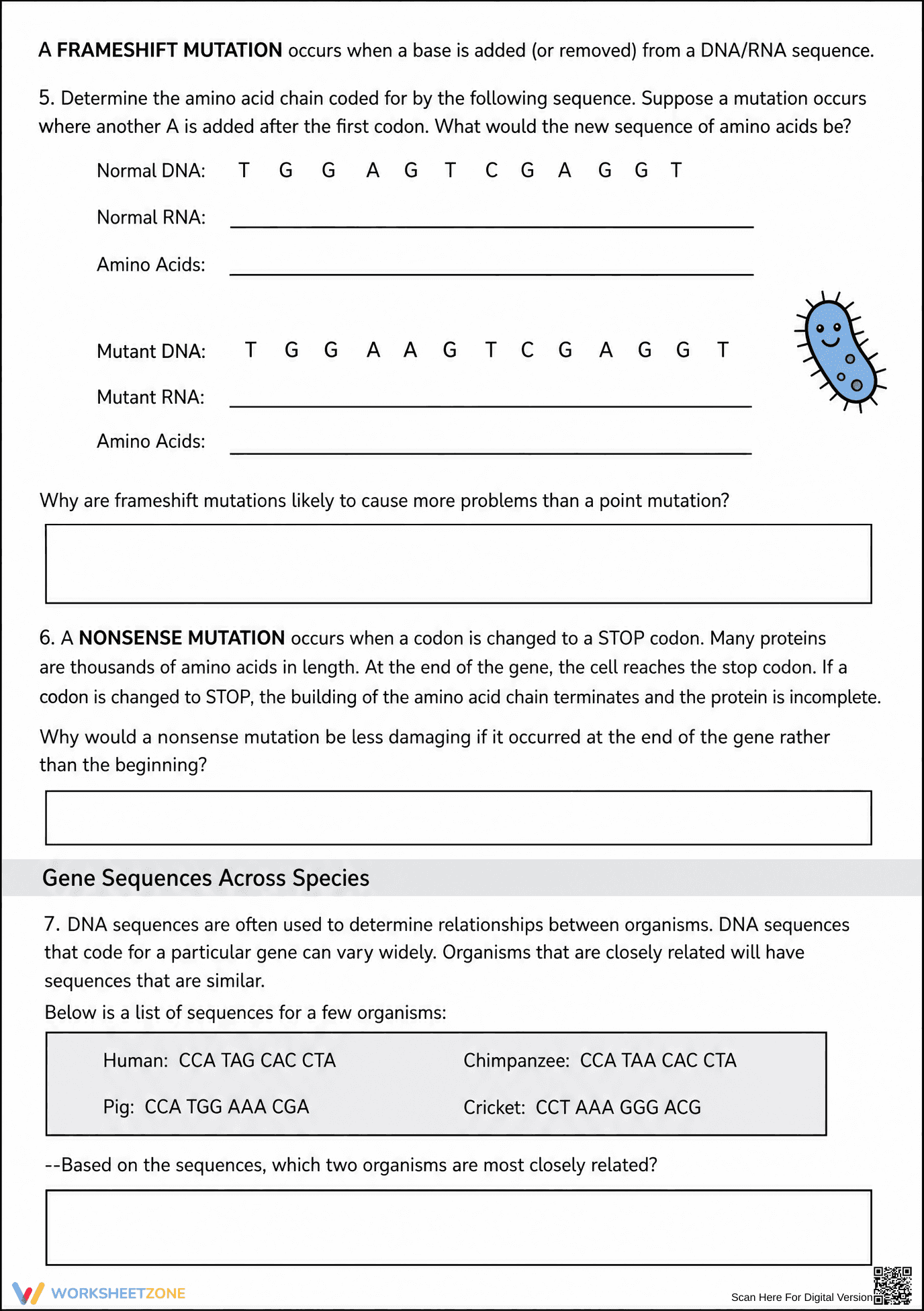
The 3-page PDF features 11 multi-part questions covering transcription, translation, and various mutation types. Students work with codon charts, analyze DNA triplets, and compare gene sequences across species, including humans, chimpanzees, and pigs. The layout includes clear definitions of point, silent, frameshift, and nonsense mutations, supported by a comprehensive answer key for immediate feedback and grading efficiency.
Skill Progression
- Guided Practice: Initial tasks use a codon chart to list amino acids and explain the redundancy of the genetic code, helping students understand why some DNA changes are silent.
- Supported Practice: Middle sections provide specific DNA sequences for students to transcribe and translate, identifying the mechanical impact of frameshift and nonsense mutations.
- Independent Practice: The final synthesis section requires students to construct evidence-based explanations regarding protein shape and its direct effect on biological function.
This gradual-release approach ensures students build technical confidence before tackling higher-order analysis of genetic disorders.
This resource is aligned with HS-LS1-1: "Construct an explanation based on evidence for how the structure of DNA determines the structure of proteins which carry out essential functions of life through systems of specialized cells." It also supports HS-LS3-2 by examining how mutations affect protein function. Both standard codes can be copied directly into lesson plans, IEP goals, or district curriculum mapping tools.
Use this worksheet as a mid-unit formative assessment after students have been introduced to the basics of transcription and translation. It works exceptionally well as a collaborative investigation where pairs discuss the impact of different mutations on insulin production. Teachers should observe student work on the frameshift section to ensure they understand how adding a single base shifts the entire reading frame. Completion typically takes 40 to 50 minutes.
This investigation is designed for high school biology students, including those in Honors tracks who need a solid conceptual foundation in molecular genetics. It is particularly effective for visual learners who benefit from the included diagrams of the protein synthesis pathway. Pair this with a digital codon simulator or a physical DNA modeling kit for a comprehensive classroom experience.
According to the RAND AIRS 2024 report, high-quality science materials must bridge the gap between abstract molecular concepts and observable biological phenomena. This worksheet achieves this by grounding the study of HS-LS1-1 in the context of insulin production and genetic disorders. By requiring students to analyze how specific DNA triplets determine amino acid sequences, the resource reinforces the "structure and function" crosscutting concept central to modern science standards. Research by Fisher & Frey (2014) emphasizes that scaffolded investigations into complex systems, such as the 11 tasks provided here, significantly improve student retention of technical vocabulary and procedural knowledge in biology. This evidence-based design ensures that learners do not just memorize mutation types but understand the mechanical consequences of genetic variation on protein folding and organism health. The inclusion of a 3-page answer key allows for rapid diagnostic feedback during the instructional cycle.


