




























Views
Downloads
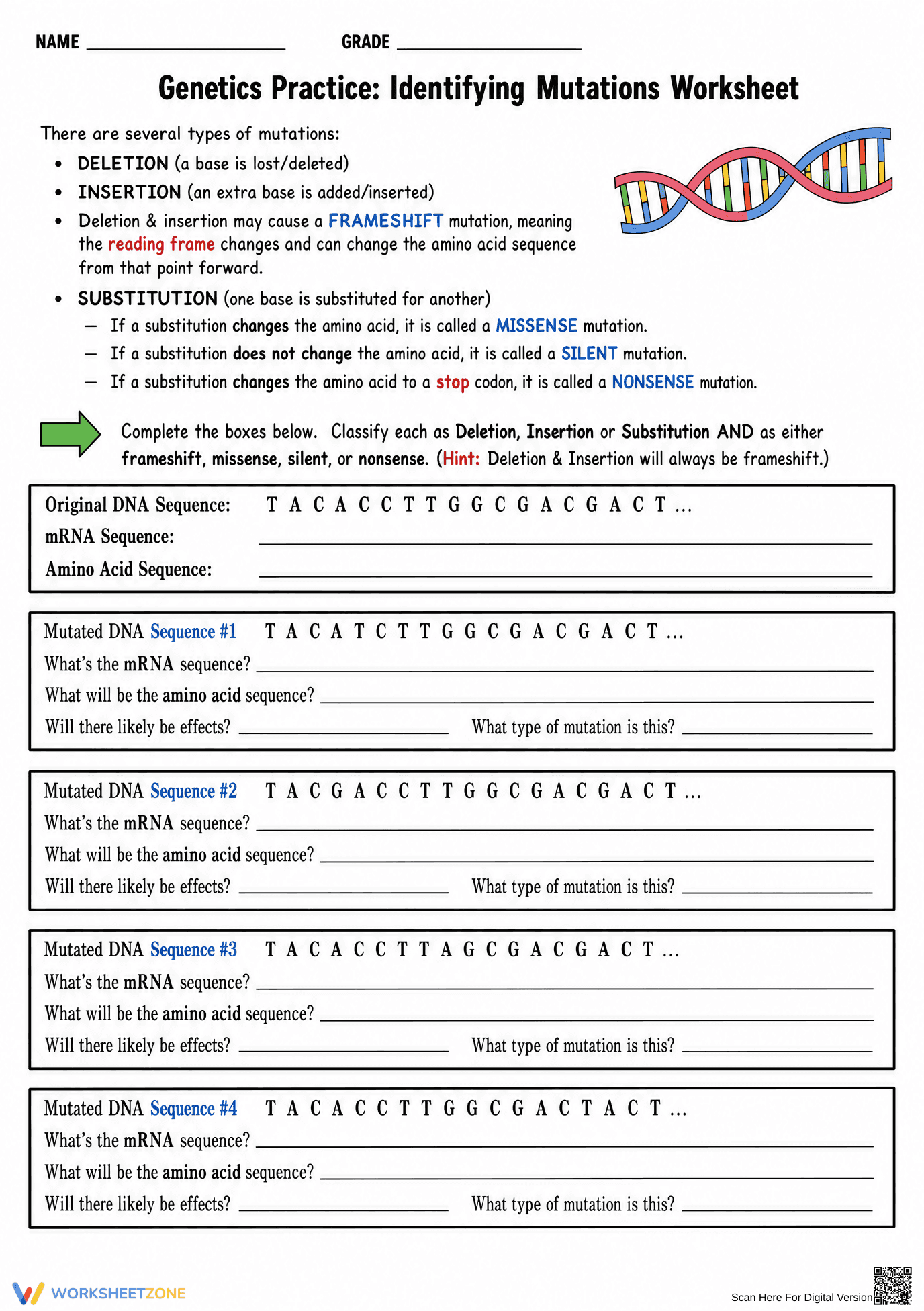


Identifying Mutations Worksheet | Grade 9-12 Printable

Paste this activity's link or code into your existing LMS (Google Classroom, Canvas, Teams, Schoology, Moodle, etc.).
Students can open and work on the activity right away, with no student login required.
You'll still be able to track student progress and results from your teacher account.
This high school biology worksheet provides targeted practice on identifying genetic mutations and understanding their impact on protein synthesis. Students transcribe DNA to mRNA, translate amino acid sequences, and classify mutations as deletions, insertions, or substitutions to see exactly how genetic changes affect traits.
At a Glance
- Grade: 9-12 · Subject: Biology
- Standard:
HS-LS3-2— Analyze evidence that genetic variations result from mutations.- Skill Focus: Identifying Mutations
- Format: 2 pages · 9 problems · Answer key included · PDF
- Best For: Independent practice and review
- Time: 25–35 minutes
This two-page resource features a clear reference guide defining frameshift, missense, silent, and nonsense mutations. It includes five multi-step sequence analysis blocks where students map original DNA against mutated strands. The second page features three short-answer comprehension questions and a real-world application section analyzing the specific genetic mutation responsible for Sickle Cell Anemia. A complete answer key is provided for quick grading.
- Guided practice: The worksheet opens with explicit definitions and rules, providing a built-in reference for students as they begin analyzing the first DNA sequence.
- Supported practice: Students work through four structured sequence comparisons, identifying the mRNA, amino acids, and specific mutation types with clear formatting to guide their analysis.
- Independent practice: The final section removes some scaffolding, requiring students to apply their knowledge to a real-world scenario involving Sickle Cell Anemia and explain their reasoning.
This structure follows a gradual-release model, moving from direct definitions to applied sequence analysis and finally to real-world biological implications.
Aligned to primary standard HS-LS3-2, this resource requires students to make and defend claims based on evidence that inheritable genetic variations may result from viable errors occurring during replication or mutations. It also supports HS-LS1-1 by reinforcing how DNA determines the structure of proteins. Both standard codes can be copied directly into lesson plans, IEP goals, or district curriculum mapping tools.
Deploy this worksheet after direct instruction on transcription and translation. It serves as an excellent independent homework assignment or an in-class collaborative activity where pairs verify each other's amino acid sequences. As a formative assessment tip, check students' work on the first mutated sequence before they proceed; if they fail to identify the frameshift, pause and review how insertions and deletions alter the reading frame. Expect completion to take 25 to 35 minutes.
This resource is designed for high school biology and introductory genetics students. For learners needing extra support, provide a codon chart and allow them to highlight the specific base changes in different colors. It pairs perfectly with a visual anchor chart demonstrating the difference between point mutations and frameshift mutations.
Mastering the ability to analyze evidence that genetic variations result from mutations is a critical component of high school life sciences. Standard HS-LS3-2 requires students to connect molecular-level changes to observable traits and diseases. According to a ScienceDirect TpT Analysis, students who engage in step-by-step sequence mapping demonstrate a significantly higher retention rate of molecular biology concepts compared to those who only read about genetic variations in a textbook. By physically circling the altered bases, transcribing the mRNA, and writing out the resulting amino acid chains, learners build a concrete understanding of abstract genetic processes. This hands-on approach to identifying mutations ensures that students can accurately predict the consequences of DNA replication errors, bridging the gap between basic genetics and complex biological systems like Sickle Cell Anemia.


